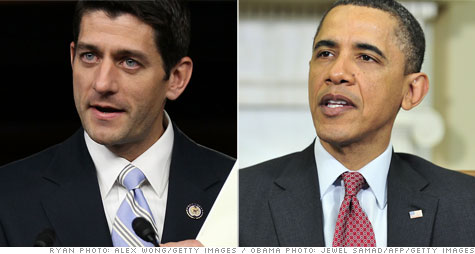
 In a CNNMoney survey of economists, six out of 18 favored Paul Ryan's debt plan, four sided with President Obama's proposal, and eight chose neither.
NEW YORK (CNNMoney) -- This month, leaders from both parties introduced two major plans to cut the nation's long-term debt. But economists don't like either one.
In an exclusive CNNMoney survey, eight out of 18 economists polled said they believed neither President Obama's nor Republican Paul Ryan's plans for deficit reduction are in the best interest of the nation's economy.
Another six economists sided with the Republican plan, while four supported President Obama's proposal.
"Partisan rhetoric has been extremely unproductive, and is pushing us closer to a crisis," Diane Swonk, chief economist at Mesirow Financial, said in an e-mail.
Earlier this month, Congressman Ryan proposed $6 trillion in cuts over the next 10 years, tax cuts for the wealthiest tier of Americans and radical reforms of Medicare and Medicaid.
And last week, President Obama surprised the opposition by unveiling a $4 trillion debt reduction plan, that left Medicare and Medicaid largely intact.
In the end, critics say it's not the timeframe that matters. It's how the plans keep the economy growing, in spite of spending cuts.
And neither plan seems to meet that standard.
"Each proposal falls short of achieving deficit reduction while stimulating economic growth," said Bill Watkins, executive director of the Center for Economic Research and Forecasting.
Bernard Baumohl, chief global economist with the Economic Outlook Group, who sides with Obama's plan, says he does so because Ryan's cuts are too draconian and derail important health programs.
"Terminating Medicare as it now exists and handing out vouchers instead is a non-starter," he said.
Proponents of Ryan's plan take the exact opposite stance, criticizing Obama's plan for being too soft on the growing burden of government health programs. Unless big changes are made, Medicare and Medicaid alone are predicted to account for a 36% chunk of government spending by 2020.
"The Ryan Plan more fully addresses the problems of Medicare and Medicaid and recognizes the necessity of reducing the burden on the federal budget of health care costs," said Lynn Reaser, chief economist at the Fermanian Business and Economic Institute.
Most of the economists who responded to CNNMoney's survey said they prefer a third option -- compromise.
"We need to both cut spending and raise taxes," said Michael Strauss, chief economist with Commonfund Asset Management Company.
CNNMoney's Chris Isidore contributed to this report 







| Index | Last | Change | % Change |
|---|---|---|---|
| Dow | 32,627.97 | -234.33 | -0.71% |
| Nasdaq | 13,215.24 | 99.07 | 0.76% |
| S&P 500 | 3,913.10 | -2.36 | -0.06% |
| Treasuries | 1.73 | 0.00 | 0.12% |
| Company | Price | Change | % Change |
|---|---|---|---|
| Ford Motor Co | 8.29 | 0.05 | 0.61% |
| Advanced Micro Devic... | 54.59 | 0.70 | 1.30% |
| Cisco Systems Inc | 47.49 | -2.44 | -4.89% |
| General Electric Co | 13.00 | -0.16 | -1.22% |
| Kraft Heinz Co | 27.84 | -2.20 | -7.32% |
|
Bankrupt toy retailer tells bankruptcy court it is looking at possibly reviving the Toys 'R' Us and Babies 'R' Us brands. More |
Land O'Lakes CEO Beth Ford charts her career path, from her first job to becoming the first openly gay CEO at a Fortune 500 company in an interview with CNN's Boss Files. More |
Honda and General Motors are creating a new generation of fully autonomous vehicles. More |
In 1998, Ntsiki Biyela won a scholarship to study wine making. Now she's about to launch her own brand. More |
Whether you hedge inflation or look for a return that outpaces inflation, here's how to prepare. More |




