
Real estate can only fall 10% to 20%, right? Right?
You've probably read this before: Even when housing prices slump, they don't fall all that much, at least compared to stocks and other risky investments. I've passed on this bit of "wisdom" myself. And it it's not a totally ridiculous thing to say: Even in the big California bust of the mid-1990s, prices in the L.A.-Orange County metro area fell only 20%
Below is a chart I made from data in a 2005 FDIC report. It shows the worst 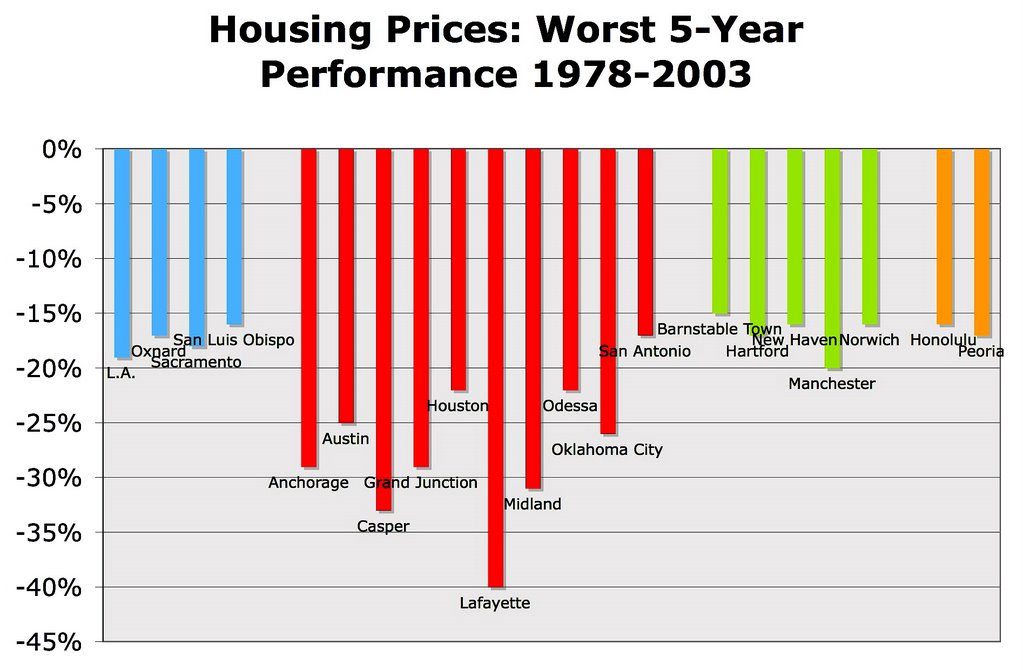 It's easy enough to dismiss the evidence from the oil patch, if you want to. Prices there were forced down by an unusual, and very local, economic shock. The economies of L.A. and Boston are better diversified. Then again, if the oil boom-and-bust of the 1980s was an anomaly, what should we call the easy-credit-driven housing inflation of the early 2000s? Liar loans, interest-onlys, option ARMs, and aggressive subprime lending have changed the rules. History wouldn't seem to be a very reliable guide right now. It's easy enough to dismiss the evidence from the oil patch, if you want to. Prices there were forced down by an unusual, and very local, economic shock. The economies of L.A. and Boston are better diversified. Then again, if the oil boom-and-bust of the 1980s was an anomaly, what should we call the easy-credit-driven housing inflation of the early 2000s? Liar loans, interest-onlys, option ARMs, and aggressive subprime lending have changed the rules. History wouldn't seem to be a very reliable guide right now.One reason real estate prices tend to be less volatile than stocks is what housing economist Karl Case calls "downward stickiness." When prices fall, many people just decide to stay in their houses rather than cut their price low enough to make an easy sale. But that also means there's a lot human pain behind a housing decline of "just" 10%. People get stuck in their houses, and that can change their lives. There's a good story in today's USA Today about workers who can't relocate to find better jobs: The silver lining here, I guess, is that companies are complaining about real-estate job lock, and they're shelling out a little bit to help entice reluctant workers. That means the job market is still reasonably tight, which should help the economy. If it holds. If. Update 3/15: For the record, the chart has been corrected since the initial post. (I added "5-year" to the label.) Update 3/16: Lots of good points in the comments below about the true cost of real estate losses. They should be drilled into the head of every Realtor. A few things worth expanding upon: I only have data for nominal (that is, before inflation) losses on real estate. Losses after accounting for inflation are much, much more common: The FDIC report found that since 1978, some 142 metro areas have seen real losses of over 15% over a five year period. That's compared to just the 21 cities in the chart with 15% or greater nominal declines. Even a nominal loss of 20% looks pretty small compared to nearly 60% (also nominal) for the Nasdaq in the five years after the crash. And while some houses in the LA market may have fallen more like 40%, some Nasdaq stocks went to zero. The big difference, though, is that most people have a lot more in their house than they do in the Nasdaq. And most people aren't diversified in real estate, whereas that's very easy to do with stocks. Bottom line: It's difficult to make apples-to-apples comparisons of the returns on real estate to the returns on stocks. In real life--that is, in the lives of non-professionals with a limited ability to diversify and a primary goal of purchasing shelter--equities and housing are very different assets. Beware of people in the real-estate industry who use simple average-returns comparisons to convince you that a house is an easy money machine. Finally, leverage adds to the risk of real estate. But don't forget about imputed rent. You have to live somewhere. The fact that some of your investment pays for a necessary consumption good dampens your risk exposure. When calculating investment declines, one cannot forget to factor in inflation. This will amplify losses.
Will, comparing percentage losses make inflation irrelevant.
I'm from Las Vegas. Prices here went up 100% + in the last 5 years. Prices continue to stay high and haven't went down. It's got to be only a matter of time because the average Joe can't afford these prices. It's ridiculous!
location...location...location
In some places this can be good news, as "reaches" to upgrades can effectively cost less, as the different "levels" of housing in "intra-local" markets, tends to become more compressed. Considering what prices were in 2001, I would expect housing to readjust again to normal levels a little above those prices back then.
If that means a 50% price drop, why not. If it can go up that much without any real reason other then a subprime frenzy, then it is just as possible for it to drop that much. I haven't yet seen any reliable or solid evidence that prices will stabilize. Housing is outpriced well above peoples salaries or possible earnings. Its beyond reasonable. You have to go back to stable/normal times before the frenzy and realize housing was priced with many factors there. The recent 5 year craze was because of mass numbers of buyers on the market who shouldn't have been allowed to purchase in the first place which drove up numbers to record levels. With 2+ million and more each day of inventory onthe market, and no more exotic loans, only "true" buyers will be allowed to purchase homes. It's going to be bad. Really bad. What most people forget is to add the "Inflation Factor" into recovering from a down turns in housing prices. The 20% price drop in LA housing market required the housing prices to climb by approximately 36% to get back to the real value dollar amounts that the housing was worth before the 20% decline. So if you really want to know the true effect of a housing downturn you need to factor in the inflation for the number of years that it takes to get back to the current equivalent value in current Dollar Values that equals the Dollar Value of the House before the market downturn. So Guys & Gals, until we get to that point in the future we will not really know just much this downturn is really going to cost us.
Although LA on average only declined 20% during the implosion following the MUCH SMALLER 1989 bubble, single family home prices neighborhoods with more speculation like Santa Monica 90405 declined a full 40-60% in nominal terms. The amount of speculation this time is far greater and far more widespread.
Additionally, you are not factoring the additional 6% real estate commission off the sellers net for traditional real estate services. So a 20% drop is really a 26% drop to the owner unless they sell fsob and try to save the commission.
The reality is that prices could drop substaintially more than that nationally and here's why: A) When you apply the upcoming qualifying guidelines for exotic mortgages being "fully amortized" and "fully indexed", a borrower making $60,000 a year will qualify for a loan that is 28% less than qualifying at the start rate. This means that the sales price of homes that look at is 28% less than before. b) the above scenario does not factor in the amount of people who use "state income / liar loans" to qualify. When you apply standard debt to income qualifications of 30/40% many people will qualify for even less. I.e. a borrower earning 5K a month qualifies for a $1,500 a month pITI payment assuming his / her monthly bills are less than $500 total. Here is a mortgage calculator to play with some qualifying numbers. People will buy what they can afford to finance... can't finance it within their budget, they don't buy. If leasing a Ferrari was only $475 a month, everyone would have one. c) downward price pressures will only increase from the addition of "must sell" real estate inventory like foreclosures and builder excess. d) public perception of stagnent home prices will cause people to be "sticky" as you mentioned in your article and this will only change when property values get low enough were a mortgage payment would be equal to renting. e) this is my personal view that I think is way under estatimated. The majority of homeowners are baby boomers rapidly approaching retirement. They have been told that their home is the retirement "nest egg". When they watch property values drop 5-10-15-20% and see their equity evaporate, they will panic and sell to salvage the equity that is left. f) we are a nation built on consumer spending which is subsidized by credit card companies and recently the home atm machine. When credit goes away so does consumer spending and in turn our economy suffers dramatically. Look at the impact $3.00 a gallon for gas does.. which for most families this is only $200-$400 a month from their budget. So yes, 20% is very much a possibly... maybe even a guarantee at this point. The real decline may be even worse. Don't forget to include the opportunity costs; after all, your money could have been safely sitting in a money market account earning interest the whole time. So if you could have obtained 5% from a money market account, then the 10% decline in your $100,000 house *actually* cost you $15,000 ($10,000 decline in the value of your house plus an additional $5,000 in interest).
Leverage is great when things go up and a killer when they don't. A 10-30% decline in home value will wipe out 100% of most people's equity. That leverage phenomena was fairly limited in the equity decline of 2000-2002, wheras virtually everyone's home is levered, with those with greatest risk of default typically having the greatest amount of debt.
Agreed. Convert nominal to real and you'll see that even the coast cities have seen 1/3 to 1/2 price drops in real terms.
FYI - AMC Mortgage (Ameriquest) has started laying off employees in their Illinois office. Don't know exact numbers, but it has been only 15 days since Citi invested, they move fast.
The other factor people seem to forget is leverage. Yes, housing prices may only decline by 15-20%, but for a significant portion of the population who have either bought or refinanced recently, this means their equity goes to zero. When you compare that to the stock market (which is an apples-to-apples comparison) housing equity isn't a safe investment at all.
It would help if you included the ski towns of VT like Stowe and Ludlow. You might find some even more "impressive" troughs.
Great look at a different side of the housing market. People seem to be so myopic when comparing stock and real estate markets. Yes, real estate markets probably wont go down 50% but most people didnt owe 85% on their stocks in 2000.
The best news I've heard in a long time. When houses get cheaper, everyone benefits.
Selling at a major loss isnt an option for most folks - they just cant afford the loss. Absent financial calamity, I suspect most people will hold on to their homes, or rent them, rather than sell at a loss. This is particularly true in desirable areas (for example, Boulder Colorado real estate is notoriously expensive because of the great quality of life, access to good jobs, and building restrictions - these factors wont change).
Two points:
1. When workers can't re-locate, and re-training takes 2-4 years to accomplish, it is difficult for workers to adjust to the quickly globalizing economy. By the time many complete re-training their new career is already on its way out of fashion. 2. The stock-market "bubble" beget the real estate "bubble", and there is no reason a decline similar to the stock market could happen to real estate. Let us remember that - although the nominal Dow gauge is higher than January 2000 - the inflation-adjusted Dow needs to rise another 20% just to match the January 2000 peak. That is assuming it happens in extremely short order and that number will be higher when factoring in more inflation over the longer term it will actually take. Considering inflation in home prices, the median home price after adjusting for inflation floated around $125,000 from 1987 to 2000 in current dollars. Now, the median home price is about $228,000. To return to the historical price level home prices will have to take a 45% plunge. Will it? Probably not. But don't underestimate how dramatically overpriced real estate is, and don't underestimate the ability of a market to take a substantial plunge. 20% in California was in the Past.
The present is a far worse off than any so called guru or economist can predict.. 80's and the ofcourse the late 90's to right before Sept 11th .. People where giving away thier HOmes,lost of jobs and another fake stock boom!!! AFTER SEPT 11 th is when if we all can remember? This is when the government switched gears to pull the trigger and drop rates and realitors started to take advantage as well as homeowners and create a false market..All three parties are to blame. Someone please tell me when the price of wood and a ocean view tripled in value!!!!! This was a wash people and some people made a ton of money .. And others will be homeless and the smart ones who sat back and watched the lies are in the right place to finally buy the Home they wanted three years ago for the correct price.. THIS IS ONLY THE BEGINING OF WHAT LOOKS LIKE THE S&L SCANDAL OF THE PAST BUT KNOW IN THE LENDING GAME.. WATCH THE NEWS FOR MANY WILL BE GOING TO JAIL!!!! Lots of good points here about the real cost of real estate losses. They should be drilled into the head of every Realtor.
A couple things worth expanding upon: Even a nominal loss of 20% is pretty small compared to nearly 60% (also nominal) for the Nasdaq in the five years after the crash. And while some houses in the LA market may have fallen more like 40%, some Nasdaq stocks went to zero. The difference, though, is that most people have a lot more in their house than they do in the Nasdaq. And most people aren't diversified in real estate, whereas that's easy to do with stocks. Bottom line: Apples-to-apples comparisons are tough. I only have data for nominal losses. Real losses are much, much more common: The FDIC report found 142 metro areas with real losses of over 15% over five years. That's compared to just the 21 cities in the chart with 15% or greater nominal declines. Finally, while leverage adds to the risk of real estate, don't forget about imputed rent. You've gotta live somewhere! The fact that some of your investment pays for a necessary consumption good dampens your true risk exposure. Nationally home prices probably will not fall more than 10%, but buyers need to beware in bubble markets.
In the last housing bust, Connecticut was probably hit the hardest and in some areas of that state, prices still have not recovered to there 1989 levels. The northern area of the state- specifically the greater Hartford area - was in a housing recession that protracted throughout the 90's. If you were lucky, you purchased after the crash and picked up a great bargain. Can't forget the effect of speculation as well as subprime. I read that the average home owner in Las Vegas owns something like 1.7 homes. Most of those extra ".7" homes were purchased by individuals as investments to take advantage of the boom. Now they are stuck with unmovable inventory, and all the negative price pressure associated. I'm renting one of those condos now, and I plan to switch locations every 6 months to take advantage of dropping rents.
I wouldn't call anything short of being paid to live in Hartford a 'bargain'.
Hey Pat:
Since when is 1978-2003 a "five year period"? Finally, I'm glad this over-inflated r.e. bubble is making some factual headline news across america. It's been way overdue. The Phoenix metro market has ballooned beyond belief, more than doubled in less than 2 years. Even my 6 figure pharmacist salary can't afford the typical tract home here (about $350 K for anything decent, Scottsdale about $600 K.) Now, you know folks there's something seriously wrong with this picture. The sharp pin can't come fast enough!
I think the "subprime woes" issues are not indicative of anything but what they are which is subprime loans. I find the slang "duh" appropriate for use here. Mr. Greenspan conceded it was "hard to find any such evidence" about spillover from housing yet, but added: "You can't take 10 percent out of mortgage originations without some impact." Now the Dems want to bail everyone out which is a huge mistake.
This too shall pass! The big question remaining is "who is going to pay for the bust"? Will it be those responsible...or Joe Taxpayer (you and me). I hope it is all of those responsible. Or, will this be S&L (Subprime Lender) Bailout Part Deux?
When I bought a forclosure in '97, I remember the appraisal mentioning that the previous owner had paid $186K for it in '86. I paid $94K. This was in Los Angeles. Quite a bit more than 20 percent. These figures between 'peak and low' over only a 5 year span are giving a false hope as I see it. Sorry.
Opportunity cost is HUGE. So is leverage.
Here is what I have done: Sold home(s) and cashed in 750k which is now in bank at 5.5 percent CDs. FDIC protection. In 2 years it will be 1 million(i'm adding to it monthly at a huge huge rate because i rent cheap) Now If I had kept the 2 homes I would possibly see in two years ALL of that 750K disspear with a mere 20% correction in housing. I would thus have ZERO vs my 'guaranteed' 1 million in bank by selling and moving to CDs. All I have to do is stay employed for the next 2 years and keep earning 5% in CDs) compare that to the risk of real estate where a small 20% dip wipes out 100% of your gains! It was a no brainer to sell and rent. If you are over 40 and 50%+ of your net worth is in real estate your risks are ENOURMOUS you could/will be wiped out in a modest real estate downturn. SELL NOW or never retire. The last downturn in Los Angeles was horrifying. People were wiped out, couldnt rent it out to cover costs and it ruined thousands of lives, marriages and there were suicides. Its called a crash for a reason and its here now. 2007 will be the last chance to cash in your home for near peak price for 15 years. And have we forgotten what happened to the price of office buildings in Boston during the Ninties? Or what happened to all real estate in NYC in the mid Seventies? A 10% drop in price is nothing compared to what has happened before. My Grandfather was born in 1888 in Boston. He sold his parents' large house and stables on Commonwealth Avenue for $10,000 during the Depression, and he know it was a steal then at that price. He never liked real estate for the rest of his life. It is absurd to think that real estate cannot suffer the kind of decline that the stock market has or will. And then there is the death by a thousand cuts when real estate declines in price gradually or barely appreciates over a twenty year period, which is probably a highly likely outcome for housing today.
This 5 year 'high-low' comparison isn't valuable to current owners. For instance, I bought a forclosure in 1997 for $94K. On the appraisal, it shows the original owner bought it new in 1986 for $180K. That's way more than a measly 20 percent! Last year, identical properties there sold for $340K. Sorry... 20 percent isn't even close to the losses coming. At least that means the rest of us who don't currently own will be able to buy again at a sensible price.
This is true there will be pressure to sell as credit once again becomes harder to get. The pressure to sell will indeed drive down prices. I am curious to see if the tax man follows suit. I think that in the long run real estate will hold value. A 1967 dollar would be worth six dollars and thirty two cents today. This is how the banks and government write off bad debts (sub prime and Iraq come to mind). I see a time when the average yearly wage will be $100,000 and the medium price of a home will be $600,000.
I am thankful yet another buble has popped (what is the next one going to be?)
I bought in a townhome community in 2003 after relocating to Jacksonville, FL. Bought at a fair price, but was dismayed at the number of 'investors' who bought in here to rent out, and the number of people that were very young and seemed to be in here with the 'no money down / no-interest' loans. There are tons of for-sale signs up now, I figure some will become foreclosures, I am just glad that my unit is paid-off and hopefully 'real' buyers will start trickling in at some point. Mr.Clinton's disasterous policies of free trade, left our piggy banks empty; recession was in the air. The Bush administration with Greenspan its collaborator, pulled wool over our eyes. They dare not treat the cause but offered a snail sauce for cure.They reduced interest and the mirage of affordability and wealth, soon appeared in the air. People borrowed money because they could repay it, if they kept their weel paying job, but the security on the loans was imaginary, the value was not there to support them. Do not be surprised if within the next five years myriad of people will lose their homes and affordable rent would be the theme of the day. But affordable rent is not enough to make payments on monies borrowed by a Landlord. Except in arears when Government is the main employer, as in DC, expect devastation, devaluation, foreclosures and bankruptcies galore. The deficit was the cannary in the mine whose song we did not hear. It keept the politicians afloat. Tt will bankrupt those who have elected them. So sell your home even at a loss because down the road you will be able to buy it back for half your present reduced sale price. Greenspan kept silent during his watch but now for his usual fee on a speaking spree is telling you the truth about the problems of subprime and everevaluation. Take this precocious ecomonist to the bank and see how much you get for integrity.
Gold. Gold. Gold. Gold.
If you want your family to have any food at all through the coming calamity, make sure you stay away from fiat "money" and get into *real* hard assets. Here is what we have been doing: 1. Sold the house and moved into a much smaller place that we own outright. It's pretty far from any major city but it's cheap and away from potential harm. 2. Stock piled food (mostly canned goods, but also plenty of wheat and other grains.) 3. Installed a large underground water cistern and rain water collectors. 4. Setup solar cells for once the grid goes down. 5. Started to learn Chinese for when this becomes a requirement. If you want to protect you and your family from the coming chaos, consider these changes. Stop what you're doing and start saving hard assets and foodstuffs. And get out of your house while it's still worth something. Home prices have also been over-stated because refinancing appraisals are included in the government indexes, even though the house never sold. High appraisals are very easy to get.
Fear is once again being fueled by the press - including CNN MONEY. Having lived in Europe for 10 years everytime real-estate hit a press induced panic "High" - they still went higher and today they are still rising. The upper limit to real estate is a great deal higher than is being communicated. There may be an issue in new construction area - as a camparison to US car manufacturers may be valid - in that they build not to market requirements - but to what they are capable of building which like US car compoanies is too much with the same consequences - overcapacity and rebates!
We cashed-out from our Sacramento, CA suburb (Roseville) at the peak in summer of 2005. Today's motivated sellers have dropped prices $100K (15%) in our same subdivision. There simply isn't the high-wage job base there to cover prices that were run-up by junk loans, buy-now-or-never hysteria, and unbridled lust for luxury homes. Game over, man.
Doesn't help when CNN, particularly your housing correspondent Chris Isidore, keeps crying wolf 2-3X a week. No other business site spends more time on "gloom and doom" theories about housing than CNN. Look, let's be real -- After years of double-digit growth nationally, things were bound to slow down. Like everything else, it's cyclical. Let it go and stop getting everyone in a panic -- just to grab attention and click-through rates.
A 20% drop in real estate wipes out your entire down payment. That is a 100% loss to the homeowner, and possibly more to the lender. Also stocks can be sold in seconds; real estate can take months while you're paying the mortgage payments. It's more than straight numbers.
When trying to calculate your true equity position gain or loss on a house or property you may want to factor in inflation and the total interest paid over the life of the mortgage as well as capital improvements. Unless you were borrowing at zero percent the interest paid must be deducted from the equity gain or loss or you are only fooling yourself. When you factor inflation, cost of borrowing and capital improvements and upkeep you had better hope the values in your area have gone way up or you are way behind.
Any thoughts on the short-term prospects of the NYC real estate market? This is obviously a different animal as the only direction to build is up. It seemed like prices were about to stabilize in late '06, but this year has been off to a roaring start. We have already lost one bidding war and are expecting to lose another. We received 3 offers on our place the first hour it was on the market, and it went for 5% above asking. I can't figure out if there is any upside to getting back in, or if I should sit out for a year and watch. I'm worried that the market will go up another 10% in that time. Weak dollar emboldens the international buyers, who are here in droves. Additionally, the prevalence of co-ops penalizes (or flat out disallows) speculators and flippers, either through onerous flip taxes or by screening out potential investors in favor of actual residents. Would love to hear thoughts from others.
While there are definite tax benefits for home ownership, one issue people don�t mention that much is property taxes. In the Bay Area where million dollar homes are common place, home buyers are facing ongoing annual taxes in the $10,000 to $15,000 range. Ouch! Lets not even mention the inevitable future increase in income taxes required to balance the massive government overspend in the past 5 years.
The fortunate thing, (or unfortunate depending on your perspective), is that real estate is not a liquid asset so the market cannot collapse overnight. But we are going to be in for a slow downward grind. One final point; people need to change their expectations. Home ownership should not be a path chosen because of the opportunity to reap large profits. If that happens then that�s a great by-product but sometimes breaking even is OK. You do after all have to live somewhere! I've been looking to buy, but it just pays to rent. I was considering a brand new, never lived in condo which is renting for $2200 and the buyer bought for probably $670K. Factoring property taxes and HOA fees, the owner will be lucky to net $1200 a month to pay his mortgage. So I would be borrowing his money at 2% to live there while he is paying at least 6% interest on his mortgage. Another way to look at it is that it would cost over $5000 a month to pay interest, taxes and HOA. Why not rent and keep the money in the bank!
Good thinking Will! Not true I live in Las Vegas as well and I've seen the value of my home go from $380K last year to $325K and prices are still falling as builders keep building in a market where there is no demand.
While there are many valid points here, people tend to get in a panic mode very easily. Yes, things could get ugly, but dont underestimate the size and resiliency of the US economy. Whatever happens, there is still a huge pool of cash that needs to find a home. Corporate portfolio managers need to get their portfolios invested, and 4.691% for a 30 year bond (todays tresury rate)is just not enough return. Corporations are still willing to take on risk to increase earings, and because of that, riskier investments will ays be around. If its not in the arena of sub prime loans, then it will be somewhere else. This is all the result of a prolonged abundance of very cheap money; a problem in our economy that has to be dealt with, reguardless of the real estate debacle. But again, dont underestimate the resilance of the entire US economy.
SELL NOW OR BE PRICED IN FOREVER! The Ponzi scheme of the last five years is coming to an end. Enjoy the show.
This is a great thread, thanks for all of your great comments.
I am going to be a first time home buyer in next month of so (NOT VERY LIKELY THOUGH AFTER LOOKING AT ALL YOUR COMMENTS). Last year when i decided to build a house with a builder i was seeing the sign of Housing market slow down but, i was hoping that it will go towards stablization in 2007 but it doesn't look that way. The funny thing is these days when i see national trends i see big downfalls and when i see local trends in our Dayton/Cincinnati local market it still shows price increase by around 5% as compare to the last year. This doesn't make much sense. I am sure even if this local market is not seeing down fall yet, it will join rest of the country fairly soon. I purchased my house in 1993 for $130,000 putting $7000 down. I just sold it for $390,000 that much. Not bad for a $7000 investment. People told me then that I would lose money. While they paid rent for 14 years and never seeing a dime back, I made back every penny and more that I paid. Now I am buying a house on the water. In 14 years my renting friends will still be living in apartments while my house will appreciate.
I assume most folks posting comments here are heavily vested in the stock market (as am I). Even Alan Greenspan doesn't think any of your dire real-estate scenarios will pan out. But keep in mind that if they do, the result will be catastrophic lossees in all asset classes -- including the stock market. So while there will be "bargains" in the housing market, you're not likely to have any money to take advantage of them.
I live on Cape Cod where the average price of a home is $350,000. When I say average, I mean a 3 bedroom ranch home in a crowded neighborhood, built in the 70's, hollow core doors, cheap cabinets, maybe a bath and a half, it's kind to say that needs a lot. Even if you could save $35,000 to put 10% down (who can really save $35,000!)you would have payments of $1888.00 plus $225 for real estate taxes and you'd need a ton of money for maintenance. And you wouldn't even want to live in it! At the traditional ratios, you would have to make over $75,000 to qualify (How do you save any money making $75K, especially with kids and college. The only reason to risk your $35,000 is in the hope that the property value goes higher, which until now, that's what has happened. We are going to see a dramatic decrease in the price of housing, this is the tip of the iceberg. Our foreclosure rate is off the charts, our savings rate is in negative numbers and credit card companies nail you with 18-21% rates which escalate with late payments. Strap on your seatbelts, we're going for a ride. Remember the tulip story in the Netherlands 400 years ago?
The sky is falling?!
Markets that are shedding huge value are the same ones that have increased over 100% in the prior 5 years, some increasing as much as 200% as of 2000. The same markets will see a bounce down to about where they were in 2000 and a quick recovery to 2004 levels. High cost homes (top 30% of local market) will stand to lose 15-20%. The rest of the market will shed 5-10% and recover most by 2010. this is like every type of market....the flavors change a little but the cycle is always simmilar. The only real threat to the national housing market is the same as for every other issue in the nation, baby boomers over the next 20 years. This article is a load of BS. Of course there may be a correction but it won't be that bad in most places. There are still plenty of buyers out there with fat wallets. Just because some delusional idiot can't buy a 500K home with a 50K a year income doesn't mean anything. Working in fixed income, I've heard the rumors related to future real estate blow up for about four years now and all that's happened is a slight slowdown. Nothing but hype!
A funny thing happened on the way to your financial web site -- I encountered two ads for what were obviously "sub-prime" type loans, offering refinancing at rates of less than 2% APR and "interest only" payments. So I decided to have some fun. I went to several other financial websites, many of which had stories on the demise of the subprime industry, and, in the course of less than 20 minutes, found 14 ads for such loans. It appears, then, that one of the causes of the easy money real estate inflation is the financial news establishment that warns so much against it!
Not only is the Funny Finance loan alive and well, so is the housing market, at least here in Southern California. My wife and I visited several new housing developments over the past month, in Palmdale, Oxnard, and Camarillo, only to find that all the homes have already been sold and that a couple of other developments have all been presold. I guess I should do my future shopping in cyberspace, where home prices are crashing, financing is scarce, and I can get that home in Santa Barbara for a lot less that a million dollars! Dream on -- the biggest mistake people make in real estate is to buy later istead of now! A lot of the doomsday scenarios mentioned above are as likely to happen as the sky falling. But thunderstorms do result in lightning strikes.
needless to say, there will be pain, angst in certain parts simply because home values got out of control, and some people got into houses because tomorrow it might be more costlier and took advantage of teaser loans and low interest rates. For some people just the mere fact that home values will decline over the next year is a shocker and that causes them to burst into state of denial. Although the sub-prime situation is likely to get ugly specially if interest rates dont change and lenders tighten the noose on re-financings which are likely to spurt Now.. but in the end its good for the economy to get this fluff out of it. The last few years have shown that people have started to trade in real estate like trading in stocks, making it a very dangerous game. Until this housing bubble people considered houses as primary place of residence.. but now you have investment clubs spanning all across the country making the housing bubble the last bubble of this decade.. and likely to be one of the most expensive ones Hey Walter in Princeton -
I second your question... I actually went down comment by comment and was amazed that no one raised that issue... NOT ONE person! :) PAT - Have you looked at the Memorial area in Houston? Would die to find a house that sells for 20% less than five years ago! I think the same forces that drove the stock prices up in the late 90's is behind the upswing in housing prices in the early 2000's. To use Alan Greenspan's term; irrational exuberance. People have money that's performing poorly in stocks and when property became the place to invest, they moved their money into that market. It's not just Americans that are driving this. We have lots of money going overseas. They have to do something with that cash and our bond prices are pretty low. Real estate was a better deal. Fixing this is going to take fixing our current account deficit.
Let's all remember we pay for the rareness of the commodity, in this case, land and housing. In some areas that are land short and industry healthy, housing is in demand and so prices will reflect that health. Other areas that are short on jobs or have a great deal of housing on the market due to construction or the graying of the community don't sell so quickly, but they still sell, so please keep that in mind. A glut of housing might also happen when a particular factory or industry shuts down and many people are moved or need to move at the same time... look at what happens when the military closes a base, like Long Beach some years ago... Charts and graphs are only indicators to a particular window to a particular scenario and shouldn't be used to scream wolf. Be careful please, you're scaring the general public or at the very least, possibly misleading them. The media has been for a number of years writing about a bubble. Well I'm in the housing industry and I know that life continues to happen... people move because they choose to, they have to or they can. We're healthier than that colorful graph. I'm telling America to not be afraid to live your life. You want to buy a house? Buy a house... it's still an excellent thing to do.
Walter 1978-2003 is a standard forcast period
1979 1980 1981 1982 1983 1978 is used as a base year Owning a house is the American Dream. One of my co-workers whom make about 60k a year, and he bought a house for 480k last month. How does he do it? Yes, it is one of those crazy loans, negative amortization loan. He put down 5%, and his monthly mortgage payment is about $1200. He will most likely loose his house in the next two or three years if the interest rate goes up or the house price doest'n goes up. I think we need to educate our people the word "affordability".
NYC thoughts,
As the RE markets in other areas of the country take a beating, one here should now be thankful of those "pesky" co-op boards. They have collectively keept away the exact reasons for now that other area prices are recieding big time. With 99% of co-op's you could not finance without 20% down or receive the rediculous mortgages that others have. This alone has helped keep and raise NYC housing prices. Another reason, here prices are so high that there is very little room for both the speculator and the second home owner type deals. Mostly never heard of except in very extreme circutances. It will take more than the sub-prime market mess to dent the real estate value here. We have other problems on the horizon to be sure, but not this one. Walter and M. Halmagean,
The chart does not show performance from 1978 through 2003. It highlights the worst five-year performance for each market shown, within the 1978-through-2003 period. For example, the 19% drop for the LA area took place sometime in the mid- to late 1990s. The Grand Junction and Peopria drops took place in the 1980s. Great list! More original ideas here than in all the media put together. it's usually real estate broker 'propaganda', or meaningless drivel that comments on the state of things without any real predication.
That said i am living in the 4th most expensive city in America: Honolulu. ave single family homes (and small) are $700,000. condos around 450,000 unless you move to one of the suburbs 20 miles away. feel my pain...ALoha is evaporating as people feel the stress...i tell you, people are lookin at each other funny these days, and you can feel the frustration of the common man. i make $70,000 a year and can't afford to buy a place, having missed the boat in '03-'05. i hope this correction happens and all the idiots who took out big mortgages get slammed. wheeeeeee! Come on People! I bet most of the people posting comments on this blog listend to CNN during the 2002 - 2006 span and never bought becuase prices were bound to fall! How much did that cost you? I can sun the sun is going to burn out and I will be right someday!
Prices are going to stay flat for awhile but no drasitc drops are going to take place. We may see 5-10% dips in certain areas. And then the investors will jump back into the market and steal all of those foreclosure homes! O Yeah one last thing! The banks are going to come up with even more interesting financing such as 40 (already in place) or 50 year loans. 2010 prices will be well above todays prices! Since I never bought a home, I suppose I will not commit suicide over this drop.
Every market corrects, weather it's stocks, bonds, cash or real estate. The only cause is, and always will be, human emotion. (We) put value on things and take them away. A chunk of land is the same as it was 1000 years ago, only we put a value on it. And when people start to panic look out. The old saying" sell your stocks when your barber starts giving you advise" also rings true in real estate when everyone jumps in to "flip" houses and make "easy" money. What goes up must come down(and correct) and the bigger they are the harder they fall. Many people will get hurt in the next few years, it's the people who keep their wits and think clearly, they will be the ones who really come out winners.
I get a kick out of those who think them media is "panicking". LOL!
I saw a post where some genius in Malibu thinks housing crashes overnight. LOL! There will always be those heavily invested in Real Estate who are unwilling, unable, or a combination of both, to acknowledge reality. The bubble is over folks� Well here on the east cost of florida, prices have shot through the roof and the average home price is 450K, there goes the cops,firemen,teachers and others priced out. Not to mention the property tax has jumped a 100% or more in 12 months. Now your property tax is same as your mortugage Now try getting home owner insurance after Jeb Bush sucked down 9 1/2 millon form Insurance companies.
Home prices are not falling, yet homes sales and condo sales has fallen flat. Florida is screwed............. WTF - Another Bush I really, really do hope that bubble burst. Specially in Phoenix!! My husband make well over 6 figure but we can not buy decent house at decent neighborhood with fixed conventional loan. Buying a house suppose to be a joy. not a getting to huge debt..or poo.
Simple math. 1999 2bd/2bth condo in my SD coastal neighborhood was $99k. 2005 they were selling for $425k. 2007 they are listed at $295k on the decline and not moving.
I live in a western suburb of Rochester NY and the BRAND NEW 1600 sq ft house that I bought in 1985 for $72,500 has NOT EVEN doubled in 21 YEARS ! It's only worth $117,000 now. That's not bad for a house on a half acre that borders woods, but the high cost of living elsewhere means I wouldn't consider moving to a place where a lesser house costs 3x as much !
I agree with Willow. Take it from an OKIE who remembers the oil bust. Treat your home as a HOME not a cash machine. If you're upside down right now just live in your home and enjoy it until things get better. Besides, there are plenty of guaranteed investments out there, they aren't glamourous but then neither is a foreclosure.
Anyone who has bought since mid 2003 and held on until now has really been renting for that entire time in regards to equity gains. We are back in 2003 again today! Anyone who bought after 2004 at 100% financing is underwater today! The end of this won't come until the new president is elected and in office for a year! Hold onto your FICO scores until then!
I used to live in LA, CA. I had purchased a house in 2001 (fighting off 12 other offers at the same time) and by 2005 I saw an opportunity to unload my home for triple the amount. I did and moved elsewhere where home prices seems to make sense. I for one thought that the prices simply did not make sense. Wages did not go up nor did the IRS decided to stop collecting taxes :-) to support this frenzy.
With the recent news of the subprime lending market, it all started to make sense. I am happy that I got out and waiting to get back into the LA market when I see the low point. Sad, but my happiness is built on top of other people's stupidity and misery, however, I won't feel sorry for it. Why would I want to own a house if I can rent it on the cheap and invest the money elsewhere? Go to
Rent vs Own for a comparison. In many cases, it is far better to rent than own these days. Do the math before you write the big check for a house down payment. Beware of victimizing people who can�t afford their payments! The only way things will be affordable again is by allowing fundamental economic principles to unwind. Speculators (read as �the many stories you will see about little old ladies who can�t afford their new payments�), as well as mortgage companies and investors MUST pay for the risk they took with these financial instruments. If congress bails the banks and "little old ladies" who can�t afford their payments, then prices will not drop and those who patiently � and wisely � waited will get the short end of the stick. Remember, no one is entitled to wealth and those who speculated in the real estate market (no one in their right mind would pay the prices people were paying for stuff) must pay for their risk they took - like any other economic entity (even if that economic entity is a little old lady).
What goes up will eventually come down. This market was completely inflated. Just like the Internet boom when I heard taxi drivers and waiters giving stock tips I knew it was time to get out. The same goes for the housing bubble. People don't realize these "exotic loans" were never meant for the average worker. They were invented for the millionaires who could already "afford" a $25,000 a month mortgage but wanted to invest their money somewhere else for a better return. The key point here is that they could afford the payment anyway. When people making 40-60K a year and are buying 500K+ homes thinking the market will go up you know we have a problem. If you have one of these loans get out now if you can't afford the what a normal 30 year loan would cost.
Foreclosures are abound and for the savvy investor their will be lots of opportunity. Buy low - sell high! Keep on dreaming, Jeff in Newport. That's the same line of BS that people bought into in Tokyo 20 years ago. Guess what their financial wizards dreamed up? 100-year mortgages. They called them "three generation mortgages". Guess what happened to Tokyo's bubble? 15 years of decline...
Sorry to rain on the gloom parade, but remember that when financing real estate with a 30yr much of the borrowing is paid back in inflated dollars, i.e. the mortgage is an inflation hedge. So when the baby boomers retire, inflation spikes to 50%/annum, the mortgage basically goes away in real terms over a period of time.
My philosophy on this kind of matter is that, like anything else, with the "wrong" ingredients, housing prices can always drop, and with "perfectly wrong" ingredients, drop very steeply (and the opposite is true too).
Take my parents' house in Japan. They bought the house in 1974 for about $200,000. There were right ingredients in Japan for housing prices to appreciate at one point, and by 1991, their house was assessed at something like $1.2 million. Then perfectly wrong stuff came in, and today, in 2007, the same house has a market value of about $350,000. My parents did not lose money, or did they care one way or the other as they were not going anywhere. But what about those neighbors who bought in 1991? Up until then, everyone believed that the real estate value would never come down in Japan. Right. What goes up does come down, and comes down very hard at times, with wrong ingredients. Thanks Jeff for being the voice of sanity..here is the real deal:
The CNN site---like all sites--- have to come up with new material to post daily and quickly to keep readers coming back. This in turn brings the CNN site advertiser revenue. Doom and gloom brings more eyeballs to the site than, "Hey real estate is going through a normal correction." Bottom line: Hold your real estate for now if you can...they don't make any more land. Some very good points here. The only thing wrong is those of us who are reading and posting are not the one's who need this information. The problem is not the "12 National Builders" (these are my thoughts) who can control the process. It is the problem of ignorant, money hungry local builders who claim to be custom. In fact they are only higher priced production builders with more "upgrades". In a normal market these builders are the ones who a homeowner will go to for their second home after they went through the production homebuilder. This naturally should take place about 6-10 years (or even longer, i.e. kids out of the house) after they build w/ a production builder. All the local "custom builders" heard how much the production builders were making on their net investment and decided to try it out. They purchased land, did a small development, built spec's, hired "has been" production sales staff, and flooded the market even more. What is worse, they don't have the six figure person who studies the local economy every day like the "big 12". What you are left with is an overpriced home sold to people who possibly can afford it, yet is still a strugle to get by. Now these people have to turn and sell their production home at an over-rated price to a buyer. Most of these buyers are your "sub-prime", or IO's, arm's, etc. The other buyers of these production units are investors. They have bit off more then they can chew as of now. I don't call it ripple effect, I don't have the words to describe it. I just tried to warn as many as I could in the prev. years about this happening. Those people thought I was too young to be shelling out advise. I am hearing some "not so good" news on their end.
Why does it seem like only those who are leveraged to the hilt refuse to admit there is a liquidity crisis?
The CEO of Countrywide Financial, in an interview yesterday, said, "There is currently a liquidity crisis in the sub-prime market" If anyone is dumb enough to think the upper echelon alone will save housing, you deserve to lose your shirt in this over-inflated market. Only those who financially can't handle a loss in real estate, refuse to see the reality that is before them. I know buying a house is the American Dream but man, I still want to live. I currently rent and looking for a house with my brother. Our income is around $150K together. I went over my numbers and was thinking, how can I even live my life after putting all my money into the house. What about traveling, going out for fun? Those things are important in life too. I'm hoping for a 10% reduction in price... then I can feel better about getting into a house. One thing people have to consider is that the real estate market has given a ton of people jobs. There is clearly going to be a downturn in business so what are they going to do? Where are they going to live? I ran into my friend that works at Etrade yesterday and works with mortgage loans. She told me all the money is in foreclosures now. That might give you a hint of where this is going.
The only people taking a "loss" are the ones who bought the year the bubble peaked...or financed on risky terms. Everyone else is going to at least break even.
Ok people you need to WAKE UP that MEDIAN PRICE stats =useless and trickery.
Read up on it. Median continues up when Actual Prices go down. This has been happening EVERYWHERE. Median is not average and its not same home sales. It just means more higher end homes are selling. "Rich people keep buying" is what the headline should say. New homes are pricey and that skews the number. Who cares?! However when you see median go down you can add 25% to that to see an actual price decrease that is happengin. Check out ZILLOW.com for ballpark in your area. The sad thing is I meet people who still say 'but prices are still going up' because the realtors publish the median stats, NO THEY HAVE BEEN GOING DOWN SINCE LAST SUMMER AND STILL TANKING. They might as well make up a number thats how misleading median is! Its a travesty it is. At the risk of stereotyping, doesn't the subprime market drying up affect a certain economic strata and correspondingly, a home value level? Meaning, there can't be a lot of subprime buyers getting in above $300- 400k, can there?
Just wondering if this is the flip side of the dot-bomb burst, where paper houses over $1M were suddenly going for 30% off. If so, is there a slice of the home selling pie which is relatively stable and thus immune from these two ends of the buyer spectrum. C'mon...make some of us middle-of-the-road guys feel a little optimistic!! Thank goodness Hillary and Dodd are going to pass legislation to help out distressed borrowers. Now I can trade up from a boxster to a 911 when my lease is up next year!
See when the teaser rate expired I was vacationing in Hawaii and didn�t notice for a month or two since I took a few months off of work to travel. Everyone should take many expensive vacations, do like I do and use the mortgage payment money for it. Now I�m back from Hawaii (with an awsome tan BTW!) and the credit cards are maxed out, the mortgage is behind and the rate reset up! Its not fair. I�m glad this is The Dmocrats platform: Everyone deserves 4 months a year vacation, a new porche every other year, and mortgage debt forgivness to pay for it all. Hopefully they can raise the FHA loan limit like Hilaray wants to 500k so I can buy a beach front condo in Maui, and lie on my application that its a primary residence. That way I can get it for no down payment, guaranteed by the you dumb tax payers and then rent it one year and flip it for HUGE $$$$. Oh and I can write off my vacations too! THANK YOU DEMOCRATS -THE PARTY OF THE REAL ESTATE FLIPPERS!!! REAL ESTATE IS THE NEW SOCIAL MOBILITY VEHICLE, YEAH!!!! Let the War On Savers continueth! real estate is a local market. if you bought into a market at the top where there was rampant speculation then you are obviously going to see a drop in your homes value. Most parts of PA, NJ, haven't seen any significant drop in values aside from certain pockets of market weakness. i know that isn't the case in places like FL, NV, AZ, etc. where people went nuts on cheap real estate and drove the market over the top. also remember, like it does with everything else... the media built the market up during the last several years getting people in a frenzy to buy homes, now they are doing the opposite. they play on your emotions for one reason... to sell advertising. if you are able, stay calm, stay put, hope to keep your job or work to get a better one, and everything will likely turn out just fine. the ones who keep a level head are the ones who survive. good luck.
Prices have been falling in some markets that's for sure. I sold two houses in CA and Phoenix last spring both dropped in value 5% and 21% respectively. People I know are suffering losses in Florida and Vages. These are investors and they are loosing money monthly because the rents do not cover the mortgage/tax/insurance payments and they can't sell or refy because they are upside down. At this point they are thinking of walking away and foreclosing before wasting cash for another 5-10 years. These people are not alone there are plenty of other investors that are in the red and as conditions get even worse they will walk away from their properties and that will only add to the inventory levels.
As of today, in most cases, buyers will need to have 5% down payment. In the coming months that might even increase to 10%, if the market will show more weakness. While majority of the country will survive the downfall, markets in CA, FL, AZ, and Las Vegas will suffer for a very long time. In Los Angeles we have seen prices drop accross many neighborhoods, but for some reason the averages still point to a growth from 2005 to 2006. I am still puzzled how this happens. Majority of the renters can not afford to buy their first homes. Also many homeowners, who refied recently, have spent most of the money on remodeling, vacation and etc. Now is the time to pay those bills. Very soon we'll see justification for paying $800K 60 year old small houses. Only time will tell what happens, but the current fundamentals here are way off in LA and most of CA. I bought my house in Casper, WY in 1994 and it's appreciated almost 400% thanks to yet another boom coupled with "the easy-credit-driven housing inflation of the early 2000s". What's amazing is watching hundreds of homeowners who have lived here long enough to remember the last bust take their equity and trade up into a nice new big house with a mortgage that will be underwater for sure in the next one. In the oil patch, a bust eventually following on a boom is 100% predictable, but knowing that doesn't lead many people to make any better financial decisions than the rest of the naive, bubble-intoxicated nation.
A 20%, 30% or 50% drop in real estate prices would have no effect on my wealth. How could that be? Because I don't measure the value of my house in dollars (or Chilean Pesos for that matter). My house is worth 1 House. I could sell it and use the proceeds to buy another one just like it (same sq. ft., same location, same pool, etc.). I wouldn't be 20% poorer. I wouldn't have 20% less kitchen or 20% less pool and I wouldn't have to reduce my spending by 20% because I my income would be the same.
What's my point? If you buy a house to live in, you shouldn't worry about how much money a real estate speculator (a.k.a. ex-dotcom speculator) is losing. What Greenspent said & What Greenspent will be remember for:
�Irrational exuberance� precedes: �Rational emaciation� Pat,
This post is useful in several ways. First of all, by showing the extremes in certain local markets over the years you help point out this current upturn in prices isn't a national phenomenon. Real estate is very local and the current areas of the country facing pricing drops are contained to those localities for specific reasons. Look to the Midwest as an area that didn't have a pricing boom over the past five years. Look to Utah and Washington and New Mexico as areas that are still seeing appreciation gains. Real estate is very local and the so called housing bulls take offense to the mainstream media suggesting otherwise. The second point you make here regards jobs. That's the biggest reason there are housing bulls during this housing downturn. If jobs were bad, I don't think there would be any bulls, but they're not. While house prices have risen significantly, wages have lagged behind. The 2001-02 recession retarded wages which are now seeing a comeback. Even after the recent downturn in the stock market, unemployment is still dropping. Today's surprising employment numbers missed the headlines I guess to keep the bad news flowing. After doing my own research on past housing trends, I have my own theories about house prices. You can read some of them here and here. 30 yrs ago a person bought a house that was well within their means with the intent to one day own the home. Today it seems that purchasing a home is a way to get rich quick or as an ATM cash machine. I bought a home, will pay off the loan, and own it. That will be the one thing that no one (bank) can take from me. Many will loose out in this downturn and may learn a hard lesson: Market fundamentals allways win.
This is getting so boring. Renters who missed out 2001-2006 are crossing their fingers and toes and wishing real hard prices will fall back to 2001 levels. Well you can wish all you want boys and girls, it won't make it so.
Where I live homes that were selling for $500K in 5 days in 2005 are now selling for $470K in 5 months. And that is the extent to this supposed housing crash, homes are taking longer to sell with a 2,3, 4, 5% drop in prices. Given the fact the homes in question cost less than $200K in 1999 when they were built, I'm not exactly losing sleep over it and neither are any of my neighbors. This talk of doom and gloom is no different than the early 90s. Anyone here wish they'd bought a home in California or Boston at the peak of the last "crash"? By the late 90s those losses were recouped and then some. If you are in it for the long run real estate is still the safest bet you can make. Yo! Joe in Dayton, you are safe. The great mid west doesn't have the warm climate, half clothed woman, beaches, etc. There will always be a SLOW increase in the mid west (normal pop. growth has no reason to spike). Yes there have been foreclosed homes in the recent month's, but pretty normal numbers for that area. I left C-bus three years ago (that's when the signs of a bubble bust started to show) to be a manager for some builders here in Fla. and now I going back home to get my own company going. Good luck.
Sounds like many in this forum failed to buy before the prices went way way up. Now, it does not appear like they are comming down. I was one of those fools who took an "option ARM" on two places in Newport Beach, CA ten years ago. Now, I am worth millions. I guess taking an "option ARM" is stupid. Dumb me.
Everyone is assuming that residential real estate is the ONLY factor at play here. Add in the national debt, the trade deficit, a dicey social security system, health care costs, a baby-boom just now beginning retirement, the rest of the world's dissatisfaction with the dollar....
This could get very ugly. Frankly, I wish the San Francisco market would dip a bit. At these inflated prices there are so few people who can afford to buy a home here. Isn't that a sign that something is wrong with this market? Shouldn't somebody with a well-paying job be able to buy his own home? Not in San Francisco, I guess --- here it takes two physicians' incomes to do that.
I bought my home three years ago with a 35% down payment and a fixed 30 year loan. I feel good about the price I paid and since that time, values in my neighborhood have risen about 15% or so. A unit in my development was just into escrow last week at a record price for any unit since our tract was built. There are issues in the housing market, but looking at Southern California, the housing recession that occurred was one based upon very weak unemployment figures. It is likely that prices could fall, but I don't see a dramatic decline unless the bottom drops out of the job market. During the 2000-2003 recession, unemployment remained low in Orange County, interest rates fell, and more people moved to the area from weaker economies. Many business writers in the press keep talking about a dramatic downturn, etc ... maybe their is some credence to what they are saying, but I have to say almost everything I read is in a negative slant ... where is the objectivity?
And yet NYC keeps on rising, rising, rising.
What price declines? I don't see any. Not one mention about the tax benefit of mortgage interest. For middle class Americans, the home remains the #1 tax shelter. Rent is NOT tax deductible, while mortgage interest is tax deductible, reducing the true after-tax cost of home ownership. I purchased my home($160k in Austin,TX) last yr. with a 15yr fixed rate mortgage, and each month $400 of my payment is going towards the principal. Even if property values fall in the next several yrs, I am comfortable with the fact that in 15yrs., I won't have a mortgage payment.
I was in real estate sales in New England in the 80's when the market corrected. There was a section in the local newspaper devoted only to foreclosures, over 150 on any given Sunday. It lasted for two years and many people lost everything. What precipitated the drop was a change in the tax code. There were no sub-prime mortgages. Prices averaged $140K. The cycle lasted about five years and then things slowly returned to normal. This time it's much different. It's a perfect storm. 50% of the wealth in this country is in 2% of the hands. The average family has bills that are three times of 20 years ago. Gas prices are high and going higher. College costs have gone through the roof. The "free trade agreements" have cost regular people thousands of jobs. Prescription drug prices are ridiculous. GM and Ford are losing billions. We have a very expensive war with no end in sight and our trade deficit numbers are staggering. The cities and towns have continually raised the taxes on real estate and are still cutting services. The sun belt states will ride this out in relatively good shape, they'll take a hit, but the baby boomers will still retire to the sun. We have an aging industrial revolution, a third rate political system and a population that is "out for themselves". The long term prospects of housing are anyone's guess. It's hard to go against an uptrend that has lasted for so long. The real problem is that most of the wealth is in a small amount of hands and that trend will continue for a long time.
wow.
thanks 'wet back' in santiago, for voicing a viewpoint that seldom gets credibility in the whole "bubble has burst- what will I do?- when will my house (as an investment) be worth what I thgought it would be worth after XX months/years?" dialog. Of course, this does not work if your home (not viewed as an investment vehicle, but rather as a "home") becomes "worth" less in a declining market...then you couldn't replace your "1 home" for an equally sized, located and appointed "1 home" in your current community....or elsewhere if you were forced to move... but I do generally share your view on NOT looking at your dwelling as an investment vehicle. i have been in home building and real estate sales for 20+ years...never ceases to amaze me how many folks stretch to afford TOO MUCH on the firmly rooted expectation that it will ALWAYS be "worth" more. Reading all of these blogs reminds me that a primary residence (whether it's renting one or owning one)should be thought as a life necessity (along with food and clothing). Once many people bought into the theory that homes were savings accounts (by chashing out equity), it allowed for major increases in prices. It's unfortunate that the results have priced alot of people out of the market in many places although the correction may soften the blow. I think the bigger issue is the fact that along with prices, so does property taxes and homeowner's insurance. If prices decline, what happens to the property tax revenue? This along with a growing older population will ultimately result in higher taxes on income, consumption, savings etc. The bottom line is enjoy life, your family and friends, but live below your means. I recommend to save and use the tax free items (Roth, traditional IRA's and 401 k's). Think of high dividend paying low cost funds. It does work and you don't have to deal with realtors, lawyers and mortgage brokers. Good luck.
population hit 300mm in '06, not including 14mm + illegal immigrants...
Pop goes up, available liveable land shrinks, prices over time have little option other than to increase. Just like a river constantly flowing. Everything else is just the short term headlines. I agree with Bill W. The whole point is to eventually own the home. As long as you can afford the mortgage the rest doesn't matter.
Who wants a mortgage/rent when they're retired? The housing market is the least of our worries. Try researching hyperinflation guys. Everything our wonderful government has been doing is inflationary: deficit spending, war spending, tax breaks. The dollar is falling against the euro and yen...huge amounts of dollars are being held in reserves by foreign banks (in asia and the middle east) and when they realize dollar inflation here is eating away their purchasing power, they'll dump them like you wouldn't believe and make it even worse. China simply talking about diversification caused a financial crisis in the asian financial markets. Why did our treasury secretary and Bernake feel the need to "visit privately" with China recently? They know China could hold the trigger. Interest rates will begin to go up (rich bankers hate inflation and they much rather send us into a recession raising rates then eating it) to try and counter inflation. If interest rates go to what they were in the 80s, our interest on our national debt will go from 400B to close to 1.5 TRILLION. That's three times our military spending for interest only!! And to who!?!? They'll try to increase our taxes, but the worst thing they'll do is start printing money like crazy... buying our own bonds (because no one else will want to buy them anymore... or to try and hold down the yields... and this might already be happening) and flood our system with even MORE fiat currency. Do the research. Why did the Federal Reserve stop publishing the M3 money supply when gold shot up to $750/oz last March?? Why would they want to HIDE measuring how much money really is in circulation?? Look into it yourself. We'll be able to pay off our fixed rate mortgages easily with the worthless money... but get ready to remortgage when you have to pay your new property tax bill. WE NEED TO FIRE ALL OUR POLITICIANS AND PUT OUR CENTRAL BANK BANK IN CONTROL OF CONGRESS AND NOT PRIVATE BANKERS!! Rome debased their currency trying to pay for a war on terror too. Read some history! Bin Laden is winning... we couldn't even learn from the U.S.S.R.'s mistakes in Afghanastan. Turn off the TV and READ SOME HISTORY. Please America wake up!! Form those relationships and sharpen those communication skills... and maybe buy some silver (no one will have change for gold *wink*). Boy I sound crazy... but these are CRAZY times!
Jeff in Newport Beach,
Thanks for the laugh! It's been a long day and I needed that. Homes are only worth what people can pay for them. Investors do not live in homes. At the end of the day some average Joe has to buy the home. Average Joe's can not afford homes (at least in California). It all comes down to affordability. I'm not super rich, but I have zero debt, nearly $100,000 in cash and I rent. Living in the LA area is not easy nor cheap, but if Japan( with really limited land) can have a 15 year correction, then I think that LA and other bubble locations better hold on for a wild ride.
Some of you people are hillarious! Stock pile food, solar cells, sell your house when its worth something. OY! Get real people. It is as if the world is ending by reading this. Just stick through it, housing prices may go down but land is the best investment a man can have. Get real and look at history! Unbelievable how misled you can be. Relax! Just be prepared to understand your damn mortgage and know that you may not be able to leave your current property unless you sell now for a few years.
Some of the comments on here are making me sick to my stomach. I'm a recently married 28 year old who purchased our first home in November of 2005. It's a little condo, nothing fancy. We put 5% down, as it was all we could do at the time. Now, I'm facing the fact that I can't afford to sell because I can't get anywhere near what I paid for it. I see people on here talking about how they sold their five properties for 1 million in profits, which is exactly why the market is as out of balance as it is. I also see all these people saying what a great thing it is for the crash to come. Have you all forgotten that there are newcomers to the market like me who are going to lose everything? I'm not in a panic since we bought below our means and can afford the payments, but we can't stay here forever and we'd like to have kids before too long. Seems to me that my American Dream was ruined by some of the investors on this very site.
It is simple economics. Supply and demand. With all the subprime lending fiasco and the amoutn of speculation that was in the housing market it was only a matter of time. Your going to see a lot more houses for sale and not enouogh buyers. Worse yet, if the bank is selling a forclosure you can bet it isn't going to be at the market price. They are not in the business of owning real estate. You haven't seen nothing yet. In some places it will be magnified by the local economy. I just recieved my equalized value statement for my taxes this year. It went down.
I'm not really sure how bad it's going to get, but the downturn's effect on the rest of the economy is going to be bigger than most people think. I live in Dallas, where prices officially haven't gone up very much compared to the coastal cities. The reason for the lack of price appreciation here is increased supply. Builders have been bringing incredible numbers of homes into the market (we've got lots of land). The result is that, although there isn't a price bubble here, there is an activity bubble. That activity bubble's gonna pop with everyone else's price bubble. I think a lot of the non-coastal cities are in the same boat .
Real estate is not always a good investment... like everything else depends when you get in. Beach front property in Long Beach, CA which runs about 2+ mil, which with 30% down - $600K and a loan of 1.4 my PITI for 30 year fixed fully amortized is: $8,624 + property taxes of $2,083 + insurance of $500 a month. Total: $11,207.
According this this real estate growth calculator. assuming a 6% real estate appreciation with no drops or dips from this point forward for the next 30 years, the property should be worth $12,045,150 and net equity after all cost (down payment and mortgage cost) of $8,423,415 without the future real estate commission of say 700K to get the property sold so I can get my money out? - vs - renting same house for $3,500 a month, deposting $600,000 in the bank at 6% compounding monthly and depositing the difference of 92k a year into the account for 30 years... end up with 11,386,984.78 according to this calculator minus my 1,300,000 in rents still have about 10 million vs. the 8.4 (or 7.7 after agent cost) of owning. Sure, I did not factor in the mortgage tax write-off or factor in inflation... but if you do the above calculation at 3% average appreciation vs. the 6... home value is 4.9 mil and net equity after all cost is 1,29 mil w/o cost of sale... at that point renting looks damn good! Hey the people that say prices will go flat then continue going up are REALTORS.
Its impossible to NOT have a crash. I work in los angeles, we have all these open positions paying 100k a year (sofware jobs) we cant hire ANYONE who isnt already a home owner OR an H1B immigrant from china/india. And those people are not here to stay (a few will). So how can a city grow when you cant even get people to move here for 100k a year?!?! Please research it - in 2006 coastal areas all have NEGATIVE population growth. Ask a teacher!!! All the local schools have less and drastically smaller class sizes. So real estate goes up?! impossible. I'm only living in LA temporarily, I will flee to wonderful CO after its foreclosure boom you can get a 3000 sq foot home for 180k. really. I assume the chart is for 1998-2003, rather than 1978-2003. Thanks.
I see a lot of coastal bias in the comments on this thread. The vast middle of America, where a nice house can still be purchased for $150K, is wondering what the heck a bubble is. Over the years I've watched DIY shows and read the articles in magazines and wondered how the heck an average Joe like me (teacher making 40K/yr) could ever buy into markets that have houses selling in the half million dollar range. A 2x4 costs pretty much the same in Waco as San Diego and the cost of the loan is pretty close. I think the cost difference is in local jobs and housing supply.
So, will the house I have here in central Texas be affected by the bubble? No. It's price will be affected by the local market and supply and demand, and if there's a shortage of supply, the prices will hold, even if the mortgage rates tighten. Look overseas, as one poster said. I'm very familiar with the housing market of Germany and the UK and there, average people will pay what they have to to get into a house. Over there, there's a huge shortage of buildable land and demand for a house, ANY house, far outstrips supply. The chart above shows the disasterous turndown in the 80's here in Texas. I can remember bulldozers going into subdivisions in "oilpatch" Texas and razing brand new, unlived-in houses because it was cheaper to raze them than maintain them until the market recovered. People forget, those houses were built to house oilworkers who left the area. When you look at your area, ask yourself, what will make people leave? Are jobs disappearing? If your jobs are holding and employment is steady, then the speculative part of the bubble won't be so disasterous. The Employed, who need a place to live, will soften any fall in the market, even if mortgage rates tighten, they'll just get smaller/cheaper houses. The only problem here (if there even IS a problem) is SPECULATION. We don't invest any more in this country, we speculate. We used to buy a home to live in. Now, we only buy hoping the value will skyrocket. We bought stock in a company because it would make a profit selling goods or services, and we would get a share of that. Now we only buy stock hoping the value will skyrocket, we don't care if the company ever earns a dime. That will be the ultimate damnation of our civilization, that we don't make any investment in anything that really earns any real value, we just speculate on the price getting perpetually, artifically bid up. Come on, folks, it can't go on forever.
Especially with more and more good jobs leaving the country! I guess that's a separate story... are there really that many overpaid yuppies among you who are CERTAIN that what YOU do can't be done more cheaply overseas (or not done at all)? I really hope that housing prices crash, and teach all those retards out there who didn't deal, didn't bargain, didn't try to hold prices down when they bought homes. There is absolutely no reason for homes to double and triple in price over the space of five years than the stupidity of the buyers and the greed of the real estate agents. The American consumer really, really needs to look at the value of his/her income, and not just idiotically say "I can afford this payment" and then allow themselves to be fleeced.
I have seen property and homes stagnate at this time..On the border of our town lies over seventy acres of prime farmland that was developed and made into cookie-cutter residences with the dream of quality living..so far only a handful of residences have been sold in the last year...What a loss of prime land for the dollar..
I disagree that "comparing percentage losses makes inflation irrelevant". As an example assume a 100,000 home suffers a 20% decline with zero inflation - loss 20,000. Assume the same situation with inflation at 10%. Loss is the 20,000 PLUS 10,000 on purchasing power of the original 100,000 for a total loss of 30,000. Estimates are that the Fed is increasing the money supply by at least 10% per year. Those dollars will be fully discounted at some point. Add in real life CPI increases, and a 10% loss in purchasing power on the dollar on an averaged annual basis is not unlikely.
38 lenders out of business and HALF ARE IN SO CAL!!
http://ml-implode.com/ These are the HIGHEST PAYING jobs outside hollywood so tell me now far prices will go. Its like 1990 and aerospace layoff in SoCal (remember?) If you dont you better read up. That Rent vs. Own link was great fun. Here are my results:
By buying your home versus renting you will have saved $425,786.42 over the next 10 years I'm buying! Ya'll can sit on the sidelines but you've got to live somewhere and that costs money regardless of whether or not it's your asset. I don't care if the market goes up or down, I'll pay about what I was renting (fixed 30-year term, great rate) and I only have to cough up a small percentage (5-10% of the value today) whereas when you buy stocks you pay 100% of the value. The lower cash out of pocket makes my ROI higher. Hawaii saw a flat market from 1978 to 1997 -- nearly a 20 year plateau. I had a friend who actually had a house he paid $350,000 for in 1978 valued at $250,000 -- twenty years later! Of course, Hawaii made a huge leap up in the last decade to catch up with that flatline period (in part caused by the Japanese stock market crash), but for folks unable to wait 20 plus years, it was zero appreciation! I watched for ten of those years and jumped in June, 1997 and did okay. But I really felt for those who were in that market and trying to sell their properties. A lot of "no money down" bargains...
One thing that many here fail to see is the unknown demand that sitting on the sidelines. After real estate prices went crazy in major cities, young 20 somethings that earn middle class wages can't afford to buy a house, period. I'm nearly in the upper tax bracket and our price range had us looking at little houses in shady neighborhoods. I know plenty of people that cannot get into the market. 10 years ago, these people would have been able to get a nice house. This phenomenon has been going on for several years and the number of people in this category are building up. Once prices on the low cost "starter" homes decline a little, more and more of the younger generation patiently waiting will be able to get a house, because the numbers are there the low end of the housing market won't fall off too much. The previous folks in starter homes have an easier time moving on into houses whose value has declined more than theirs. The market will flatten, low cost homes seeing very little change with the change growing exponentially, so the top end homes will see gigantic losses. Sorry baby boomers, but your crazy spending spree from a few years back that kept us out is dying down and now that we are getting our chance, prices will plummet, at the top.
You people need to go back to school and learn to spell properly.
Dear Pat,
We're all gonna die, this it, the end of the world..... My grandson is a senior in college majoring in real estate...I sent him these comments..he surely will find quotes to try on his prospects...thanks folks.
Bye bye snowbirds! In S. Florida, when you combine out-of-control property taxes, outragous property-insurance, and a median housing price of over 350K (for a dump with a blue tarp for a roof), you get housing that is almost California-like in it's unaffordability. With added inventory on the market due to the relocation of storm and insurance-weary snowbirds coupled with speculators just trying to get out, there may be an even greater drop in the Florida real-estate market. Come-on bust!
Hey Nigel,
Almost everyone recognizes by now that employment statistics are pretty worthless when you consider that the number of jobs being created is less than the number of potential workers. Furthermore it says nothing about the quality of jobs created. That fact is that "The number of workers remaining on unemployment benefits rose by 48,000 to 2.576 million" (From the article you cited). The government doesn't track those who've run out of benefits. It doesn't track those entering the work force for the first time who can't find employment It doesn't track those who are ineligible for unemployment benefits because they work freelance but can't find enough work. More and more people are falling into this last category. The economy for regular people sucks! This article is low quality. The title is very scary and when you read teh contents its based on simple speculations. I noticed that most articles related to real estate on this site are low quality. When the major banks think their risk is well contained with 20% down (i.e. no PMI) it means teh big wigs are not counting on worst than 20% drop in worst case. Or in other words the banks won't allow a drop of more than 20%. Also, buying in real estate was always beyong the means of first time buyers even in the 1950's when a home was 20,000 - this figure was too much for a new buyer then.
It would be very interesting to see what happened in the prior 5 years in each case, and the following 5. By just taking the worse case, you are fudging the case a bit. It is very likely that each market corrected after such a drop. Certainly LA did.
The mortgage market was fueled on unrealistic greed, they all get what they deserve in the end
LEt 'em fall as far as they can! I live in the San Francisco Bay Area where the average 1 bedroom ranch house costs $500,000 or more! Let alone a bigger house in a desireable neighborhood! So from my perspective, property is totally unaffordable for 90% of the population in my area. As I want to buy a house some day - I'm overjoyed at the continued drop in the housing market!
Someone posted "But again, dont underestimate the resilance of the entire US economy"
I keep hearing this and it drives me nuts. The worth of the US economy is in the PERCIEVED value of the dollar, not it's real value. Come on, look at the trade deficit. How much longer can one keep spending past income? If it ever got to the point that the rest of the world's vaults are so stuffed with dollars that they don't want any more, how could this country's economy continue to function... So... is resiliency equivalent to China financing the US economy? "Doesn't help when CNN, particularly your housing correspondent Chris Isidore, keeps crying wolf 2-3X a week. No other business site spends more time on "gloom and doom" theories about housing than CNN. Look, let's be real -- After years of double-digit growth nationally, things were bound to slow down. Like everything else, it's cyclical. Let it go and stop getting everyone in a panic -- just to grab attention and click-through rates."
Best post yet. Find the same stories on other web sites and CNN's is almost without fail the most apocalyptic. They seem to find the worst bit in any report that comes out and that's the header. Most of the posts here are from markets that are / were so hyper-inflated that people who wanted to own homes were forced into the sub-prime market, and they will pay the price, as will the markets that they are in. Finding the worst cases, throwing it at the wall and using it as the model for the market as a whole is ridiculous. I run a foreclosure company in Orange County, CA. I can tell you that I have seen foreclosures increase at a near exponential rate. It is not just the 80-20 high risk loans. It is spreading. Affluent communities that were once considered "safe" are foreclosing at higher rates that middle-class communities. I watch banks like Countrywide eat $5 million in loans when outside buyers refuse to bid. The coming years are going to be bad, mark my words.
What is also missing is the cost of ownership. At a minimum it is the Taxes per year and the interest cost. If you buy house for 100k and sell it for 207K a year later with no comission you most likely lost money since you paid a years worth of interest and taxes ( ignoring the use benefit) It is the speculators wh owill be driving prices down in the coming months as they are caught in an overssupply situation and the carry costs are piling up.
I can't understand why no one else I know, did what I did a few years ago. When the interest rates were the lowest, we re-financed our house from a 30 year fixed to a 15 year fixed. I now have a payment less than what it was before, and add principal to every monthly payment. I'll have a house paid for by the time I'm 40.
All of my friends went out and bought 400K to 600K houses with HELOC's and "creative financing". Their payments are now three times what the bought at (due to rising interest rates), and their house is worth less than what they paid for. I really wish new buyers had to go to a class to understand what they are buying and how the financing works. If they truly understood what "creative financing" gets them - who in their right mind would sign the doc's! My house was worth 320K 9 months ago, now appraises at only 240K. Who cares - I'll own it outright in just a few years. We bought a condo in 1987 and sold it in 1989, making a 66% profit. Boy, we were so proud of ourselves! We bought a house in 1989 out in a lovely town in the country. Then came the 1990 recession, I lost my job, and the only job I could find, after 8 months of trying, was an hour and a half away. I did the commute for three years, then we gave up and sold the house in 1993 at a 30% loss, and walked away with virtually nothing at all. That's why I roll my eyes when my compatriots coo about their great home equity loans. I know the bad things that can happen. I finally have a house again, and I'm not touching that equity. If I need something, it will have to wait.
i'm glad i'm rich
I am so glad I do not have a doom and gloom crystal ball sitting on my desk! Everything is cyclical - PERIOD! FYI - go back and read some of the Real Estate headline articles as far back as the mid 1950's - same stories - different year! Just remember to look where we are today!
I bet most of the people up there are "homeless", and can't wait for the prices to drop big time. It won't happen folks! Especially not where you want to live. Nobody's stupid to lose money. So you may have to wait another 5 years and still pay the price I want.
People like to hear news about housing market crashes now-a-days. CNN news editor understand this "need" and keep writing stories about impending doom... after all you need somebody to ready their articles. Dont believe me? Keep watching the "Business" headlines section on the main cnn.com page and count the number of negative housing articles versus others.
A home is a liability not an asset. An asset makes you money. Unless you rent out your home while you live there, you live in a liability. Yes, you do get a tax write off but you also pay for up keep, furniture, utilities, property taxes(which have been going up). The only way you make money on a house is if you sell it, but then you need to buy again(you have to live somewhere). The way to win the game is to have more assets in your life than liabilities. And if you live in a house, it's your home, not your golden egg.
Yes, real estate is very local. For instance, in Kansas City as a professional couple one can pull a family income of 100k/yr relatively easy. An entry-level home can be had for about 150k. A nice new home can be had for 220k. That is still well within the limits of being affordable.
Compare that to Phoenix where we live now. We moved here a year ago and against everyone's advice, did NOT buy. If we could not afford (or chose not to afford) a 200k home in Kansas, what would magically make us afford one for twice that in Arizona? - Nothing. This is the big difference between markets. Some areas will cruise on alright while others will suffer. I keep asking my wife, if the median income of a city is 51k/yr how many families make 150-200k to be able to purchase a contractor grade POS home in a bland subdivision? Where does the average working professional live when all homes are priced at the exec. level? honolulu down 15%+. Where are you getting your numbers and why do they end in 2003? Why not continue to the present? A $35,000 piece of land in Honolulu purchased in 1978 would be worth well over a $1,000,000 today.
My condo rental property in N.J fell below 20% value (purchased price) back in later 90s. It was very disappointing, but I hold it out and now is Ok. All paid off and income generatiing few $$$
The truth is finally coming out about housing. The prices can not only fall 10 percent...they can fall 100% percent! That's right, at some point there can be zero demand for housing. Remember, housing is non-fungible -- you can't buy half a house. So, if everyone who wants a house, has a house, then the price is zero...because you can't sell it. And if you want to sell it and you're paying money on it -- then it might be worth your while to pay someone money to take it from you! Yes, that may sound strange to people brainwashed by real estate agents, but it's true market economics!
Looking at the worst data from the past could actually be an optimistic view under the current circumstances, because we have NEVER had a peak that was preceded by such insane lending practices. The credit situation is already deteriorating and the vast majority of mortgages with resets have not yet begun to reset... there's over a trillion dollars of mortgage debt that has yet to reset to higher payment levels. The iceberg is in view, but we still haven't hit it.
All you doom and gloomers need to wake up and smell the compost. Real estate is not going to severely correct because compared to the DOW and other investments it didn't run up that much in the first place. Average home prices in the mid-1980's were in the 80,000 range for a city like Seattle. Today they average 400,000. During the same time period the market ran up from 2000 to 12,000, a 6-fold increase. So if you're going to argue the value from an investment standpoint they aren't that over-priced.
Resist the urge to compare a bubble in the housing market to the only other bubble most of us know, the stock market. Stock prices fall fast and furiously because of the ease and speed of computer trading. One click on the keyboard and the problem is gone; trading programs and stops speed the process. Housing is different because it is difficult to sell a house with the primary reason being the problem doesn't go away, people have to have a place to live and rent is generally still higher than a house payment. As for the high inventory of homes, many who list aren't serious but if someone is willing to give tham double what the paid for it two years ago of course they'd be happy to sell.
I learned my lesson in the oil crash in Houston during the '80's. House I bought for 60G was worth 35G in 1985. I had a nice job offer, but I had to relocate to Austin. No help from the new company-move it or lose it. So my New England sensibilities had to be put on the back burner-gave the house back to the bank. Made a nice living while living in apartments for 15 years. Decided to retire, bought a house in Vegas in 2001. 20% down, 15 year mortgage. Low taxes, mild/hot weather, cheap utilities, strip view. Yes, I had to endure knowing that my credit was crap for 7 years, but everything turned out peachy. Most of the real estate moaners, IMHO, don't want to move (the schools, the neighbors, the neighborhood, the job, boo-hoo). So stay in New England or the Midwest, slog through the snow, and wait for the next boom-and stop bitching-you asked for it, by planting your ass in one place forever.
What raised home prices was private investors (e.g Blackstone) artificially bidding against ordinary people. After they can not squeeze out more cash from Americans now they are leaving the US and going somewhere else (e.g. China and India). This left Americans fighting for their lives.
These large investors consider themselves citizens of the world and will protect their buying power. So if the US is not giving them good returns they not simply move somewhere else. Just sad reality of capitalism. I am not a real estate expert, but I can't identify any reason to be be optimistic about a near-term recovery . I think the growth rate in the U.S. population is either stable or declining; more baby boomers are downsizing their homes; marriages are being delayed until later in life and household size is trending downward; the ratio of home prices to incomes is at an all time high; consumers dependent on wage income see ever smaller annual pay increases absent promotions or job changes; big-ticket energy, education and health costs erode disposable income at an ever-increasing rate, and the immigration pipeline that helped to sustained the housing market during the 1990s has been effectively cutoff either due to lower immigration rates or fewer illegal immigrant purchases (above the table or otherwise).
If you factor in tightening credit standards, possible interest rate hikes later in the year that may make home ownership too costly for some who would otherwise purchase, and buyer-slowdown due to rising perceptions that bargains can be hard for those willing to wait it out, what prompts a recovery? I don't see any changes in the near future in any of the conditions I just mentioned. The numbers don't add up to a recovery for me. Can someone point out what I am missing? Hmmm could this be because more and more 20somethings are paying large loans taken out to pay for college? or possibly 20somethings are not marrying at an early age like the boomers? With an entry level position, college loans, and gas prices I for one am a 20something destined to stay at home with my parents for quite some time...
If you think housing in the US is overpriced try buying in France, or Spain, or Italy, or the UK. If house prices in the USA continue dropping they will just get snatched up by Europeans who are looking for dirt cheap vacation homes.
This might be a tad offtopic but as someone who hasn't bought a house yet but can certainly afford one, I'm very turned off by people upgrading houses with options I don't want.. such as throwing in a plasma TV then jacking up the price 5 grand or adding marble counter tops.. how about taking out the fancy stuff that you might have a preference for and leaving the house alone so its more affordable. It's akin to people souping up cars... What you might consider nice and would gladly pay for might not be what most people want
To tell you how crazy an insane it was, a clerk in my company making 28,000 bought a house in 2005 for 380,000 dollars with no money down! If you want to call it a house - located in a bad area, unpaved road, simple raised ranch with no backyard! So many stories like this.......the loose money policies were a fraud and the uneducated, unwise, and untruthful, all came together to create the perfect storm. The housing market in RI is slowing coming down, and now with the funny money going away, panic is setting in. As someone making 145k a year and renting, I can't wait for a real opportunity to arrive and the correction to make things the way they should be!
Everything I read in the way of comments to financial articles screams the same thing: it seems that every American citizen is a financial wizard, has stocks (aside from those incorporated in their 401k funds), and has incredible knowledge about the real estate market.
I am happy at least to see an article that is not all "happy news" (i.e. wishful thinking). I am just an average person in a one income family. I am no financial wizard and have made some bad, though not devastating, financial decisions. We DO own our own home and shun credit cards, and subscribe the now "prehistoric" notion that most debt is bad for people's over all peace of mind and contentment. As an "ordinary jane", I can observe that, though I have limited financial knowledge, I do have common sense, and even a moron knows what he can and cannot truly afford. There are two groups to blame in the coming horrendous decline of the housing market and the over all economy - lenders of all stripes -the loan shark banks, credit companies, and mortgage lending agencies- and those who, though they want so badly to consume,deep down inside, know they cannot afford it. The goal in life now seems to be "get it and get it now". The fall may not be so bad, but the landing will be terrible. And average janes like me, who try to soncume only what we can afford and take on debt as little as possible, will also have to take it on the chin for the bankrupcies caused by all the financial wizards. Thanks a lot, oh brilliant ones. I have been predicting this bubble for 2 years now. It is of no surprise to me.The only thing that saddens me about all of this is that I dont think the housing market or anything to do with the economy will ever bounce back.Ther are too many new variables in the picture,including a government that hates Amerians.
I think sometimes people don't look at real estate for what it relly is. For most of us it is purchasing a home to live in. A home you can afford and that's how you should make the decision when you buy. Can I afford the payment? Are there factors (ARMS ETC) that could impact my ability to stay in my home? People, live within your means.Don't look at your home as an investment in terms of cash. History tells us real estate always goes up and down, so make sure you make decisions based on what you can afford today. Don't look at your home as a financial investment think of it as an investment in a home for your family. If the value increass, thats a bonus. If not,you have not lost, you have a home for your family.
This is a wake up call for Corporate America , that concentates so many jobs and employees in one region or city. Look at the New York Metro , the number one Terrorist Target in the world. A concentration of population which is impossible to evauate but yet Corporate America continues to grow its job base there escalating population and housing costs. Ofcourse if there is a downswing in the economy these Super Cities are hit the hardest in real estate prices. Its simply a reality check.
Bought my house for $300K in 2003 using a 4 year fixed ARM. That ARM readjusted this month and GHASP!! my monthly paymen went up $203!!!
Gee wiz, guess I'll have to declare bankruptcy huh? Oh but I make $30K more today than I did back then, so hmmm maybe not. The sky isn't falling folks. I'm just amazed at how complicated people in the media make this. It's not very complicated.
Housing (like stocks, bonds, commodities, currencies), goes up and down. It's gone up and down since the beginning of time. A decline in housing is not new or unexpected, the way SARS is a new epidemic. The media and politicans like to gloss everything over and pretend no one will ever get hurt by anything. Of course people are going to get hurt, we had a wild boom. What other end result would you expect? The idea that housing goes down because of "downward stickiness" is lunacy. Try telling Japanese homeowners that prices went to down because of "stickiness". Its like anything else, if you can't make your payments anymore, you're going to have to sell. The reality is, a bunch of people bought houses they couldn't otherwise afford. It'd be like a middle class wage earning buying a $75,000 BMW. Instead of a normal lease, the payments were "creatively" stretched out. Everyone rushed into the BMW dealership, happy as can be. But now, payments are going to start doubling, tripling, quadrupling, the creative financing dept of the dealership is closed down, and a bunch of people are going to find out they can't afford their new luxury car. THe end result will be a mess, people will swear off real estate, there will be tons of investigations, there will be fines and hearings. Just a disaster. Why is everyone worrying? Houses are going on sale. This is where the real investors step in.
Purchasing homes is the only sure way to acquire great wealth.
It's a new paradigm, and everybody who doesn't buy, now, will be priced out forever. Anybody who does buy will be rewarded with a lifetime of riches, as their property will continue its 30% yearly price increase. Renters, and anybody born in a future generation, will not be able to afford a $10,000,000 starter home in 15 years. They will live in tent cities, and Hondas. This asset bubble is different than all of the others - it will never slow down, or pop. The gains are permanent. When the stock market crashed everyone overloaded their credit cards. Credit card debt is out of control. The only saving grace most people have is their home. The Fed can NOT afford a major crash, a strong correction - yes. When things get bad look for mortgage rates to correct with tighter application requirements. It will be painful but a payment is a payment.
Everyone is writing about how affordable the housing market will be. When will I be able to see this. I understand that it will change but as I continue to wait and wait I still do not see it. Let's get some predictions from some of you that know about the market.
My goal was to have my mortgage paid off. I started with a 20 yr. fixed rate loan in 1991 with a monthly PITI of around $900/mo. at around 8.5 %. Refinanced a couple of years later to a 15 yr. fixed at 6.5 %. My monthly payment was virtually unchanged, but I knocked 3 years off the term. My mortagage balance was down to about $50,000 five years ago when I took 20k out of IRA's, plus 30k from non-retirement accounts and paid it off.
Was it the "smartest" use of money? I don't know the answer to that. Some would say keep the relatively inexpensive, tax deductible 6.5% loan and invest that money; some would say that paying the 10% penalty on early withdrawl of IRA funds was stupid. Perhaps. I do know that owning my house free and clear with no monthly payment is a good feeling. Very good. I realize that I have been very fortunate in that health or employment matters did not interfere with my goal. I also know that I never looked upon my house as an ATM machine by continually borrowing more money whenever it's value "increased"--either in reality or in the mind of some creative financing mortgage lender. I have no idea how this latest sub-prime debacle will play out. I know personally that the market value of my house is of very little concern to me. If this spills over into the economy and stock market, then it will no doubt affect my investments and perhaps my employment situation. People...get ahold of yourselves!
This is the same old story...media headlines drive mass hysteria. The same thing happened in the dot-com era run-up and subsequent meltdown. The key to boom and bust cycles is to keep a cool head, gauge the opportunities and "silver linings" that will inevitably appear. The people that dumped all their equities after the '01 market crash locked in their losses and have terrible stories to tell. The people who read the current crop of media 'doom-and-gloom' reports on the sub-prime liquidity crisis and sell their valuable real estate at fire sale prices will also have tragic stories to tell to the 24/7 media machine (talk about free therapy!) The street-smart solution (both mainstreet AND Wallstreet) is to hunker down and HOLD ON. Yes, you may not be able to buy that new car you wanted or go to Aruba AND Vail this year, but let's face it people...we, the people who own assets CAN afford an extra $1,000 per month if we make the effort. The vast majority of the total outstanding mortgage balances at the national macro level are NOT sub-prime or exotic liars loans as the media headlines would make the average person believe. Real estate in the U.S. is inherently valuable because of the stability and long-term security even the most craven skeptics will admit are ours in this Republic. The proof of this are the hundreds of billions in treasuries, securitized mortgages and debt financing via derivative instruments that foreigners on all shores have continued investing unabated in American assets for over 100 years...during booms AND busts. In closing, I will admit wholeheartedly that I am a property owner with vested interests in both Colorado and California. I own a total of 20 rental units in 3 different properties as well as my own home. Anyone who tells me I should "dump" my properties because I have to pony up a few extra hundred dollars a month per mortgage is just another of P.T. Barnum's "fools born every second." This is the time to suck it up, cancel that extra weekend in Marin or stop getting your pedicure and manicures while sucking down $5 dollar coffees every other day...come on, people...life just AIN'T THAT BAD!!! Plus, five years from now, this "crisis" will be old news and I'll STILL be sitting on a cash-flow machine that brings in damn near $20K per month gross. Just because I have to work a little harder and stretch bills out a little longer, in 10 years those properties will be worth millions (at least) and the cash flow will be more than half mine. Get a GRIP and don't give in to the hype! Cheers, DB Denver, CO Huntington Beach, CA Typical investors. Buy when prices are high, even though every smart advisor warned against it, then cry like a baby and sell at the low. I get rich off of fools like you, seriously.
P.T. Barnum was correct...it is sad that there are too many suckers that should have been protected by due process from the lenders...is it let the buyer beware, or a fool and his money is soon parted? Me? I sold and now rent and thank the fool who bought my over-priced house (for cash no less).
sounds like many people here missed out on some good investing during this long overdue realestate boom. Hey, I know sorry losers when I hear them. I bought & sold over ten homes over the past 8 years here in Florida and set my family up well. I now own a home on the Indian river 5000 sqft indoor pool & the works . I paid 600k for it last year. 4800 property taxes, 5000 yr insurance. You find a cheaper place to live like this and I'm all ears. Florida realestate bubble my ass. The best place in the world to call home. Ranked 39th in the country for cheapest taxes. Bubble? You people watch to much TV. The world aint coming to an end believe me. In fact you will kick yourselves in the ass for not taking advantage of these great deals right now. Oh yeah, you didn't buy before the boom so your definately not going to buy now. No risk no reward is how the wealthy get wealthy. Go against the grain and you will find the pot of gold. Media has an agenda and is run by the smooth politicians. I went from $500 bucks in my pocket in 1989 to over a million today by taking risks. I have no education to speak of, just a strong will and dream to be the best I can be. If all of you people painting this doom and gloom picture knew how many investors were smelling you blood right now you would be amazed. I can smell it, I'll wait till it's an all out panic then I will pounce. Sorry for sounding so cold but if you only knew. You wonder why the rich get richer? It's simple really, they feed off the weak. I see plenty of weak hands right now. Time to add to the soup bowl. Good luck all.
Thank god the days of 50% interest only housing ratios are coming to an end. The crazy lending just qualified people who couldn't afford the house and drove up prices. Now that they can't qualify for a refi, their ARM bumps will put many into foreclosure. I'm glad the lenders are going to get hit because they created much of the problem. Unfortunately, the stupidity is not over yet. New Home Builders are still managing to find buyers by offering modest upgrade incentives. I'm shocked that people are still chasing new homes in the Bay Area. I fear that inventories will need to get much worse before the Bay Area buyer puts on the brakes. I suspect it will be a slow death over several years before the market tanks. As long as employment is strong and rates remain low, the market correction will likely be cushioned in the near term. Has anyone thought about demographics? The last of the baby boomers have bought their move up house already...
I bought my house for $280000 last year in Salt Lake City. I just sold it for $5.71 so I'm pretty sad.
The debts in U.S. are on two bases, the individual debts and the national debts. The individual debts are mortgages, credit cards, home equaty loans, etc. The national debts are U.S. Treasury bills and bonds. Let's find out where all these trillions of dollars come from? For mortgage and equaty loans, the lendors bundled these loans then sell them to hedge funds, pension funds, mutual funds and big foreign investors (includes commercial banks). These funds and investors expect a good interest return. Freddie Mac and Fennie Mae are the two largest lendors among them. The availability of trillions of dollars helped fuel the risky housing bubbles. The lendors expect the borrowers to either work hard with steady good pays, or refinance when the house prices increase. Now the house prices do not increase as expected, the only savior for their investment are the steady jobs with good pay. This applies to ALL kinds of loans, prime, Alt-A, sub-prime, etc. Since the global economy and U.S. job market are still seem to be healthy, the big finnacial institutions on Wall Street and golbal markets are not in a panic mood. Now we start to look at the huge national debts, which is fueled by the huge trade deficits owned by many foreign central banks. For as long as we Americans spend irationally, the big global economical wheel will keep turning and feed our dollars back to us as national debts. But unfortunately, the big easy money (i.e. home equaty loans, credit card debts, etc.) is getting exhausted. That is, we Americans are spending less and less, as everyone can easily see. The slowing down of global economy will erode away the U.S. job markets and good pays. Folks, this is the real killer which will slowly pull the only remaining leg from the real estate markets. Now can you see the gradual long drop of house prices in the next 5-10 years.
I am not a doom sayer, instead I am an aggressive multi-million investor for the last 30 years. I believe in real estate, I rent out the S. Cal. ocean front complexes, I sold the Del Mar houses in 2005 and exchanged into four plexes West of I-5. In very few isolated areas it's bubble proof but the majority of the red hot areas from 2004 are subject to a painful long decline in prices. I suggest those current house buyers to be VERY cautious. It's better to stash cash in CDs or commodity ETF when you can not find a super bargain. Take me for example, I live 1500 miles away from S. Cal in a cheap place, and I am very patiently waiting while gethering resources. Many young men/women can see this is your first big chance, just don't hastly waste it. No one should be suprised that bankruptcy laws were changed to make it harder to be clear of financial problems. This has been a setup that we've all been suckered into by all of the credit card companies and banks. There's a reason that our grandparents and parents very rarely if at all, used credit. It can get you into a lot of trouble. This is the endentured slavery of the 21st century.
Another attack of our 'Media of Fear'. While I am sure that Mr. Regnier is an experienced journalist and Money is respectable publication (I am personally a subscriber), fact remains that most of the media is enticing viewers, readers and bloggers while leaving some keys facts on the table.
Rarely is there mention of population increases, personal income increases, booms of immigrants coming to the US, or what continues to be historically low rates for borrowers. Compare inflation figures? Try comparing population figures. There are 55 million more people in the US in 2000 than there were in 1990. And we question why we had a real estate boom. Blame developers? Sure they are an easy target. What business doesnt make a double digit profit? How about the clothes you wear, car you drive? What is the markup on that Latte? How about local governments who cant hire qualified people, cant get the regulations straight and continue to raise regulatory fees? Are they to blame for a percentage of housing increase in major metro markets? Lax lending is the pitfall of the US economy. It is the Ghost to your PacMan, gaining on you constantly. However, real estate is a tangible asset, a field of dreams, if you build it, someone will show up. Yes, some markets are overbuilt, the Southwest, Florida. But where there are jobs, it is a basic supply and demand calculation. Are some in over thier heads, sure. Probably the same people that are upside down on auto loans, is congress going after them? What about credit card companies and the ratios of personal debt to income? 60k salary with 30k due to Capital One at 14%? What did we do with that 30k anyway? Ah. Is Johnny Repoman going to come and foreclose on my tan from Bermuda and my gut from all of those restaurants that I frequent? Is he going to give me a raincheck on my alcoholism? No. If you think that you are getting in over your head. "Read about it". Since this turning out to be an era of unbridled greed and unscrupulousness, is there any chance that we will see insider abuse in the foreclosures market? In other words, bank employees, credit agency folks, pvt equity etc. abusing their access to inside information to corner creamier properties? I there any thing regulators can do to preempt potential for fraud?
Real estate hasn't historically been very volatile since returns haven't been very high in that sector. It's your basic risk-return trade-off. But that relationship can change, and now that we've seen big jumps in returns to real estate, volatility might similarly increase. In sum, given an unprecedented run-up in real estate prices over the last few years, who can accurately predict what happens in the opposite direction?
Come on now. Can we forget the baby boomers? What about the baby boom echo? That's a huge population anomoly looking to buy retirement and first time homes. Plus the amount of foreign investors that still have an appetite for our bonds are keeping mortgage rates relatively low. I just can't see a crash like you are talking about. Sure a stabilization is under way but no crash.
Seeing and being use to a slow growth of 4% per year in my area in both construction and housing it is easy to see how some area's that have seen huge jumps over 10% per year to feel a major pain when in 2 or so years the market takes a crap on them. Being lucky enough to have bought a penthouse condo in the early 90's at fair market value for the time I can now sell cheaper than my neighbors and make a nice profit of 56% going by current fair market value. My other real estate investments have been trimmed also. I went from a total of 14 rental houses (mostly section 8) to zero in 2 years time. That maney was placed in Mirant stock when they went bankrupt and the price was low. Now that small investment has grown from 15 dollars a share buy in to a little over 38 dollars a share today. I tend to have a strange investment strategy though. I only invest in public utilities, liquor and beer, and tobacco companies. Seems no matter how bad the market gets everyone needs electricity, and when the economy gets really bad people drink and smoke more also.
Most of the people writing here live in places that suck. No wonder you are so down. The towns are dead-end and boring so of course you leach onto the gloom and doom headlines like this one that grabbed all of our attention.
I live in Naples, Florida!!! Real estate here has not declined. Prices HAVE risen and the market here is realistic. We have gorgeous beaches, sun almost all of the time, more golf per capita than any other place in America, tennis everyone, boating, no snow to shovel, more cleavage to see than anywhere except the beaches of Rio. That, friends, is worth money. Guess what? All of those things are here to stay and improvements to our area make it even better all of the time. There are plenty of rich people who want to move away from places that suck so they continue to move here. Go ahead, wait. Rent. Lament. People here who own will happily sell to you later for more money. So many people think they are economists and analysts. It's all wishful thinking. Buy a home when you want one and LIVE there. I bought my first house in 1991 because we needed a place to live. It was $165,000 and I was scared to death. What a mistake, I kept thinking, worried it would get taken away. 12 years later I sold it for $910,000. I love the people who rent my other two homes because THEY pay my mortgage. If you think you can flip, you are a moron. Real estate is a long term investment. Will Rogers said, "You don't wait to buy real estate. You buy real estate and wait." That's because there are plenty of people too scared to buy and end up paying even more later. Sunny beaches, boats, boobs... it's all here. Also, one of the strongest job markets in the country. Stay where it sucks. You deserve it. I live where you vacation. Don't agree with the article, but great comments from both sides of the argument. One thing to keep in mind that humans tend to have this "herd mentality". Just like those do-do birds or lemmings, we blindly accept comments from others and follow. STOP AND THINK FOR YOURSELF FIRST! It doesn't take a rocket scientist to recognize that we were living in a borrowed time, but instead of "oh-my-god, the world is ending" attitude, do what YOU CAN to fix the situation:
1. If you have ARM, refinance now to a fixed loan. 2. If you are upside-down and have ARM, call you lender now to arrange for a fixed loan. They rather lose $$ and refinance your loan than lose $$$$$ and get nothing 3. Get rid of your Hummers and Suburbans to save money on gas! There is absolutely no reason why 9-5 office people and soccer moms to drive these mack trucks 4. If you make $4000 per month, don't be an idiot and spend $5000 on crap like HDTV, hi-def this and hi-def that. The bottom line is to live within your means and turn off all these chatter box journalists. Yes, the real estate market COULD crash 20, 40, 80%. The only recourse for you is to suck it up and prepare as best as you can. Good luck! I bought a 1 bed/1 bath condo 1 block from the beach in 1994 in Long Beach CA for $49,000 !!! Imagine that!! In 2004 I sold it for $275,000 and then got transferred to Phoenix. Bought a 2bed/2bath condo for $62,000 in cash. I'm mortgage free ---yeahhhhhhh!! The place is now doubled in price but I can see the prices in the neighborhood have gone down a bit. But, I dont care--I'm mortgage free and dont have to worry about all this drama. However, if the prices start to plummet further I think will pounce on a foreclosure for a rental unit for extra income. I think the worst is about to come in the next 2 years and opportunities will be everywhere----get ready investors!!!!!!!!
Way to go DB from Huntington Beach!!!
The only way to know if prices are going up or down in a market is to graph the $/sq ft vs. square feet of recent sales vs. the same period in past years. On this basis, the prices in my town are flat, as they are in many other towns nearby. The median house price number that everyone uses is useless for determining what prices are doing. I do think there will be downward price pressure, but not the catastrophic drops written about here.
look folks...
This is going to get Bad and Ugly I mean real bad. We are on the Cusp of another Great Depression in this Nation. This one is going to be worse than the Great Depression of the 1930's If we lose 1/3 or 2/3rd's or more of our nations food supply that is predicted as a result of drought, the loss of our honey bee's and other new agriculture diseases that have recently inflicted our nation. Not to mention the absolute foolishness of wasting our nations food crops on Ethanol. you will be lucky to get a loaf of bread for your house as tens of millions could be starving to death as our nation faces it's first recorded Famine in it's History. Its nobody's fault but those who took the risk of borrowing more than they could afford. For those blaming Realtors (I'm not one), guess what, they want you to sell quick and cheap not sit on the market for the highest price possible. The seller wants the high price and was bumping it up.
America is full of material gluttons who are trying to live the lives they see on TV. Go buy a friggin mirror and get clue. If you aren't paying cash, you probably can't afford it. That applies to anything! The solution is simple: Rent your home.Buy or build a country estate in South America(at $22 a sq.ft)and retire off shore. We've outsourced everything else, why not outsource the good life. I have,
For those of you that read it, the Wall Street Journal had a great article last week in their monthly "Your Money" section. To paraphrase, a home is a bad investment. I fully agree with this, yet I expect to be a home-owner until I am buried. The reason I don't worry so much about prices going up or down is that I intend to stay in the same market long-term. If I sell in a down market, I will buy in a down market. If I sell in an up market, I am forced to buy in an up market. Over a 40 year time period, I figure I end up OK. I live in a home I can design around my needs, I take advantage of the tax breaks, and I sleep well at night knowing a portion of my monthly payments are going back in my pocket. If you are planning a big switch in geography within 5 years, particularly from a lower priced to a higher priced market, probably best to rent. Same way if you are planning to need money in the next few years, don't tie it up in stocks. The simple reality is that in the long-run, it is good to own a home, there are very few sustained 30 year periods that have seen price declines. The only ones that really need to worry about fluctuations in the real estate market are speculators.
None of this matters if, as a buyer, you were buying your primary residence and you wisely chose a fixed-rate loan with mortgage, property taxes, and insurance totalling not more than about 25% of your stable monthly gross income. So you won't become rich overnite, but you'll live comfortably your whole life. The moral is to avoid doing stupid things in your life.
I can't believe all the Chicken Little's here. Yes, the housing market is due for a decline, how big is hard to say, 20%+ may well be in order and if you calculate inflation etc... the real losses will be bigger. HOWEVER, you still need somewhere to live. S.California's economy for example is much more diverse than it was in the early-mid 90s, desireable areas will always command a good price, you can't build on already developed land! The good news in my book is a decline offers future buying opportunities and with the Prop-13 tax benefits in California, buying at a lower price is an even greater benefit. Prices/Rents will stay solid if you live in an area people desire to live. Sub-prime woes are overblown and the companies who are now suffering, have no one to blame but themselves.
Hooray! Looks like a it's going to be a nice time for a first time buyer like myself to jump on the home-ownership bandwagon - being careful to avoid "funny financing" of course!
Nice to see CNN *FINALLY* catch up to web-sites like PIGGINGTON.COM and PATRICK.NET. You know only a couple of years behind the curve.
Anyhow, previous commenter noted if housing goes down, stocks will too so why count on that? I tell you sir, I can sell my stocks in a matter of minutes. How long will it take you to unload that KB-manufactured stucco albatross? A lot of stickiness in prices right now is people waiting for the promise of spring sales to bail them out. When they hear nothing but crickets chirping this spring at the Open House..... well by the summer is when the collapse will become GLARINGLY apparent to everyone. The emperor has no clothes, too bad it took everyone so long to catch on. It's not a loss unless you sell and take a loss no different than with stocks. If your playing the short term the risk reward is always going to be higher. If your playing the long term then you have much less to worry about. Similar to stocks there is alot of money to be made when people panic. The job market is better than good therefore people will buy and or stay in the homes they have purchased over the last 5 years. Unsold inventories are dropping not increasing. The subprime stuff accounts for a max of 10% of the market and the subprime troubles are primarily made up of people that purchased in the last 90 days and haven't made a payment...that's right they purchased less than 3 months ago with a credit score under 660 and haven't made a payment.....so the mortgage gets kicked back to the mortgage company from the investors which causes a problem because the Mortgage company doesn't have the money to buy all these loans back. It's a more recent problem where some aggressive/greedy/un-wise mortgage companies got caught with their hands in the cookie jar and simply don't have the cash to float these bad loans they made. The Gov't/Fed has been in there as well trying to make these alternative loan products available to the less creditworthy in the name of equality. The markets that are getting hit the hardest have been the ones that had the greatest rates of inflation. On the whole retirement issue we just had someone with our company retire who bought there house in 1973 for $55,000. They just sold it for $1.1million in a down market. Was that a bad investment. 33% of homes in the USA are owned outright and 57% have traditional fixed rate products which accounts for 89% of the market(facts courtesy of the WSJ). So someone is going to tell me that 100% of the 11% variable rate subprime mortgages are all bad and going to cause values to drop 20%-50%. What really will drive the values down is the loss of jobs or significant wage reductions or the media needing something to report on. They move stock prices at will and they move house prices as well. Simply follow the money and figure out who is making money on all this and then you will find the responsible party for your property value declines.
I watched a vacant home here in KC go from $142,000 in July all the way down to $95,000 currently. Still vacant, and there are many similar properties in this area that have seen the same drop in value. I wonder how much I should low-ball the mortgage company who owns it? Any suggestions?
DeNile is a river in Egypt. It hurts, but what goes up does in fact come down. Prices went up 100% in an unprecedented short time frame because of a hyper extended buyer base of zero down non-credit worthy individuals. Do not kid yourself. This market will correct and there will be pain. That is how a free market corrects itself. That is what can happen when capital is put at risk. Another way of putting it,... A fool and his money are soon parted.
Oh yea! I love to read the Realtor(tm) shills and cheerleader comments.
We've been blogging about this in exquisite detail for years now on bubble blogs like http://patrick.net/wp/ (where I am a long time article author -- full disclosure). I remember when we had only maybe 5,000 visits a day, and half of those were Realtors(tm) chuckling at us for daring to do math and talk reason like we were a freak show act. In context, now, the REIC scripted rhetoric here is laughable. Those comments here read like a list we compiled about a year and a half ago of all the Agent-Scripts. You've heard them: - When you rent you're just paying someone else's mortgage. - Monied immigrants are buying, so prices will keep going up. - Foreign investors can't get enough of our mortgages. - Prices only ever go up. - You have to 'take the plunge'. - Buy now or be priced out forever! - Renters are jealous of you. - You'll never get rich renting. - Prices can always go higher. Every single one of those statements can be proven categorically false, even the foreigners buying our mortgages one now, post Subprime fallout. I hate to admit my own schadenfreude, but the fear I'm smelling is oh so sweet. Oh oh, and the newest Realtor(tm) script: "It's all the mainstream media's fault! They are causing everyone to panic." The smell is sweet indeed. And real estate only appreciates at about inflation + 1% over the long run, if you bother to look at historical data that's not pre-packaged for you by your realtor(tm). Don't believe me, do your own research. You'll be suprised what you can learn. Please don't end your sentences in prepositions, and punctuate correctly. If not, it will only make the housing crising seem even worse!
I come from a family thats made a lot of money in real estate and also lost a lot over the past 25+ years. It just depends on which family member your talking about. The stupid, egotistical, and frivilous ones lost. The patient, decently aggressive ones are sitting on houses that they owe 15%-30% on. Many with house value over 1.5 million. Dont' treat your home as a cash machine and your fine. Please don't feel sorry for these people that lost their homes, can't afford it, or can't sell. Inversely, people who made a profit deserve it. Someone in a previous post said to go back to basics.
If you buy something worth 400,000+ you should have the intelligence to learn, research, understand, etc... what you are getting yourself into. People do not take accountability for themselves anymore. Rents ARE going up because more people want to rent. Why???? Because housing is still more expensive than renting. Immigration, illegal and legal will push things up. People will go where the jobs and climate are. In the case of NY, CA, certain areas of FL, and other metro areas. Just think, they don't make anymore island in Manhattan, I can't think of a place below Santa Barbara in CA where there are not houses RIGHT on the beach that isn't owned by the gov't, local and federal and set aside for public use. (exception: military bases). I am much more worried about people taking responsibilty for themselves, their country, and their families. If someone put 10 or less down on a house. Oh well, they won't be able to buy the kid a new toy, go on a vacation for a year or two, and probably wont be buying that new car right now. Not fun, but not going to kill anyone either. (Think baby boomers who lost money recently in stocl crashes, they lost a lot more than 10% of $400,000 house.) If you put 20% or more down on a house in any part of the market. You probably wont be losing that house. You didn't get into an exotic mortgage. My advise is "think" I've watched builders build $200,00 to now over a million dollar homes. Yet, this city is basic 80% service town with salaries ranging from $9 to $11 per hour. Housing price have doubled in the last few years. How do people, who work in these service industry, afford these prices? See the hook and bait....? Another problem that has occured that is not being talked about is the raising property taxes. Mine have gone up 50% in the last two years. People are being forced to sell their houses in areas up here because of high property taxes. The developers and people with money come up here and inflate housing prices. Our city government is salavating over this new funding tatic. We need to talk about the cause of these creative loans to insure it doesn't happen again.
I am a 40 year old professional with a good salary who can't afford a home. This has to end. Viva la crash!
This is a useless piece of garbage with a sensationalistic headline (i.e. typical CNN content)
Is owning a home better then renting? Ofcourse! Yes, the housing market is in the tank. However, for the majority of America that has good credit; now has the opportunity to afford the homes they have always wanted. Regardless of appreciation or even a slight depreciation. Right now Americans have the best chance to purchase a home they desire at an affordable price. If they stick with their 30yr fixed mtg. then it everything else will take care of it's self. Plus, a seller will probably pay their closing costs at this point.
The housing market is always compared to many other different markets. However, there are only so many houses and so much space. Waterfront is gone! Lakes, rivers, marsh, and decent views are next. The only known thing to me as mortgage broker is that this we are running out of space. So, every year the population increases so does the property closes to water, view, etc. In Charleston SC, it's all about the same values. However, 10 years from now that will cost around $1,000,000. Foreclosure is a problem and so is deliquency. The moral of the story is over population. Baby boomers, x generation, new generation, etc. Regardless, there is only so much available property. Which is why it will always be a good investment! The present condition is a result of lenders creating funny money through the MBS market - they agreed to sell these financially unsound loans to the secondary market and the originators will default on their obligations to replace the paper and that in turn will impact the liquidity of the secondary market - everyone has made money on creating this scenario - There was no sound business thought ever given to this side of the busines other than generating fees - The buzzards have come home to roost
Now the investors that never lived in a home and the people who never could afford a home will let these homes go back to the lender. They will take a haircut along with the builders who produced mostly the starter home inventory and pulled the apartment dwellers out into being capitalized homeowners - This is a necessary and orderly function of the market and it will impact everyones liquidity in the meantime - I do not feel that the world is coming to end and that I should run to the forest and dig in with a survivalist mentality and store up food for the apocolypse - I do think all should convert as many assets to cash as possible to weather it and take advantage of the opportunities that will avail themselves - Remember when cash is hard to come by - the interest rates are up and the CD returns will make you sing people quote the real estate crash of the early 90's in LA. blaming over appriciating home prices hence "bubble" but no, it was the drastic downsizing of the defense industry losing 250K jobs in sth cal alone and tax increases. We don't have these circumstances now.What helped bring back the housing industry was the "northridge earhquake" rebuilding. LA is now a diverse market with continued major growth potential...jobs,industry,trade,tech, immigration and ports!
Hey Pat, couldn't disagree with you more. The only correct thing you said is that we're in uncharted waters. So uncharted that statistical finance reporters are left scrambling without a net. During the 5 years you charted, the country wasn't recovering from a 9/11, there wasn't an eternal domestic terrorism threat and global warming scares hadn't put people on the edges of their seats. There also wasn't an endlessly hopeless, impossible to win war created by a crooked crippling president. That's the difference between real human pain, which has people scared now, vs. the good old days human pain of worrying only about a 10% adjustment in a 100% inflated housing market and their "wish I got paid more" jobs; which was the case in the mid 90's. People now have put a greater value on their "home" than ever before and returned to comfort food. Find a comprable chart to the above and lets talk.
JIMMY,you and you brother should be looking for a duplex or a fourplex so you can have a roof over your heads,and,rental income to pay the mortgage.An investor from the 60s has said it all William Nickerson"how i tuned 1000 into 5 million in real estate in my spare time" buy it and make your millions:}I did following the advice in that book.
When realestate goes down, it's a painfully slow process (many years). At least with stocks, the pain is short term.
Two things. First, how did they come up with that 20% figure for Los Angeles/Orange Counties during the last drop? The properties I knew of (a house and a condo) dropped 40-50%.
Second, a few days ago out of curiosity I looked up median income and median home price in one suburban neighborhood (Calabasas, CA). Median home price was some $1.3 mil, median income - around $100,000. Which would qualify that family for max $400,000 loan. It's bound to come down. A lot! We were buying in the early 1990's in California. The average is the average. There were many factors. Lincoln Savings and Loan had been for years making 100% to 95% loans. Appraisals were always supportive of the sales value to provide the mortgage. The defense industry cut backs caused tremendous layoffs. Realtors did all they could to support the declining market. There were a lot of forced and voluntary foreclosures. Banks were selling homes that were upside down to the mortgages. The higher priced homes had more room to go down. The FSBO market grew a lot. Most of the FSBO numbers would not be calculated if MLS data only was used. It would be good to get a forensic factual study. All I am saying is that I agree with the numbers as a minimum and I think the decline was greater than indicated. Tax assessors were even trimming the value on the tax roles based on the facts coming from sales. California property tax is based on the sales price. Many folks moved inland to less expensive land and homes. Their commutes increased or they got jobs that paid much less. An average is perhaps the best we can get. Entry-level average most likely had the least room to go down. Thanks for the article. Yes of course, inflation factor is real; it is not limited to housing. A person who paid high for a home, spent some money fixing it up, and then sells it may have done well to get the original purchase price out of the deal. It seems one either has to buy low or hold for a long time to get a large gain in real estate, short of having the Planning Board give the property a true increase in value as many developers have learned quite successfully how to do. Lenders almost always turn a blind eye and deaf ear to the complaints of neighbors to a development that is something that would never have been permitted prior to the particular developer obtaining financing and plan approval.
I'm a licensed CA DRE mortgage broker and a foreign attorney. I predicted the worst catasthrophe ever since I was working in Ameriquest back in 2005. Now I'm receiving calls from those who trusted my words.
All you out there. The worst still has to come. Until 2009 this will be what I'd call "mortgage mass-murder." Subprime lenders are the only's to blame!!! The apples-to-apples comparison people need to make is the rent versus buy comparison, a neat little 5-step trick I learned studying accounting in college. As an example, I compared my monthly rent to the after-tax cost of buying a particular house in Spring 2005.
Step 1: Decide on a time horizon�5 years in this case. Step 2: Figure out which scenario (renting or buying) results in the greatest amount of after-tax cash flow (or more appropriately the least negative amount of cash flow) on a year-to-year basis. Don�t forget to consider cash out flows for homeowner�s insurance, PMI, real estate taxes, maintenance, higher utility bills and the opportunity cost of any cash used to make a down payment. Also, don�t forget there is an inflation factor to renting (that factor could turn negative if a lot of empty properties hit the market). ANSWER: renting resulted in more cash flow to me. Step 3: Back solve for the rate the property would have to appreciate for my [investment] to break even had I bought (include real commissions and other selling costs). ANSWER: A double-digit rate of appreciation. Step 4: In March 2007 find a �For Sale� sign in front of the exact same property with an ask price that is 25% lower than where it was offered in Spring 2005, and make an offer to buy the house for even less. Step 5: Check your math to make sure your offer price allows you to back solve for a break-even appreciation rate that is not higher than the sum 1% plus the U.S. inflation rate because that is rate at which real estate has historically appreciated over the long-run (the morale of this story). I believe this exercise may have save me some of my hard earned wealth, especially at a time in my life when renting an apartment suited my needs just fine. I bought my condo in Oct 2005 for $610K and now the damn comparables are selling for $530K. Looks like i'm in a world of $&#@. Can we say Short sale? Anyone in a similar situation?
Realtors talk like , seller pays for the commission so you as a buyer doesn't have to pay from your pocket.
Guys, this is a trick. if there is no realtor the cost is really 6% less of list price. So who is taking the loan? who will pay it? it is the buyer not the seller. and you may never realise that for years or maybe never!!! Interesting how so many on this board state how real estate prices have to go back to where they were 5 years ago. With that logic, the DOW should go back to where it was 5 years ago - 9,000. And energy prices should go back where they were 5 years ago ($40/barrel oil), and construction prices should go back to where they were 5 years ago (50% lower), and movie ticket prices should go back to where they were 5 years ago ($6/ticket). Where in the world is the reasoning here? Why should prices drop to where they were 5 years ago?? Real estate was ridiculously cheap 5 years ago. So much so where you could buy a place and rent it for ridiculous cash flow. Real estate prices will go up for the simple reason that land values go up, construction costs and material costs go up, rents go up, etc, etc. Prices will probably drop but definitely no where near where they were 5 years ago. The people that will get burned are those that bought on speculation (bought to resell in a few years). If you bought in the last year or two and can weather the payments, why sell? And if you bought in the last year or two and are renting it for enough to cover your mortgage, why sell? And if you can't cover your mortgage with rental income, but can still make up the difference in personal or business income, why sell? Real estate is a LONG TERM investment. Hold for 10-20-30 years. It's no different from ANY investment. One thing for sure, real estate ALWAYS comes back from the depths of any long term crash, whereas you can lose everything you had with stocks and NEVER make it back, EVER. Invest and hold - for a very long time. And you will do just fine.
I hear about falling home prices every day. So far, I have not personally witnessed it. Home prices continue to be ridiculously high in Southern California. Only 24% of the people make enough money to qualify for a starter home.
The foreclosure rate is accelerating real real fast. This year alone 1.5 trillion (yes trillion) dollars worth of loans will reset from the teaser rate. There will be so many foreclosed homes out there and it's not going to be funny. Looking at Countrywide Foreclosures, you can see how fast it's spreading. Also, Delinquencies and Foreclosures Increase in Latest MBA National Delinquency Survey This is not only going to be a subprime problem, it's going to get a lot worse. Buckle up.
You come to earth with nothing. You leave with nothing. Don't worry. Be happy.
Anyone that buys a property with no money down is an idiot. That's the bi-product of idiocy, naivety and late-night infomercials. Yes, you CAN buy a property with no money down, just like all those rich people portrayed on the infomercials. But that doesn't mean it's smart. All of you will get burned but there's not enough of you (thank God) to crash the market. Prices will drop in certain locales, but it's not the end of the world, people. Hang on for another 5 years and you'll be OK.
let's see... "I must have somewhere to call 'home'"; or, live out of my car. Additionally, I make so much money that without a tax write-off (only one left is the interest on my mortgage) the IRS is going to double my income tax from 15 to 30%. If I make a sizable down payment in a bull real estate market, I could accidentally lock up my savings in a piece of dirt during a real property market correction. Makes me think a 100% 80/20 Alt-A loan is very attractive right now. That way I can keep my 20% down payment vested in a diversified equity and debt instrument retirement portfolio and if the housing market does a bearish correction, regardless of its intensity, unless I'm forced to sell before the market regains its legs, I'm safe and warm, maximizing my fed tax deductions and keeping my liquid cash available for life's little unexpected surprises. Oh ya, did I mention the part about firing my investment advisor because the retired women's stock market investment club down the street is consistently getting a better return... and I heard they forgot to take the test for their series 7 securities agent license? Buying a house without considering an exit strategy is most likely a move based on greed which is nothing less than a symptom of fear of loss (what I won't get that someone else will). Common sense is a gift. It's time for individuals to take responsibility for their own reality and stop blaming mortgage lenders and brokers. Free markets, whether currencies, equities (stocks), debts (bonds) or real estate notes (mortgages) always respond to the degree of demand for the paper... that's why they're called 'free' markets. As for the congress, they would be wise to stop blaming the lending industry and get real universal health care and disability legislation passed so people don't loose their homes when they are saddled with unexpected illnesses and loss of income due to injury. Are any politicians listening? I'll step down now.
Wanna take any bets on "how many houses will "catch" fire in the coming months"?
I like what Rich from Naples said. I also like what he did..buying a place for $165,000 and 12 years later selling it for over $950,000...
I, like Rich from Naples, also live on the west coast of Florida...and started investing in real estate 5 years ago when I I took equity from a house I bought 9 years ago and put down payments on several houses...I now own 7..and live in the nicest one, on the water, where (on a Tuesday) I can jump on my jetskii and go island hopping and dolphin chasing with bikini clad babes who don't seem to care what I paid for a house when, and what its wourth now...I do my best (and will continue) to keep all my renters happy..pay all my insurance and taxes..and pay all the banks who lent me money ..so the people like you who can't afford to (everyone can afford to) so who or are unwilling to buy..can live in the nice houses I own...If it ever gets to the point that I cannot meet my commitments..despite my best of intentions..I will just have to surrender my collateral back to the bank...but if you guys think that the bank is just going to "give" these houses away...you're delusional..meanwhile..I've enjoyed building my own enterprise..meeting with people..not having to slave at a job working for someone else the past 5 years...If I make it another 2 years..and then its over..then, it's over...I'm no worse off than when I started.. How many of you "renters" can say you've had 7 years "off" in the prime of your life? And..how much money can you really "save" by renting..even $400-$500 a month won't even add up to a 10% down payment(on a $250,000 house-- barely a charmer in this area any more--)after 4 more years of renting...Part of the real estate problem right now..is..too many people have bought into the idea that its better to rent..than "take a chance " on real estate...Hey..if you've got to take a 95% - 100% loan to get going now..then do it...you'll make alot more on the appreciation..then you will trying to save a few hundred dollars a month over the next four years..and you'll be helping the whole market to return to health... ...There's no guarantee I..or you .. (or any of us)will be alive in another 2 years..."live" a little..be thankful there are guys like me who are not afraid of 1500/month ..2000/month...3,000/month mortgages..and will pay the insurance..taxes and interest that you're too squeamish to pay...I myself am very happy to have had the past 5 years and at least another 2 Years to enjoy the autonomy I have ..That same autonomy that some of you will be waiting until your gray (if you lucky enough not to be bald) and stooped over to experience...Real Estate is great...and if it continues through the ups and downs the way it always has..I ..and all longterm owners will be allright..and maybe even wealthy...but if it doesn't...at least I've had my retirement when I could enjoy it...Life is more than money and security...(after all..you can't take it when you go..) Its about taking chances..(if you're so inclined)..and living your days with enthusiasm...If the market goes belly up..we're all going to have to bite it...but if it doesn't..than the million dollar waterfront home with 4 master suites in the gulf of mexico..that I'm purchaseing tomorrow...will be worth..maybe two million...who cares...I'm going to enjoy living in it..(along with a few of my renter friends) for at least a few years..and we'll all be better off for the memories... Ten years of appreciation, and now we have one flat or slightly down year. Whats there to worry about? To me that is eleven years of appreciation.
We bought a house in Orange County, CA in 1995 for 140000...conservatively today it is worth 620000 equal to OC median price. Yes the numbers are accurate, it is worth about 620K in 2006, and in 2007 that number is the same. We bought another house in OC in 1997 for 235000. Ten years later, conservatively speaking it is now worth about 835000. Will we ever see prices fall to level of 10 years ago? Absolutely not. What happened over the last 10 years that contributed to appreciation. 1 Population grew at a rapid pace 2 Income has doubled 3 Rates has come down. 4 Easy access to financing Why housing price needs to take a breather. 1 Income can catch up 2 Everyone can make adjustment lenders, builders, sellers, buyers Why in 2008 and beyond it will continue to rise, not at the pace we seen in the last 5 years, but a gradual 4-8 percent annual appreciation 1 US population just passed the 300 million mark last year, our population will continue to grow. Where are people going to live? 2 Land is scarce. Haven't you noticed...every big development is going vertical now ie Anaheim Platinum Triangle, there is no more land to develop in OC and LA, housing will become a premium in these area 3 Strong economy no sign of weakening 4 Strong rental market. Rent is rising quickly too and just like your stamp it will never go down. Renters turn into buyers 5 Tuition, healthcare, everything is projected to rise, what makes housing not to? Unless we see a reversal in the economy, or extremely high interest rate of 9.00 or above, housing will rise at minimum above inflation. In this day and age, there will always be:
Those people who mislead and those who are misled. Those people who want to be misled and those who don�t. Those who find unexpected financial success and those who find themselves stabbing themselves (figuratively) over financial woes. Those who profit over other�s fears and those who profit over other�s demise Those who profit from being genuinely happy Kindness and hatred Greed and generosity Threats of global climatic change (Keep in mind that one major volcanic eruption could send soot in our upper atmosphere for months/years at a time and could happen in a very short period of time. This would most likely result in massive food shortages and conflicts around the globe with the advent of massive population migrations) Global climatic stabilization National natural resources, money Crooked politicians, honest politicians Crooked businesses, honest businesses One can allow fear to rule or one can fight the fear to find real happiness. Yes, everyone seems to be predicting a corrections...some think it will be 5% to 10%, while some think it will be 20%, 30% or even more. So what can you do about it?
Well, there are some options. There are new derivatives trading now that allows people to bet on the real estate market just like they can on the Dow or Nasdaq. The CBOE Futures Exchange has created five National Association of Realtors Existing-Home Sales Median Price futures contracts that track the median sales prices in the U.S. overall, and four regions within the U.S.: Northeast, South, Midwest and West. So, one could hedge risk of a downturn by buying some futures contracts that increase in value as housing prices decrease in their area. I found a pretty good article on this at http://findarticles.com/p/articles/mi_pwwi/is_200603/ai_n16111063. It can also be found on the CBOE's website: www.cboe.com (type in "real estate futures" in the search box, and click on the first hit: "CBOE Press Releases"). Another way is to take advantage of a new quasi-insurance product now being offered. It is, basically, insurance against your house falling in value. It has gained popularity in Europe over the last several years, and is now available in the US. A company in Los Angeles is launching the product, whihc is underwritten by a Lloyds of London affiliate. While it is not true insurance, and is therefore not highly regulated, it is interesting. The product is a simple option to sell contract. The homeowner pays a one-time payment of about 2% of the value of the house, and for this the homeowner has the right to sell the house at today's market value for a period of TEN YEARS. But the option cannot be exercised for the first two years (so you can't decide to sell, and buy the contract for 2%, and save your 6% real estate commission!). So, for example, if you own a complete dump in Los Angeles, it's worth a rediculous $1.0 million. You can pay $20,000 to the insurance company to buy this contract in March 2007, and have the right to sell your house to the insurance company for $1,000,000 at any time starting in March 2009, and ending in March 2017. This means that if the house falls to $900,000, you can still sell it for $1.0 million, and you avoid that $80,000 loss. You also saved yourself that $60,000 commission, by the way. If the market drops by 30% to $700,000, you still can sell the house to the insurance company for $1.0 million, thus avoiding $280,000 of losses (plus the commission). I think the insurance company must be hedging their risk by taking some of that 2% fee and buying the CBOE's National Real Estate Index Futures, or something like it. Imagine if seller's, in justifying their high asking prices, were able to include a contract giving the buyer the right to sell the house to a major insurance company in two years for the same price? That, in and of itself, could put quite a damper on any bursting of a real estate bubble. In any event, I have more information on the homeowner's option to sell contract offered by the insurance company...I've been doing a lot of research on it because it seems like a pretty good way to sleep at night and not have to worry about this bubble everyone's talking about. I'd be happy to provide more links and information to anyone who asks...you can email me at LIVE90034[AT]YAHOO.COM. (replace the "[AT]" with "@"...this is a probably fruitless attempt to protect this email address from rotten spammers). With all the doomsayers preaching a bursting bubble in housing,I wonder why the area i live in is poised to explode again in relation to house sales and new construction starts.Major home builders are installing infrastructure in very large developments and large corporations are building commercial projects for what looks to be a soon to come buying frenzy.Existing homes are still appreciating albiet slowly;large estate sized homes have not slowed in sales and have increased in value 15-20% over the last 6-12 months. Local government has wooed bio-research companies to relocate here,major companies are opening new divisions,cities & county services are expanding as a prelude to a new surge in housing and growth.It seems that this area will boom once again very,very soon. I cannot speak for any other area of the country,but am very glad to be here where it looks promising.
the market is still booming in middle ga in certain locations. location is the key. besides, this country is more populated than ever and everybody needs a home. rent on the otherhand is like flushing money down the toilet! when you rent, you lose 100%!!!
Not sure if anyone at CNN Money reads these stories before they are posted..this one has tracked edits!
It amazes me that people still put parameters on how far an investment can fall after all we've been through with the Nasdaq pop!
Everyone,
A few folks have mentioned the baby boomers, and said they'll make this real estate "correction" worse, but haven't offered much explanation why. So, if you're not up on your demographics, let me spell it out for you: The baby boom generation is larger than Gen-X and Gen-Y combined. Historically, this is a freak event, as this is the first time in American history that the younger generation has been less numerous than their elders. This "inverted" population overturns a key assumption of our economic model, and that will have serious consequences. Let me ask you, what will happen when the baby boomers try to finance their retirement? Given the average person's humongous debt load and pitiful savings, there is only one asset most folks have that is valuable enough to pay for their golden years, and that is their home. Once the kids are in college, they will have to downsize or sell their house to fund their retirement... However, here's where the Law of Supply and Demand kicks in, with a vengeance. In previous generations, the supply of retiree homes was low, and demand high, because the younger generation was larger. But, with inverted demographics, that's reversed. There are not nearly enough young people to buy all the homes that will be put on the market by the retiring boomers, and that's going to put severe downward pressure on prices. Those unfortunate souls who have the worst debt will be forced to sell for whatever they can get, or face foreclosure; either way this floods the market with cheap homes, and things will snowball from there. Those people who say "this is just part of the cycle" have missed a key point: The same circumstances yield the same results, but unique circumstances yield unique results. Here, we have a natural, normal correction that coincides with a unique set of demographics, and the two together will result in an unprecedented drop. As for myself, I'm Gen-X, white collar job, and live in the Los Angeles area. I have never owned a home simply because I cannot afford one, yet! [Poor family + big college loans + LA prices = I rent.] However, I expect to own a very nice home outright within the next decade, and luck isn't a factor but patience and planning are. I feel sorry for those folks who are going to lose everything during the coming recession, but that's always the way it goes: Those few who think long term and plan ahead get hog stinking rich, while the multitudes that are short sighted, follow the herd, and react to trends get eaten alive. That's true for any investment, and real estate is no exception. The best financial advice I ever received was "look at what the masses are doing and do the exact opposite". Nothing goes up without going down. I suspect people are both too pessimistic and too optimistic. Real Estate will probably remain flat for a long time. The problem will be people that have to sell won't have a choice. Others will wait it out if possible. The problem is always greed.
The unfortunate thing is the banks and the people who couldn't afford the real estate in the first place were in collusion. I have always wondered where all the money was coming from to buy all of the new expensive houses. The bad part about all of this is that it may end up bringing us all down with it aka stock market, jobs. A lot of people profited and a lot more are going to lose. Sounds kind of like a ponzi scheme. It will be nice when a home is no longer an investment, but a place to live so that more people can afford a house. This isn't reporting, it is fear mongering. The facts..fine; your title line and your closing sentance are irresponsible and aren't journalism by even the lowest standards.
Isn't this whole housing and subprime loan fiasco not unlike what happened in the 20's when the stock market crashed. Too many people buying stocks on margin that was as little as 10% of the value of the equities they bought. Kind of like a subprime loan hugh? Nobody should be surprised here. Most of the poeple that are getting forclosed on should not have been given loans in the first place. Shame on the loan sharks at these outfits, they should go out of business. But haven't we become a nation of people living beyond our means? Go down to the local strip mall anywhere and look at all of the payday loan places making a killing by charging the multitudes of financially incompetent Joe's 800% interest so they can get through till next payday. These poeple need to be put out of business also. More importantly people need to get a grip on their expectations and quit trying to have what they cannot afford.
I think the problem is the media brain washing. People use to buy starter houses and sell the house with a nice big profit to buy up. Not buy the first big house they see. Alot of the increases in property taxes and college price, gas prices. Schools need to teach a basic economic principals. Alot of people don't even know if you pay 20% interest on a credit card what that means this is sad. People need to read a book on finances and dept and stop watching these mtv shows pimp my ride, sweet 16 about people blowing 80 k on a birthday party or car. America is all screwed up
Saw this coming years ago. Can't say I'm sorry for anyone who was stupid with their money.
Great article and I totally agree with your analysis. House prices are outrageously high and should drop no less than 25 %. I have been saving up for years and been looking for a house and I cannot find an affordable house.
Being an expat living and working in Europe now after 10 years in Manhattan has given me a proper perspective on the housing and macro effects. In the end, the arguments about real estate being good or bad (since everyone has their bias depending on their needs/occupation/experience) are moot when you consider the macro-economic implications of employment, REAL wage growth, inflation expecations and fiscal policies effect on the BIG PICTURE. Without the sheltering tax benefits, stable inflation rates and growing personal income to tax to return back to the community, housing is a so-so investment. But, hey, we all need a roof over our heads so whether you rent a house or make/lose your equity on your purchasd home, just be happy to have something decent as long as the community around you is thriving and the education provided in the area facilitates the proper intellectual and social development of your children. That, in the end, is the bottom line my friends.
Ward, Pasadena, CA : 7:11 AM :
Great point. Anyone who skipped past your post because they thought it was a long read needs to go back and read it. Now. I've been thinking the same thing for a while, and to expand upon it: consider all the infrastructure being built out (sprawl!), particularly in retirement havens like south Florida, Phoenix, and Las Vegas. What happens when this huge influx of people die off over the course of 15 years? (Apologies for the crassness of that, but it's reality). As a nation, we better be ready for that contraction. Unfortunately, I'm pretty sure we won't be. If an an investor was betting the housing market will crash, what would be the best to invest in to profit off of it?
I am 49. My house is worth $375K and I owe $70K, the result of 25 years of home ownership, incl buying first house in 1981 w/13% interest. My house will be paid off hopefully in three years. Then it doesn't matter if it goes $375K --> $675K or down to $75K, excpet lower price means lower taxes and insurance. I can just live in the house until I die and remain unaffected by the madness. If you just buy a house you can truly afford, and make the payments, you will be fine. In some places, like LA, this is obviously very difficult. So move somewhere else and buy your starter house where you can afford. I do feel sorry for the young, which is why I went in as a 30% stake-holder on my daughter's townhouse. So, if you are young, strike up a deal with your equity-rich parents and have them give you the 10% down in exchange for owning 10% (forever) of your house. They would have given you the money anyway upon their death, so why not just help you out now? It never hurts to ask. I even got my own parents to kick in and help with my daughter. If you are resposible and a hard-worker, people will help you out. As for the investors and flippers, I have no sympathy for them.
There is only one factor that will accelerate a sharp price decline, and that is interest rates.
In 1989, when I had a condo in So Cal, an overprice market was coupled with rising interest rates - I think my rate was around 10-12%. Now, even though we think rates will rise, they still have been relatively stable. If interest rates go up, then all these "overpriced" home will really be out of reach. Don't look at prices, look at monthly mortage payments to see if homes are overpriced or not. Not sure how you would fit that in your chart though. Ah Bill from Tampa, sounds just like dot com-ers in '99. Short memories. Not everyone is going to bite it if the market goes down, as much as you'd like to think. The government won't bail you out either (and if they do, the notional amount will be marginal compared to what you've lost). The pain will be isolated to "homeowners" for the most part. (0% down with interest only makes you a renter holding a physical equivalent of stock shares, NOT an homeowner) The memories will be short lived, and vultures will pick up the remnant condos for pennies on the dollar, at your expense. Oh, I'm a homeowner too :), so I'm prepared for the 10-20% decline on the short term, even in the "bubbles can't happen here" booming Triangle area of NC. But, unlike Carlton Sheets cool-aid drinkers, I won't end up in jail for stealing bread to feel my family after the crash.
Chicken little
Sky is falling Pat needs a headline So lets scare grandma Lets shake middle class out of their investments Sell im cheap boy's before you loose all! ...So Patty can get his paycheck from the Big boys for help lead the sheep off the cliff. Here little sheepies, Here little sheepies Bet the farm Bet the farm Oops! You loose! FDIC is a joke, there are no guarantees, we are in a deflation that was accelerated by lowering the price of credit after the 2000 bust. Everything is dropping, the real estate and blue chips being the last two relics of a bull market of historic proportions that can only be followed an equally great and scary bear market. Brace yourselves people, the future is here and it is not pretty.
Since I am an oldtimer, 44. I can tell you real estate can really move a lot if you have a long term memory. Back in 1989 I really wanted to buy a coop in NYC and they were going for way too much, 120K for a studio in a walk up in midtown NYC. Mind you married men with kids in their 40's were only making 40K a year so that was a lot. Finally I started looking at Queens and a coop in Douglaston Queens were offering fully renovated one bedrooms for $107,000. I finally gave up my search and in the summer of 1992 I saw a foreclosure auction sale notice on the front of the Douglaston coop, turns out the sponsor went bankrupt and the single S&L that loaned him the two million to turn the aprartment building coop went under as a result of that loan and the Resolution Trust Company took over the building. I bought at auction a fully renovated huge one bedroom for 27K in the fall of 1992 and sold it in 2000 for 86K, The next owner did nothing to it and sold it 24 months later for 120K in 2002 as he thought the market was peaking and he moved into a rental to buy back when apartments would get cheaper. Last Sunday an open house in the paper had my old apartment back on the market again for 245K!. Almost a 1000% increase in the 15 years since I bought it!!! Can that go on forever with out a bust like in 1991/1992 we will see. I don't have the answer, but my nice one bedroom coop 20 minutes from NYC in the rich neighborhood of Douglaston Queens "should" you would think be insulated from such extreme price movements in the last 20 years. So anything can happen.
I am very disappointed to see current US Senators and potential Presidential hopefuls starting to talk about bailing out the mortgage industry. Economics is a zero sum game and these folks who took out mortgages that they knew they couldn't afford will now learn a very tough lesson. They certainly weren't complaining when the market was going up.
If the rates were 40 year low then the reverse impact of those mortages will be prolonged as well. Housing market will face stiff declines during the next five years and add a recession with it.
While I tend to agree with the fundamental arguments here, I'm STUNNED at the level of bearishness in the comments. Markets don't crash when everyone is gloomy, thats when the bottom out and stabilize. If someone wants to profit from a fall in housing, they can short the builders or builder ETF.
Ultimately, the number of dollars in circulation has doubled over the past several years. That led to a doubling of most asset prices, not just houses (gold, oil, S and P) as our dollars became "worth less" by virtue of the fact that twice as many were circulating. I'm not sure the government can take all those dollars back. As a trader, the level of gloom tells me there is more upside left in housing, and I'm quite surprised. Woot. Thank God! Capitulation has finally arrived, do a find and replace in all of these comments of "real estate" with "stock market" and you have the same blogs you would have about the stock market in the summer of 2002.
And yes, our government will print dollars to solve this problem. Anyone see that the CPI jumped 1.3%? Real estate debt will be written off through wage and price inflation due to the printing of greenbacks and the stock market will continue to deflate in real terms for the next 5-7 years. Another "sky is falling" article!
People are not going to sell their house when ..let' say it is 20% below market...everyone waited..and before you know it..it will be back to good bubble time again. 5% down at most...if not up is my bet. Pacific Northwest real estate went up 12% last year compare with the rest of the country at -2%....I am hanging on to my bubble! A decrepit tract house in San Jose, CA fetches $760,000.
This is the criminal result of generations of over-a-barrel putting. People keep trying to determine the fair value of a house based by comparing median price to median income. What you don't realize is that real estate appreciation is a real phenomenon and it isn't factored into this "median income".
Many of us in SoCal have been earning an extra $50,000, $100,000, and higher every year fome appreciation alone (make you wonder why we even bother with jobs anymore, eh?). So when it comes time to buy a so-called overpriced house, yes of course we couldn't afford it based on our "median income". But when we include the profits from our previous house, real estate is actually still quite affordable down here. Of course, if you have been renting for the last 5 years, or if you haven't owned property here or in another rapidly appreciating area, then our property might seem unaffordable (one look at a weather map will demonstrate why land down here is more valuable than, say, ohio!). But for the vast majority of us, our homes are as affordable as ever! The real cost of home ownership:
Mortgage, property taxes, school taxes, maintenance and upkeep, insurance, utilities. The higher the price of a home, the higher the price of all those items mentioned. Will the local municipalities CUT their prices as the prices of homes drop? Doesn't seem to wanna work like that as municipalities have learned to live up to their spending budgets and CAN'T cut their services if the community around them starts to crumble. It is going to be very bad state of affairs as this housing bubble deflates. Thank you Mr. Greenspan for engineering this catastrophe. Bravo, Maestro...NOT! I agree that the housing situation is going to get worse and that this is going to have a spillover effect into other sectors of the economy. When you see 1.2 trillion dollars in the sub prime market, this means there is a lot of defaults that are going to happen. Even in somewhat insulated communities, this will eventually affect them too.
When you add to this that an increasing number of Americans are maxing out their credit cards in order to pay their bills, this leads one to the conclusion that a significant recession will take place by the end of the year. FYI. Keynes used the term 'downward stickiness' over some 75 years ago, so Karl Case is not very original.
wow...just spent 45 minutes reading through those comments. Unfortunately, I'll never get those 45 minutes back. I think that's the thing making me the most upset at the moment.
3 thoughts: 1) Poor article in the first place. I'm sad that you're a senior editor. Was wondering though - do you own a home? If so, when did you buy? 2) people who take pleasure from the pain of others are no better than those who act irresponsibly in the first place. Both are the actions of miserable, ill informed people. 2) I'll be laughing all day at those who "predicted all this 2,3,4,5, whatever years ago." Too funny. Do us a favor - toss out a few more predictions...I'll need some jokes to tell at the bar tomorrow over my guiness. The dominoes are lined up. The big question,"how far," can be analyzed by going back to ones childhood while playing the tipping game. Once in a while they were lined up just right and they all tipped and at other times they only tipped so far. By the way we are all being duped by semantics: subprime should really read, extremely high risk.
They have packaged these mortgages as if they were bonds guarantteed by underling realestate( mortgage backed securities). Another unanswered question, whose holding them? Unlike the savings and loan bailout there is no insurance here that is absolute. If an employee is relocated by the company due to job changes and consolidation, the employee is reluctant to move to a newer area since the relocation site is usually more expensive, and the probability that more company consolidation may be in the cards. So why would an employee want to move to a more expensive area only to be "downsized" with more debt incurred during the move?
It's pretty simple really:
Median price of a home in 2000 was $120,000. Now it is $210,000 In 2000 a 30 year fixed was 8%. At 8% the payment on a $120,000 8% loan was $880. In 2000 the median household income was $42,000. As a % of income that $880 equaled 2.1%. At today's 6%, a $210,000 loan is $1260 a month. Median income in 2006 was $47,000. As a % the payment today is 2.68% of income. So to get back to the 2000 starting point prices have to go down to $165,000 or a 21% drop. That has already started happening in places like Miami and Phoenix where prices are already down 10%+. This will hurt for some, but it will be no different than previous r/e corrections. What I am sure of is that 10 years from now the median price will be higher than it is today. We will be in the midst of another bubble. Analysts will be convinced "this time it's different". If there is one sure thing in life is that people repeat their mistakes and never learn. Not all bubbles are created equal.
I recently moved from Durham, NC to Miami, FL. I was living in a nice new house on 5 acres 10 miles from work for a measly $300K. In Miami you might get a small apartment or some fixer upper in the slums for $300K. Add some exorbitant property taxes and insurance into that witch's brew and you're looking at a $2500/month payment for some sub-standard housing. Right now I rent one of those places for $1400/month, a lot cheaper than buying. I let my landlord worry about covering the remaining $1100/month. I'm sure he'd like to charge more but then I just move into one of those empty places down the road that are up for rent. Over the long run (10 years or so) things will work themselves out naturally. In some of the bubbliest markets valuations will decline with the help of inflation to about 50% of today's level, other markets might not decline at all. I live in the "oil patch" now and work for an oil major. One of the relocation benefits is price protection on your current home and the one you are moving to. If you move for the company they will absorb any loss on the home.
Housing investment has different aspect that you live in it. By buying house, you are paying yourself as well as bank in interest. Over a long term, anything over three years for people who itemize, even a 20% drop in house price will be have minimal impact. Even your house equity drops, you have saved amount in rent and tax deduction you have had will more than make up. After 15-30 years of paying rent and tax deduction, you will still come out with equity at the end no matter how much housing price drops. Be smart go for 30 year conventional and add 20% more to the payment, you should be able to knock it off in 15 years, but when you are down you can always pay lower 30 year term.
I know 14 people that sold in SoCal and move to Austin in the last few years, others moved to Colorado and Utah. I only know 1 person who bought in the last six months, and plenty of qualified buyers unwilling to buy. I bought 10 years ago and didn't tap my equity.
the problem is not just that some people are going to be UNABLE to keep up with their mortgage payments as prices rise (which will happen to some extent) but also the people who are going to do the math, who are going to realize -- wow -- i owe $350,000 on this 2-bedroom house which is now worth only $260,000 -- and decide that it's cheaper to default on their payments than try to swallow $100k in debt in month-sized chunks -- this creates a negative feedback loop, people want to sell because prices are falling, prices are falling because more people want to sell ....
60K Job + 450K Mortgage = IDIOT!
Wow everyone needs to just take a deep breath.
Unless the tax benefits of real estate are repealed there will be no major real estate correction. The money saved through tax breaks vs renting easily covers a ST 2-5% depreciation over 5 years...EASILY. In New York City rents are rising rapidly. People are afraid to buy, and then rent, thereby driving up rents and giving support to housing prices as investment properties. In these bumbl-f%*# areas that you people live in it will take time for prices to stabalize to rents and income but it will not be as severe as the powdered milk stories in the comments section here. As a primary home you will always be better off in the LT buying, investing in real estate has always been easier for deep pockets. Rule of thumb sez: OVERPRICED
A house down my block (upper Noe Valley in SF, CA) just sold for 1.45M. A similar-featured victorian home accross the street just got rented for $3000. Gross Income / Asset Value = 2.5% annual. And that's before property taxes (15K/Y), maintainance/depreciation (6K+/Y). In all, you're looking at 15K before mortgage interest of income. That's a dismal 1% income. And that's a lot of mortgage too. This can mean 2 things: Option A: The rents are too low. They should be more like 10K/month. Yeah right, and gravity is also a lie made up by bungee-jumping gear manufacturers while you're at it!!! Option B: The property is overvalued. When you account the fact that people WANT to buy instead of rent, the ownership-dream effect can only account for so much. Everyone buying at this price automatically factors the potential market appreciation. I was in a market that would "never go down" before: Paris 1994. I bought a place for 70KEuros in a building. I bought the place accross the courtyard in 1997 for 20KEuros. Talk about market collapse. It can happen. Housing prices are still affordable for those who are financially responsible, but greed has affected even the low to moderate income households who are looking to buy their dream home. Look at you reallity pay check and you will be able to buy a reality home. Look at your dream pay check and you will be able to buy a dream home. The subprime addreees the wants of those who want to become investor or developers overnight and overnight they learn that it is more complex and very expensive.
60K Job + 450K Mortgage = IDIOT!
Posted By Really, INDEBT, USA 60K Job + 450K asking price + 200K equity from appreciation of previous starter home (was only $89K five years ago!) = reality in California It takes a house to buy a house. Ward from Pasadena has a good point: Boomers will have to sell eventually.
But boomers have more equity than Gen X/Y, simply because they have 30years+ of mortgage payment behind them. The current situation is unique in any ways: - Boomers will have an impact, that's for sure, but which one? Is it in overbidding for second homes like SoCal during the last 5 years? Is it by moving ot of the empty nests and downsizing? History only will tell. geography definitely an impact. You want to go to a better climate. - Resources are an issue. Californiais overstretching itself in terms of water, power, transport. There's plenty of land when you think about it, but you need resources to occupy land and it is not clear whether we can grow from 40M to 60M that easily. Which means that long term, California will be more expensive. But this bull run has stopped, and the bears could oversell, just like the bulls overbought. Bring on the cheap homes. I'll be buying. Did you get your chart checked by a statistics expert? If you do get it certified by one, your story and your chart will have more value.
Your article misses the main point, which is that most people have their house leveraged. If we assume a home buyer puts 30% down, takes out a 70% LTV mortgage, and subsequently the house drops 20% in value, that home owner has lost, in real terms, 66% of his equity, not just the 20%.
It always interest me how the people who primarily support the tock market always bash the Real estaste industry. I've invested in both over my 60 year life and all I can say is I made a whole lot more money off of real estate investments then I ever did off of stock. As mentioned real estate never goes to zero. The real estate industry has been so good to me I finally obtained a license in two states and will be adding a third state to that list shortly. Last year was the second best year I've had in real estate. he stock market did OK last year also for me.
Interesting article. I hail from Denmark and worked for a large mortgage company during the crisis in the late 80's and early 90's. Things that theoretically couldn't happen - prices dropping 50% or more - happened every day. We had some areas where prices dropped 100%; because of the lack of employment opportunities people left, and with no possibility of selling their house, they just handed it over to the mortgage company. With no chance of re-selling the houses at any price, in some cases we sold them off at $1 and they were demolished to avoid operational cost. And we're talking about perfectly functioning houses here!!
Now, whereas there without doubt has been somewhat of an overheating in the real estate market, and without doubt has been quite some element of speculation too, at the end of the day, I would think it unlikely that we would see a huge, all out collapse in prices. The simple reason is the significant growth in the US population - 300m now and 400m in about 40 years I think - which, everything equal, will deliver a continued high demand for real estate. Even with some bumps on the road for our Economy, I can't see any significant downturn in the prices looming. Try and check out house prices in Northern Europe; you will see that US real estate is sold at a significant discount in pretty much all areas. So for the ones who are hoping to talk the prices back to the "good old days" my advice would be to resign to the fact that the clock only goes forward. things i don't like:
People in CA stay home. U r selling your homes for great sums and buying in other states like CO where u r driving prices up. looking to buy new home in new developments and a large number of buyers are speculators. I don't like getting a home for my family in a nice area only to have a ton of renters there or vacant homes being re-sold. I'm happy to see the market slow down and speculators go home. I'm also happy to see builders get stuck with speculator cancellations. I don't think this is the end of the world - it's a correction of a grossly inflated housing bubble that was driven by low interest rates and greedy lenders. I just had a recent selling experience and was lucky. I bought a condo in 2004 that was basically appropriately priced at 105K. I was a first time buyer and put no money down on a 5/1 ARM with a 4% rate. I did some remodeling and put it on the market in 2006 after I got married. Fortunately, after about 3 months on the market I sold it for $142,500 this past November. My husband already had a house and we talked about selling it and building a new one, but right now, that just seems like a bad idea. Houses are sitting for much longer, the inflated prices have been slashed and interest rates are up. The perfect storm... That being the case, we're going to stay put in our perfectly good three bedroom, three bath house with our 30 year fixed mortgage at 5% and are about to remodel the kitchen and bathroom. That's about as much risk as we want to take right now.
Im curious as to what percentage of homes that are bought come from first time home buyers, and what percentage comes from existing home buyers? The more populated the US gets, the more homes we need, thats a simple fact. But to what extent does it help the market?
As Paul McCauley (head macro economic guru at PIMCO) said, "we're all short one roof over our head...we all have to cover our short sale (you have to have some place to live) if we want to sell our home for fear it will radically decline in value in this market." Keep this in mind before you forecast a massive price decline in for-sale housing. That said and viewed from the lens of coastal California home prices (and this follows in many places in the country), I do not understand why there is not more focus/discussion on the TOTAL cost of ownership as a corolary justification for some decline in house prices. For example, home prices in CA have risen nearly 150-200% in the coastal areas in 5 years and therefore property taxes have risen 200% on a marked-to-market basis. Have you looked at your insurance bill lately? Mine was $1,800 in 1998 and was $4,700 in 2006/7 (that's an 11% compounded annual increase in premiums, part of it due to an addition I will admit). What 2-3% inflation? That's a bogus number for many actually used components of consupmtion for middle to upper America.
As to property taxes, if I move from my home with a 1998 $1.1mm Prop 13 tax basis (which for which my tax bill is around $11,000) and for which the current market value is $3mm which for a new buyer would cost around $30,000/year in taxes for the SAME home (making California easily as expensive as the high tax Eastern seaboard states on a relative basis). If I "move up" (absolutely no pity here for this self made entrepreneur) to a $5mm home I too can have the privelege to pay around $50,000 per year in property taxes before I insure the home, pay the garderer, turn on the lights, send four children to private schools because public system doesn't work, assist both sets of parents who didn't save for their retirement, pay all the happy times bonds that the California citizenry keeps voting for themselves, etc. Ok, I'm in my early 40's and if I want to live in my $5mm dream home for the next 50 years, does anyone really calculate what that delta in taxes ALONE costs? How about $3.3 million in ADDITIONAL taxes over living in my current home for the next 50 years and a whopping $5.65mm if I simply put the tax differential in a double tax free account at a measily 3.5%. What am I missing here? Does the Baby Boom really think on top of their property tax bill that Fed+State taxes won't go through the roof when unfunded Medicare/Medicaid and Social Security payments for tens of millions of ill-prepared baby boomers hit retirement? Someone help me with the justification for paying "market" for California housing today, whether $700,000 for a "starter" home in a decent neighborhood in OC or $5mm along the coast for a very nice home, but nothing compared to palatial estate that $5mm would buy you almost anywhere else in the country. Also, how the hell do people with a conscience buy a home with "no money down" and no credit. Wait until our newly elected Democratic Congress starts it's howls to protect those "poor people", Sen. Dowd has predictably already weighed in. Certainly there need be more protections for certain predatory practices (as if the 30 page loan documents and disclosures aren't enough) but there needs to be common sense on both sides and the pain and repurcussions for the greed on behalf of BOTH lenders and borrowers should be shared. Sorry, suffer for your own willful acts both of you. Live within your means borrowers and take your lumps lenders who participated in these unsustainable and immoral lending practices. As to the public, be patient, look to opportunities, buy what you can really afford, buy a home for the long term and PLEASE, do not ask your Congressman to fix this mess, it will create more harm than good. My prediction: a 5-15% general price reduction (on average in the US housing market)over a 3 year period that commenced in June, 2006. Enough to do harm to the economy but not derail it. As usual the media uses statistics to create the worst picture possible - it's the only view that will sell newspapers and click throughs.
I notice the vast majority of this blog is from CA,FL,WA, and NY. Here in Northeastern Ohio, we didn't experience the runups. I bought a 2br 2ba condo in 2004. Now I have to sell since I built a house. I have been trying to sell the condo for 18 months...lowball offers only. I took out an ARM for that condo. However, when I set it up I told the loan officer that I only wanted to finance what I could afford IF I WAS TAKING OUT A 30 YEAR FIXED. That way, worst case scenerio, if the rates jump, all that will happen is that I will pay what I could afford with the fixed rate. Bottom line: I got away with a rediculously low mortgage payment for a couple years, and now am paying the price of the 30 year fixed...no problems making the pmts. Also, the condo is priced to reflect a measley 2% appreciation. SO, why no buyers? Answer: they are all waiting for me to drop the price to 20,000 less than market value because they keep listening to the media hype about sellers that "HAVE to drop their prices "or else"!" I learned the other day that someone is "waiting for the price drop" before making me an offer. Whoever that is is going to be wrinkly and white-haired before that happens. That condo is a great tax shelter, so I win if it sells.....I win if it doesn't. Everyone....come to the midwest where housing is cheap!
Bought my home in Anaheim CA for $153,000 in 2000 and paid $1,875.00 a year in taxe..... sold it in 2002 for $187,00..... bought a home in OR for $100,00 and the tax is of $465.00, use the rest of the money to buy silver.....that's called security.
Get ready for what is to come and store extra food and anything that you might need in order to survive for at least two years. Bubble, schmubble. The real thing to worry about is the asteroid that's going to hit the earth and wipe out all life as we know it. Scientists have predicted this will happen in the next 10 years. I know b/c I read it on the internet. Oh also, zombies will take over the earth right after the asteroid hits.
So sell your homes, stockpile food, gasoline, guns, and ammo, and build a bomb shelter, prepare for mass chaos, start learning Chinese or how to speak zombie, and make sure to buy a generator powered by solar panels and/or a windmill. Oh, and buy gold. There. Just thought I'd do my part to contribute to the ridiculous doomsday scenarios laid out in some of the above posts. Comparing your primary residence to your stock portfolio is a bad idea for yet another reason: holding your stocks costs you nothing (if they were not bought with borrowed money), while your hosts costs you a great deal in taxes, mortgage interest, maintenance.
My god ! The kooks are coming out of the woodwork!
Time to buy a gun Here goes the "mass hysteria" again, except now its going in the other direction. I can see most people in this post are salivating, waiting for prices to drop in half. Hey if that were to happen, I and a thousand others will be next to you making that offer on the deal. What people forget here is the law of supply and demand. Median prices in LA area peaked at $550K a year ago. People are having a hard time selling and they dropped their price. Those who dropped below $500K are getting action and mutiple offers. My point is that there are many people waiting for the a low lying fruit to be in reach. Once its within their arm's reach, they will grab it. They won't wait for the fruit to droop to their knees because there are plenty others next to them waiting for that fruit.
Hey Howard from Brookline, MA., you said the $1.5 trillion in ARM is to be adjusted this year, is a real surprise to me. If it's true, then all those ARM originated in 2006 will be worse. The global, especially U.S., economy is slowing down rapidly. How are those people going to pay? The Iraqi war is coming to an end, the Republican wasteful spending will stop, and the back-flow deficit dollars will decrease. For those who bought houses in CA during the 1980 & 90's, better unload them ASAP so you still can take out the diminishing equity for retirement. Hmmm, old houses are like setting sun, they are very pretty before they went dark. Hmmm, you need to think hard.
Housing market isn't going anywhere long-term for two simple reasons:
(1) the US population continues to expand above the linear scale [1960: 177 Mil, 1980: 226 Mil, 2000: 281 million, 2007: 300 mil] More people means a bigger demand for housing] (2) environmental regulations will only make new houses more expensive to build US housing is still cheap compared to Europe. CITIZENS OF POTTERSVILLE !
BE IT KNOWN, I WILL OFFER ALL PERSONS 50c ON THE DOLLAR FOR EVERY SHARE THEY BRING ME FROM THAT OLD BROKEN DOWN BAILY BUILDING AND LOAN. Sell , Buy Gold , Dig a hole, How bout just paying your mortgage and waiting for the next upturn. It will happen. I have seen it three times in my life. Buy Hold, buy more , hold and life will enrich you and over time your properties will as well. Stop the Crying
Regardless of other factors, a lot of people will walk away from their houses when the price of the house drops below the value of the mortgage. This is what offsets "stickiness". Falling prices have this effect on people with relatively little equity in the house, although the farther prices fall, the more people are affected, and so on. Markets are set by what is happening with the transactions actually occurring, not by the millions of people happy to live in their home and therefore unaffected by the market. But the houses which must be sold for various reasons, including forclosures, are what sets the market prices. And those, given the current psychology, are travelling in one direction, and will drop faster as we get deeper into the cycle.
This is a comment to the young people of the United States who want a place to call their own. Buy a home that is well within your means. Save enough money before the purchase to put at least 20% down and enough left for home fixups and an emergency fund. You have your whole lives ahead of you to do this, so start it out right in the first place. I am 11 years into my home ownership years and I still dream of that first home, a 2 bedroom bungalow my wife and I bought for 59k. The payment was $500 incuding principle, interest, taxes, and insurance. I forgot about my dreams of true homeownership and realize I could have easily paid for that home by now had I stayed put. That and I wouldn't be paying $1350 a month PITI for a 189k house (which is bigger and in a bit nicer neighborhood, but not necessarily better). It'll be 20+ years now before I have this one paid off.
And some Cities don't even bother to put the needed services in- like here in Sacramento, where the poor residents of North Natomas pay sky-high, ever-increasing property taxes, yet lack buses, schools, roads, or police and fire service. So, you just might not "get what you paid for!"
Recently I always find people from real estate industry are whining about negative news about real estate market. Basically they blame newspapers for the market slowdown. But in reality, all the newspapers, magazines are too late report this issue. There are economists who made forecast about this risk two-three years back. All the newspapers and magazines ignored those forecasts. After ignoring the forecasts when all the newspapers and magazines started reporting the ground-reality, they are taking the blame from real estate bubble. That's laughable!
There are people in real estate industry made comments here that price is not going to go down, sub-prime market is just a tiny fraction of whole mortgage market etc etc. Basically they are trying to give a false notion that price is going to go up farther. Here the basic facts: - All the people in real estate industry are not necessarily economists or good economic forecasters. They may be good in dealing with real estate transactions, knows all the legal matters in transactions, but not necessarily they can predict the future of real estate market better. As an analogy, I am in a computer industry and my prediction of hi-tech market could be as bad as those real estate people's prediction about real estate market. Bottomline, being part of an industry does make me better economic forecaster about that industry. - For any kind of investment timing is everything. It's the difference between buying Enron stock in 1985, then selling in 1998 and buying its stock in 2001, then not selling it. Same way, those who bought their home before 2003, it's a good investment for them. But that does not mean that someone who bought his home in 2006 made a good investment decision. - In most of the coastal area or USA, 90% of population cannot afford single family homes in median price. It's hard to imagine that 10% of population will keep up the same appreciation rate that happened in last two years (at least your realtor guy wants you to believe that). If the price appreciate farther, that population number (those who can afford) will shrink to 5%, then 2% and then 1%. Shrinking that number means that if I buy a home today, in future less number of people will afford to buy my home. Do you think that's a sign of farther appreciation when there are less numbers of buyers? People should read Extraordinary Popula Delusions and the Madness of Crowds. My neighbor bought his house at the last peak of 1990 in Honolulu at $750,000. The price dropped down to $400,000. Now it is advertised at a million. The prices are way overvalued in Honolulu.
The housing market in the US has always seen regional price changes based on regional supply and demand factors from migration. During every housing slump in the past, there have always been other markets that were booming in different areas within the US. There is no solid reason this pattern should change.
I've seen a few posts comparing investment in stocks to "investment" in real estate.
This is how I think they compare: 5% stock market appreciation = 15% real estate appreciation 15% stock market depreciation = 5% real estate depreciation Here's why. You can usually buy and sell a stock for about a 1% commission. When you buy and sell a house, you pay 6% to the criminal who get's between the buyer and seller (BTW it's about 2% in every other country I know). In addition, you pay closing costs, tax, insurance, maintenance, and a bunch of other stuff you wouldn't pay if you rented the place. How much it adds up to depends on the number of years, but for one year it's easily 11%. In other words, the price of your real estate has to increase 11% just to break even! When people get good returns on real estate investment, leverage is usually helping quite a bit. When you compare returns, you should not include the effect of leverage because it distorts things by introducing lots of risk. Say you bought a $300,000 dollar house with $60,000 down a year ago. Now you sell it for $285,000 (only a 5% drop). You need to pay the bank $240,000; the realtor steals $17,000; Uncle Sam takes $3,000 and you're left with $25,000. Congratulations! That gives you a Return on Investment of -58% on a 5% price decrease! Being a home owner (elsewhere) and a renter (where I live), I can see the advantages of both owning and renting. It's totally dependent upon time and market conditions.
Current market is definitely a "no" to buy. People bought a house, either to live in or for investment, in past three years are worse off than renting. I own my first home outright and purchased the second. The rental is $1100 per month on the 240k property. It sounds like a good investment. However, when taking into consideration maintenance costs, taxes etc., the combined rental from my two properties just make it even. I can't imagine how people can afford $700,000 investment homes with a meek rental return just around $2000 per month. good news
Excluding McMansions for millionaires, ordinary people depend on raises to pay for increases in housing prices. Therefore long term, house prices can not increase by much more than average wage increases unless lenders lower interest rates or increase loan duration. 10%+ per year house price increases are not remotely sustainable. I'd look for house prices for sub $1 million homes to revert to prices you'd get if you retroactively applied about a 4% annual increase to the past 5 years or so.
Houses worth more than $1 million don't have the same constraint because people who can afford those typically get much greater than average raises. Some people made the comment that the bank is not going to give away houses that they forclose. Wanna bet? Come up here where the forclosure rate is the highest in the U.S. and I will will show you plenty of houses that the banks are giving away. Banks are not in the business of owning real estate.
I can't beleive I actually read all of these posts.
But I did. All I have to say people, is live within your means. You might even be prudent to live below your means, and start saving the rest. All of the comments about asteroids and zombies was quite entertaining, but lets get real. This cannot go on forever, so after this correction works itself out things will return to normal. Oh yea, in case you forgot NORMAL equals a 2-4% increase per year not 50 to 100% every year or every other year. I always wanted to retire in the mountains, so I bought a nice peice of property in McCall Idaho in 2004. Yea, we paid 140K for 2.6 acres of dirt. My mom thought I was out of my mind, but I convinced her that it was for our retirement. I never expected to fall on top of a gold mine, nor am I jumping through the roof at what happened over the next year. Thats right the price doubled, but it means nothing. The land is for retirement, so in 15 or so years we will build our dream house and settle in for the long winter. Oh yea, you guys down in FL and CA claiming no one wants the snow, think again. You would be amazed at what clean water and air can do for your peace of mind. In fact I beleive its all you from CA looking for that 2nd home that is driving the market through the roof. Well I would thank you but no need, thank god the taxes are LOW. Anyway, if you all would quite buying everything on credit, start putting some real money in hard assets (silver, gold, money market,cd's etc.) then maybe just maybe there will be hope for all. OH YEA maybe our government should start setting the example and quit spending all the tax dollars they dont have. Well have fun, no debt equals happiness. And yes I own a house in El Paso, it is also paid for. They don't make any more land. Boy that is profound. People who bought in the last 3 years in Ca. are going to get buried. You are an idiot if you can not see the sham of real estate today. I sold out in the summer of 2006. Run for the hills or risk losing it all.
I use to think that I was cursed for having to pay $1,400 a month child support for almost 13 years which kept me out of the real estate boom(twice). I couldn't afford anything because the lenders factored in the support as expenses. Renting was my only option, now I see that I may finally have that chance when all the forclosures happen and I'm no longer paying that support. Another few months and the banks will be flooded with REO's. My time has come! Thy will become... A HOMEOWNER AGAIN!!!! Thanks to all of you and those crazy mortgage loans.
WOW...so many opinions here...."the sky is falling dig a hole"...or "you all are stupid, I'm a millionaire from RE and I didn't even go to school". There are a few bits of sound advice in here though. If you are in RE and not over your head, stay the course. If you are waiting for a drop, wait a little longer it will come. True RE will always be a good investment in the long run, if your investment is YOU and the mighty $$$. The world will always have rich, middle-class, and poor. The rich use their brains, the middle just try to copy the rich and the poor don't think at all. Be your own judge, study, read, reserch for yourself. In the long run your investment in yourself will pay off multifold.
The govt refuses to enforce the immigration laws in part to keep up R.E. prices. Expect worse border control.
It's funny! Let's think for a minute. Something about this thread sounds eerily familiar to those discussions had between people chosing to run out of the Twin Towers in NY and those deciding to leave New Orleans and the surrounding cities.
People in NY said: 1. DO NOT PANIC! Keep a level head and we'll see what happens. 2. We've had fire drills before. THIS WILL PASS. 3. We have an exit strategy in place in the event something happens. People in New Orleans said: 1. Oh! Another Hurricane. We can ride this out as we've done in the past, NOTHING REALLY BAD WILL HAPPEN. 2. Let's sit on the front porch and watch all the doom and gloomers drive by. THEY'LL be back! 3. I wonder why all the Home Depots, Walmarts and other department stores are selling out of goods. OH IT'S A MARKETING TACTIC! Sounds Familiar huh? All through out this thread we hear; You'll be fine, The market wont take a huge hit, There's gold on the other side of the rainbow. The keyword is: Circumstance. If you read my points above each time someone told these people about what was to come, they (the weak-minded)threw caution to the wind. While those with common sense took heed. The reason I say circumstance is the keyword, just think. Before the attacks on the Twin Towers no one had ever witnessed such a thing. That didn't stop it from happening. Before Katrina hit New Orleans and the other cities, no one hadn't seen a severe storm in ages. But that didn't stop it from happening. Just because there's been up's and down's in the housing sector and we've managed to make it through, does not mean that this time it wont wipe us out. Unemployment is still high. We are still at war. The economy is suffering. People are maxing their lines of credit to the limit(s). It takes two incomes to buy what one income could afford 50 yrs. ago. Marriages are suffering. College students are choosing none traditional jobs because they see their parents being beat over the head with talks of overseas. Then there's the Stock Mkt. which dipped last week (hard might I add). Now we're here talking about a housing bust. History can be a great teacher, provided you learn the lesson. Prepare yourselves. We haven't been down this road before. The other times we kept passing by. So because we've passed by so many times now, we've become comfortable. But in truth we really don't know what's a head. Most all of these messages refer to the appreciation/depreciation of real estate. That is an important aspect and very fun to talk about. Another benefit that should not be overlooked is having a renter pay down a mortgage for you while you lower your taxable income. Do this a couple times and over the long haul you will have assests that will have steady appreciaiton and rental income. Real investors are looking for deals now while the others are stashing their money under their bed. Take a look at your city and find out what houses sold for 20 years ago. Buy now and you and your children and their children can reap the rewards. BUY AND HOLD...or don't do anything and let me become wealthy.
What people forget here is the law of supply and demand. Median prices in LA area peaked at $550K a year ago. People are having a hard time selling and they dropped their price. Those who dropped below $500K are getting action and mutiple offers.
a) There is no "law of supply and demand" to forget. b) Beware people invoking economic terms of art as if they are something simple and ruled by common sense. Most economic principals are actually counter intuitive to people who haven't studied a lot of economics. c) The example above does very little to invoke supply and demand, because the housing market is not a perfect market priced at marginal cost. Settlement price of housing transactions has more to do with behavioral economics and perception of utility than with "Curve S cross Curve D at at this point". ...and I'll add d) After writing extensively about this subject for the last two years I have concluded that most realtors(tm) *think* they know a lot about economics. 99.9% of them are usually wrong in humorously ironic ways. I saw Paul McCully of PIMCO was quoted in this board.
Lets see. 2001, PIMCO says dow will fall from 9000 to 5000. Instead, it rises to 12500. WRONG. 2005, PICMO says housing will crash. Since then, LA house prices are 25% higher. Now, PIMCO says housing will crash and they were right all along. I'll bet they are wrong. Chicka boom chicka boom...ratta ratta tatta tat tat...this is the fifth time I've come across a monkey in a blue suit market and I'll do now what I did in the 30's. Now look at me, I'm on a web. For all of those out there in world of I don't know what to do, listen to me. Three things make the world go round, gravity, magnets, and the other thing that I forget sometimes. But mostly I'll have the memories. Buy low sell later that's what I say. Herumph!
SOme random thoughts.
Housing is usually pretty resilient but: I live in Santa Monica, make 245k per year and cannot afford a 3bd 1 bath teardown 1950s bungalow on the Westside. I guess I should not try to live beyond my means :). I bought a 2 bd condo in 2002 for 340k, 0 down 30 year fixed at 5.75%, now worth 800k. I have been looking to move up to a home on the westside of Los Angeles for about a year. Prices keep going up. Only price reductions are when owners significantly overpriced their home to begin with. Compare this to San Diego where my brother just sold a house he purchased in 1999 for about 30% gain = 4% a year price increase. This despite reported 20-30 percent annual gains in his market. He is happy. Just means his new house on the beach was that much cheaper. Everyone I know not stuck in LA because of a job and who bought more than two years ago have sold and moved to a cheaper market. My coworkers all making 200k+ cannot afford a home. Seems out of wack, but there is still alot of money out there. My guess is that as soon as the reality of little or no appreciation, let alone a decrease of any percent, in the market hits buyers, prices have to come down. Add that to tighter lending or an increase in rates and watch out. Every person over 50 that I know that bought in LA when it was cheap is just waiting to cash out for retirement. Still, it seems like there is alot of money out there. Another CNN money article that is WAAAYYY behind the curve AND highly slanted.
Either the sky is falling and I need to buy a 4wd and some guns or start crusing the overprice neighborhoods looking for bargains. Hmm.. I think I'll just have a beer after work and check out the car show this weekend :) jb in Long Beach, Where are you living to get rent at the same rate for 30 years, fantasy land? Only rent control NYC
where you can get that, so factor that into your calculation. Nobody loses money until a sale, and there has NEVER been a collective 10 year period in California that real estate values have not appreciated 50%, so buckle up and enjoy the rollercoaster, take in some sun, and quit panicking. Seems to me a lot of mortgage banks and employees at these type institutions are feeding this negative outlook perhaps in hopes of lining their own pockets w/ panic sales below true values. I like the anonymous quote "Chicka boom". I haven't heard authentic frontier gibberish in ages. "The sheriff is near!" monkey in a blue suit market...you can't make this stuff up, pure gold.
Affordability has become THE dominating factor nationwide. The best cure is a quick crash, or shock. Some speculators will suffer sorry they deserve. But it is benefiical for the economy. The Fed policy during 2002-2005 is to blame for the souring house price.
So after you rinse the sausage, put it in a pot of boiling beer for about 10 minutes. In the meantime, your chopped bell pepper and onions go on the grill with a little olive oil and salt and pepper.
After your sausage is boiled, put it on the hot grill until it has a nice char-crispness all around it. Add the peppers and onions on a nice roll, add mustard and enjoy. I find this much more enjoyable than reading about all of the fools who think there is nothing wrong in the real estate market. Just as sure as that sausage and peppers are tasty, so will the real estate market crash. That was a lot of reading, I think I'll throw another sausage in the pot. I am one of those people who said over and over three years ago that the crazy expensive condos ($400K+ for a 1BR) popping up everywhere would plummet very soon. I knew it because I knew of not a single person who could afford an apartment in any of the seven condos going up within 100 feet of where I lived. There are hardly any lights on in the buildings because the buyers don't actually live there- the buyers are all investors, not actual residents. I still believe that the high-end market is the one that's going to hell. The prevalence "for sale" signs are crazy, and I've seen some significant price reductions. I wouldn't be surprised at all if a $700K condo with 1BR+den ends up being sold a few years down the line for $450K.
On the other hand, I've always maintained that the lower end of the market will hold. There's always someone who wants a starter studio apartment in a major metropolitan area, so the low-end ones at $150-200K will always be in demand. I am also someone who doesn't make much money but has a big mortgage. I make $50K, I am in my 20's, and have a 30 year fixed rate $400K mortgage (monthly payment is at $2,400 including taxes + $100 for utilities) and I get $1,900 in rental income. Basically, my part of the mortgage is $500. For that money, I can't even rent a room in a house in my metropolitan area. If one room were to open up and I couldn't rent it out, I could be paying $1200, which is roughly the cost of renting a 1BR in my city. I will live here for as long as I can, and if I get tired of it, I will rent out my place and still break even. The current situation is hurting those people who overextended with ARMs or other crazy mortgage deals and investors who for some stupid reason thought that the prices would go up infinitely. These are the people who are going belly-up. I'm just glad the boom is over. Now I can keep saving my money for a down payment. High home prices made a market for those condos and townhouses. If you reduce SFRs by 10%, those condo prices will dwindle down to where they are supposed to be at.
I think everyone is overreacting. Chill out! Buy in the best area, do reasonable upgrades, and be comfortable with your decisions. The house is first a home and second, an investment. If you use common sense, you will not suffer the financial blow the rest of the pessimists forecast.
All of those here carping that some of us are panicking are the same boneheads who bought at NASDAQ 5000. No doubt, at that time, they were over on the CNBC message boards telling all of us "panicky types" that we were �missing out�... LOL! The boneheads all chirped, �It�s the new economy!� By the way, how�s NASDAQ 5000 workin� out for ya? No doubt this post will get a response from someone who �claims� to have made a �killing� and now lives on a solid gold yacht, or something of that nature� LOL!!!! My dad has a lot of �big fish� stories too, but I love him anyway�
Again, those who have the most to lose, refuse to see the reality that is before them. VERY SLOPPY. I UNDERSTAND WHERE YOU ARE GOING WITH THE ARTICLE BUT THE WRITING WAS SLOPPY.
sounds like lots of amatures here. spine-up a little bit. now is the time to buy. if you are buying at the peaks and selling at the troughs, then i understand the hesitation and hysteria. get hold of yourselves a bit. kites fly higher against the wind.
Posted By Paul, Seattle : 3:45 PM
Excluding McMansions for millionaires, ordinary people depend on raises to pay for increases in housing prices. No, ordinary people depend on house appreciation to pay for increases in housing prices. This isn't just true in SoCal, I've seen the rapid price appreciation in Seattle too! People who don't own a house can't affor one there either. Houses worth more than $1 million don't have the same constraint because people who can afford those typically get much greater than average raises. It's getting harder and harder to find houses <$1MM in California already. Look, this whole country is turning into a class-based society. Those with the houses vs. those who don't own. House owners vote in more and more laws to protect the interests of house owners, thus maintaining prices, and limiting supply (with building restrictions, etc). Ever try to get a building permit in Silicon Valley? If you don't like being a renter and missing out on the gains, you can either try to outvote us (good luck) or join us and buy what you can afford. Today. Because you will afford less tomorrow. If you think the home owners are going to voluntarily give up our hard-won property appreciation, then you my friend are mistaken. Does anyone look at current statistics and historical data? If you do you will find that real estate as appreciated on average about 7% per year. The great thing about that 7% you earned is you earned it with someone else�s money.
Current statistics show two things, 1. low unemployment and 2. rising incomes. Both of these have historically fueled the housing market. In my state of Virginia (and this is true for many states), housing prices have only declined in 6 quarters over the past 128 quarters. Not too bad! People have commented that because of the sub-prime people the housing market is in trouble. First of all, sub-prime purchases are not the lions share of loans being made to purchasers. 40% of the homes sold are investment properties and second homes. Most of these are done for well qualified borrowers. I KNOW THIS BECAUSE THIS IS WHAT I DO. I AM A CERTIFIED MORTGAGE PLANNING SPECIALIST. I REVIEW CURRENT STATS AND HISTORICAL DATA FREQUENTLY. That leaves 60% of the purchases for everyone else, and I assure you that sub-prime borrowers do not account for the majority of those purchases. It would be somewhere in the range of 20% of all borrowers are sub-prime borrowers. NOW if you look at the data, you will see that it�s about 20% of the sub-prime borrowers that are in jeopardy or are jeopardizing the housing market. That means it�s 4% of the borrowers that are in jeopardy. NOW will 4% of the borrowers screw up the housing market�NOT LIKELY!!! Now is the best time to buy because: 1. Rates are low 2. Unemployment is low 3. Incomes are on the rise 4. Prices have stabilized and there are bargains out there 5. The value will go up over the next 12-18 months Investing in real estate is historically always better than the stock market�because you get to use other peoples money. And I can prove this financially for anyone who doubts. To anonymous,
keep your home,there will always be a middle class.That may be true,but the new middle class will be of hispanic illegal origin. Anyone thinking about a Luxury "Escalade Type" Motor Home.
* Moderate cost to heat & cool. * No Foundation Problems. * One Monthly Payment. * If Self Employed and Work from "Home", Then a Possible Partial Tax Deduction. * If the Business Climate in Your Area Slows, Problems with the Neighbors and If Location is Key, Just Program the GPS and Pick another City. Thinking Outside the Box on a Friday. Chris in Charlottesville - you are completely wrong in at least one respect. The average return of real estate over any long period of time is approximately 1.3% over inflation. The return of stocks is about 6.5% over inflation. Compared to stocks, real estate is historically a terrible investment. While mortgages can be leveraged due to low borrowing costs, so can stocks, if you choose. The mortgage deduction is largely overstated for most buyers, and if you are a mortgage professional, you should know this.
Thank you Winston Ray in seattle. Oh please hold on to your bubble so that I can sell my house. My house is on the market for 3 Months. Not interested in cutting my price down because all index around here is upward as you hear here and there. My house price is the same as i bought 1 year ago. but not selling still. why? Please hold your bubble. If winston, your house also come out onto this market I may have to lose everything. Please stay there until i sell mine.
Anyone who is buying or selling real estate today is either in trouble or is an idiot. RE prices will correct over time. RE is way out of whack right now. Sure glad I got out at the top in Nov. '05. Not making a mortgage payment now.. The renters are making it for me.
Ben Bernanke can print a trillion dollars faster than you can say inflation. As a matter of fact, if you listen carefully, you can almost hear the printing press err... keystroke going off. Oops, there goes another trillion dollars. You can't have had the housing inflation of the last five years without the active participation of the Federal Reserve. So, do like the government wants you to...don't save a dime...instead spend every cent you get your hands on otherwise they'll just inflate you out of them!!
I'm afraid I have become one of those grumpy old men that I used to make fun of. I grew up on a farm where I learned the meaning of 'work ethic' and 'common sense'. These are two traits that society has failed to pass on to the next generation. Treating large investments earned with hard labour like poker chips hoping to get rich quick in the housing or stock markets is irresponsible and we will all pay dearly for it. The sad part is this is nothing that we haven't seen before but the swings in the cycle are getting violent. People in the U.S. should Google "national debt meter" and check it out. You are in serious trouble with a 8.7 Trillion dollar debt growing at 1.99 billion dollars a day. Double digit interest rates are not far away.
Chris from Charlottesville... I've never heard a mortgage broker or RE agent say, "It's a bad time to buy".
Having read all the comments and although I do not understand all the abbreviations you use please let me help you put things in an international perspective. I am a Dutchman living in Belgium, havig sold my condo in The Hague for EUR 221k (that's $294k, for 85 sq meters, I don't know how many sq feet that is, my guess is 765?). Anyway, that is the median price in Holland, Belgium is a little bit lower. Although there has been a tremendous appreciation in some parts of your country, in EUR terms even the most expensive houses still look cheap compared to Europe, not to mention your houses tend to be bigger, with bigger gardens, bigger garages etc too. In the end it will all come down to supply and demand in a given area, but believe you me when I tell you that most Europeans would gladly trade in their home for one of yours, at today's prices. Bottomline, if you are not in over your head with mortgages enjoy living where you live and keep on breathing!
The stockmarket versus the housing market is a lousy comparison. People buy stocks as an investment in the hope that they will rise. The primary reason people purchase a home is to live in it. There is huge value in living in a home but nobody ever mentions it. I don't know the stats buy my guess is the vast majority of homeowners in this country are not moving anywhere. If you want to compare stockmarket investors to real estate investors who are 'feeding the alligator' every month that is fine.
P.S. 'Feeding the Alligator' is a local Florida Real Estate expression. It refers to the flippers who are shelling out mortgage, property tax and hurricane insurance payments every month to desparately hang on to their 'investments'. I sold a condo in 2004. It increased 221% over my 1999 purchase cost even though I basically "dumped" it to get rid of it fast. That's 45% a year gain in original cost. My pay barely budged in that time and after factoring in increased health insurance cost, my pay only moved up 1%.
I'm meeting far too many people who, due to relaxed lending standards, bought property that they were unsuitable to afford. One asked why they let her do this. How could I say that they were more interested in their commission, rather than her financial ability to do what she did. It actually frightens me when I think about what is coming. Umm, this article fails to take into account leverage. Since most new home buyers put down very little of a down payment. A 10% loss on a house with 10% equity is a 100% loss! No different than a 50% loss on stocks bought on full margin. A 10% loss on housing across the US effectively negates one year's wages across the US. Think about it, the effects are going to be staggering.
Theory: The Chinese and Japanese, hold, according to our trade imbalance with them, huge accumulations of U.S. dollars and prop up the market for U.S. Treasury debt. If you look at the return (interest rates offered by their own countries) then these low rates directs the flow of funds back into treasuries. Now someone on Wall Street had a bright idea a few years ago that they could bundle (subprime mortages, mortgage backed!) into an investment vehicle and offer them at a higher rate then the treasuries were paying. Since mortgage backed and higher interest rate had great appeal to foreign investers who were flush with U.S.dollars it was almost like buying treasuries but with a higher return. Does anyone agree that the Chinese and Japanese may be holding the bag( the subprime mortgages)? If they do what does it mean at pay up or default time?
ah,california-- a state full of fools victimized by greed of lenders,brokers, realtors, builders,investors,speculators. OVERPRICED Homes-- your homes are not worth it. Only fools buy homes at those prices. California will be hit HARD indeed. Ive been around many Cali cities, you got nothing for your houses to price that much. Come to North Carolina and you'll taste heaven, including the climate. Sunny Cali is overheated. You'll be amazed what your $400-700k homes will be like there. Sorry folks, the Truth hurts. Wake up.
The doom and gloomers are boneheads.
I just purchased a home in Durham NC where the real estate bubble has hardly popped. People have to realize that the doom and gloom that is prevalent in some markets is not present in all markets. Further more, people have alluded to the fact that the boom was caused by people over extending themselves but the reality is that the cost of money decreased(interest rates) so more people had access to more expensive homes. People can believe what they want to believe about free markets but the fact of the matter is that the government controls the economy to some extent. The chairman of the fed is perhaps the most powerful man in finance and who does he work for? If the housing sector started to decline in epic proportions don't you all think that the government would lower interest rates again. The housing market will never completely tank because there will always be a demand for houses. The reality is is that nobody wants to rent forever and when interest rates dip again, then the market will rebound. Bottom line... calm down folks, this to shall pass.
On winning the game:
From a previous post..."The way to win the game is to have more assets in your life than liabilities." Life is not a game about who has the biggest 'net worth'. If that's your game, I think you need to take a look at your priorities. Hey! Wait aminute,
"Now is the best time to buy because: 1. Rates are low 2. Unemployment is low 3. Incomes are on the rise 4. Prices have stabilized and there are bargains out there 5. The value will go up over the next 12-18 months " That's what my realestate broker said 5 years ago and growth has still been flat. Are you sure about that? What about all the macroeconomic indicators? Not that a mortgage lender has any vested intertests or anything... In 2005, I bought a beautiful 1 acre lot for $281K with the intent to build a new home and sell it for profit. My father inlaw thought I was out of my mind and some of the few we told thought we were nuts. We sold the home last year for $805K making a nice profit. The land was purchased using an interest only loan which was perfect for the application. I am now looking for the next opportunity. During the process, I was sometimes nervous and had trouble sleeping occasionally as I was in debt up to my neck. Nothing ventured nothing gained so we are looking for our next opportunity with much greater flexibility.
Nice article. The collapse is still just beginning. Greed and ultra loose credit have their ramifications and dangers and now a fall of 50% is in order. History is full of bubbles and collapses and this housing event will just be another one for the books. Hopefully, in the future Greenspan will be recognized as the bubble blower and liar that he is. Alot of pain is on the way, get out of the way before you are one of its victims! The US is not the economic powerhouse that it once was, this will be evident more and more. Loose credit is the drug that we are addicted to but it will lead us to ruin eventually!
Some of these posts said there are ao many buyers with lots of cash waiting on the sideline will get in on a 10% or less price drop. Well, those on the sideline with lots of cash and good credits are the REAL smart ones, that's why they have the cash. Do you really think those real smart and rich ones (includes foreign investors) will become so stupid and jump into a market which is just started to fall. Dream on and watch your equity diminishes everyday, WA, CA, OR, MA, NY, NJ, FL and CO. It's time to take your money and run, let the real suckers to pay for your $500K tax free cash.
A tip for M. Halmagean in Houston & Walter in Princeton:
If you click on the link in the 2nd paragraph (FDIC Report), you will find that they are talking about 5-year and 3-year "boom & bust cycles" within the 1978 to 2003 time span. for example, some 5-year busts may have started in 1980 and some may have started in 1990. Hope that's helpful. mr brilliant,greenspan,should have never taken rates so low and cause this bubble,it bad leadership.
Hello,
Live in Arizona an am 33. Purchased my first home for 119,000 in 1997 - sold it in 2005 for $240,000 and purchased a house in 2004 (with equity loan) for $195,000 and will sell it for $300,000 and am now buying a beautiful home in Northern Arizona on over a quarter acre for $349,000 and will live their with my family for at least the next five years. God Bless Arizona...... If you invest $100,000 in stock and it doubles in price and you sell, you owe capital gains on $100,000. If you buy a $100,000 house and which doubles in price, you can exclude the gain by buying a house with a higher price. If you elect then to sell your home and use your one time tax exclusion you have $200,000 untaxed. Further, you have lived in the house without paying rent. There will always be short term (5 to 10) year fluctuations both in the stock market, and in housing markets. It is unwise to invest in only one sector, diversification spreads risk and decreases volatility.
I'll tell you what, this thread is freaking jilarious, yes, jilarious. If you are a proponent of the housing prices will stabilize argument, then you are one of a few things, 1. A fool. 2. A realtor 3. A homeowner with a need to sell, ie Arm, IO loan about to expire and no way to make good on payments. 4. A mortgage broker. 5. A bored loser.
The FED has kept the interest rates at an all time low (5.25 is still awfully low, a mortgage rate on a 30yr should be about 7%). When they raise it next week, it will spawn the spread of inflation fears (which is already here) and then there will be a blog on that. The housing market will crash. A crash will be greater in areas of more irrational exuberance, than others. Don't be an American Idiot, like Green Day says. Think without your hand in your wallet and the other on your genitalia. It seems a lot of the price rise in So. CAL is due to fraud. People using straw buyers with false appraisals to jack up prices. Check out this blog
http://bubbletracking.blogspot.com/search/label/Mortgage%20Fraud I feel nothing for you greedy buggers, wanting more and more and more. The masses of borrowers created the probelem we have right now, Adjustable rate mortgages expiring, interest only loans being signed up for by the millions and falling prices with no or little equity left in the home. Many of you bought houses, took out extra cash to pay off credit cards and personal loans but after you closed the sale you began using the cards again, running up the debt. Then you got a heloc, borrowed more money. Tisk, tisk, tisk. You live in an area whenre prices are falling and falling and falling. Not me, i live in Seattle. Prices here are hotter than ever, we have so many jobs available. Why? Look around, the high tech companies are adding thousands of people. Ok, so most are from India or another country, but they are buying houses. Jobs are plentiful, home prices are great and yes gas prices are high. I own three houses and one condo, doing very well.
Bottom line, put a little more thought into where you live and what the employers are around you. Our country is supposed to grow to 420 million in 20 years. Where are those 120 million more people going to live? Not in Kansas, Nebraska, Colorado, Oklahoma. East coast and West coast, period. Get smart or get POOR. It�s very likely that the problem could be worse than what is currently being reported. My reason for saying this is that statistics on the number of defaults on subprime loans are, for the most part, attributed to the proverbial 500-FICO score guy who owns a pick-up truck and has high cholesterol. However, it would be useful if the Fed Reserve produced a chart that breaks out the number of loans that are currently in default or past due 30, 60 and 90 days by FICO score to get a clear picture of the situation. If that analysis illustrates that the problem loans are overwhelmingly concentrated (95%) in the low FICO range then I would predict that we are, at worst, in for a reasonable correction in housing�say a 20 to 25 percent decline in prices�as the support that helped push up home prices would be out of the market.
However, if the analysis illustrates a meaningful percentage (say 25%) of PRIME borrowers are either in default or behind on their payments then I would predict a much larger decline (up to 50%) in home prices. I would also predict the U.S. is running the risk of recession. Several factors could have caused this: new mortgage products that have negative amortization, ARM, and people buying far more house than they can afford. The fact is that borrowers who are under water on their real estate purchase but still have cash flow that can be used for living expenses would simply exercise their [put] options on property by handing over the keys to the banks and taking the tax deduction on the loss. The banks would then stop lending, and we all know what happens when liquidity dries up�� Also, at that point rate cuts by the Fed will have only a marginal impact consumer and industrial spending because Greenspan & Co. lowered rates too low and then kept them too low for too long (marginal utility theory). I read most of these posts and learned a lot, outside of those trapped in greed and fear. Here in the mid-peninsula, about 1/2 hour south of San Francisco, prices are flat, but have not dropped--in some areas prices are still slolwy rising. Nor have they dropped much in other areas where there is strong demand and short supply (parts of Oregon, New York, some midwest states, etc.). The bottom line is that there are different supply vs. demand situations for regional markets. While parts of Nevada, Florida, and Colorado are steadily losing value, there are pockets that are still appreciating. YOU MUST PAY ATTENTION TO REGIONAL SUPPLY DEMAND ISSUES to avoid making a tragic real estate mistake. I sold my house in 2005 and am now looking to discover what local areas are declining and will have the greatest chance of appreciating 10 years from now. Once I am convinced that I have found that area, I will move there, buy a house, and not think about housing value.
What really pisses me off about this blog is all of you a-holes posting on here about how you made a million bucks and your fine so the rest of the country will be fine.
have you lost touch with reality. I would give your views more creditbility if you for once noted that real people are going to lose their homes in the next few years. Are you saying this isn't happening. Doom, Doom, Doom. I don't freaking really care exactly what happens on the Macro level in our country but I do know that every freaking behind every freaking foreclosure listing is somebody in a world of hurt and for the investor types to come on here and dote about how YOU GOT PAID...so everything MUST BE FINE. F YOU. Your world may not be falling apart...but others are...AND IF your not careful...those others...JUST MAY AFFECT YOUR paper MILLIONS. @Chris in VA
Investing in real estate is historically always better than the stock market�because you get to use other peoples money. And I can prove this financially for anyone who doubts. OK, I have built a model, which has been publicly available and open for comment and review for over two years, with over 100,000 downloads now. Find it at www.capitalism2.org (upper left are links). Anyone, including, you Chris, are invited to "prove" what you claim, in objective, financial, transparent terms. Or, I can save you the time. You are purposefully omitting a number of opportunity costs associated with owning in order to make it look like "owning is *always* better". But please, go ahead and "prove" it for me. I'd love nothing more than were someone, anyone prove to me in financially sound terms that I should take my inflation protected equity-in-waiting investment and buy back in. Renting sucks, but not as bad as paying 4X for the privilege to own. When I first bought it was about 1.2X. Wow! What a new paradigm. Please, show me the data and equations to support this extraordinary, historically unprecedented adjustment is sustainable. Please. Bush I led Resolution Trust fiasco and Bush II is leading the bogus mortgage blowup of 2007-2009.
Let this notion from a CPA/CFA holder taint your attempt at calulating return, measurement, comparative analysis...land is worth nothing other than what those who hold the keys to the rules say what its worth. Abraham Lincoln gave 40 million acres to the Burlington Northern in 1865 FOR FREE. They still own some of that land today. Only labor and use upon barter or exchange create value. Blank land and plastic homes don't. Besides, thinking that one little postage stamp of land is one's main defense against the vicissitudes of the world is tantamount to Sadam's medieval military strategy of just sitting there hoping for the best. Too late; its a new game homebuyers. For Dee in OC and everyone else who thinks "they aren't making anymore land". I recently moved from the OC to NorCal and I can tell you, everywhere I look in this great State of California, I see nothing but empty land. In Orange County and LA, all the way up the coast and all the way back down the 5. Nothing but miles an miles and miles of EMPTY land. Look out the window next time you fly up or down the state. There ain't enough people in America to fill up all the empty space. It is just a matter of political will to develop it.
Not to mention, of course, the articles I've seen showing a net loss of population in SoCal in recent years. Get over the "no supply" argument. It's been a red herring from day one. To all of the fools who made millions and say nothing is wrong:
Sleep well for the next few months while you still can, for after that your worlds will turn as well. History will show you to be the biggest fools of all, you will be the ones jumping out of windows for you will have lost the most. The average man/woman will survive, they will have lost, but they will rebound faster(and hopefully wiser). And to Chris in Charlottesville VA. You irresponsible ass..."4% won't screw up the whole market" 4 out of every 100 homes going belly-up will crush the housing market by the cascading effect. Each home that busts will bring down there neighborhoods value and so on. And the Fed won't/can't lower rates again. Their hands are tied, if anything they will succumb to foreign pressure and raise rates. It may not happen over night, but it has already begun. And to those who see through rose colored glass...keep it up, we need to thin the heard anyway. We won't miss you. i think prices are going further than 20% in CA this time.
heck my condo is already down 20% from the peak. Great article and you're right about needing to look at inflation-adjusted returns. There is huge difference between a home that doubles (or halves) in value in 5 years vs. 25 years due to inflation. That is why I like the thebubblebuster.com information which shows historical inflation-adjusted prices for many US cities.
Blah Blah Blah...
Shut up and buy some gold. A while back, someone posted it was "just" subprime....people that bought houses in the last 90 days, and haven't made payments....not so...the CURRENT crisis is in loans originated in 06, and many loans will just now start to ratchet upwards....plus, the spillover is moving up the foodchain, to Alt-A loans.....it's gonna get worse, before it gets better...btw....rent, not own...am in the market....35% of portfolio (and climbing) in cash/bonds...
Location! location! location! The losses will be huge in the areas that appreciated the most proportionally. In Asheville, NC, for example, the local economy is on fire due to the reloactions of hundreds of thousands of retirees from the east coast who can't afford the skyhigh insurance and property taxes. It was cheap for years, and now it is red hot, with large tracts of mountain land within 50 miles of the city being bought up by consortiums. Many people are moving here from Atlanta, DC, even the West Coast because the life style and cost of living is so attractive. Not all is doom and gloom.
The problem isnt that houses are not affordable. The problem isnt that mortgage companies shouldnt be lending to some people. The problem is that today, there are so many other things eating at our wallets. Example: Cell phone(s), larger car payments, larger electric bills, larger natural gas bills, larger internet bills, larger television cable/satellite bills, larger televisions that cost more, Tivo bill, larger property tax bills, larger car insurance bills, larger home insurance bills, larger grocery store bills, larger auto gasoline bills, larger auto maintenance bills, larger association bills, larger water bills, larger waste bills, larger preschool bills, larger daycare bills, larger home maintenance bills, larger pet care bills, larger medical insurance bills, larger medical deductibles, larger auto state license bills, and of course I cant forget the larger postage stamp fees.
These extra's were not around 20 years ago. Society in general will need to change. Till that happens, we'll still log on an respond to CNN articles. we are two people who decided to live on one income and save - we moved from roswell,georgia (relocation) and bought a house in a gated neighborhood north of tampa in summer 2004 for $370,000. paid it off by spring 2006. relocated to tennessee in fall 0f 2006, bought a house in gated neighborhood in TN for $540,000, sold house in FL for $507,500 - about $23,000 less than we thought we'd EASILY (NOT) get. yes, we made a great deal of money on the florida house, but we'll pay for it if/when we try to sell our current home in TN (we bought on the high end - but we paid this one off also - yes, we realize the opportunity costs of being debt free, we also treasure the psychological effects). if the entire housing market takes a dive and we decide to move, I'm sure we can buy another house that is equal in comfort to the one we currently have for about the same price, so we do not care what happens to the housing market. of course, if we sell it for less than we paid, we have a write off and never had to pay tax on what we made in FL...hoewever, the story here is...most people will buy, not rent, because of the expense and hassle of moving, not to mention the emotional pull of being in "your" house - especially when you consider it the primary home.
i personally think the market is headed south and believed that when we moved and bought here in SW TN only 5 months ago...but that didn't stop us. I was raised in Lafayette, LA - home of the oil bust in the 80's and I saw 50% drops in home values and what it did to families that were highly leveraged - wasn't pretty. it took almost 20 years for values to return to their peaks (not inflation adjusted). MP in St Charles, IL,
I think you just about captured it all. I couldn't agree more. For instance, in FL our water bills were routinely $250/mo and electric $300/mo, property taxes and HO insurance were becoming frightening. we were happy to be relocated to TN where our water bills are $30/mo electric $75/mo and property tax plus HO insur is acceptable...it is surprising that overhead costs such as water and electricity can overwhelm in some states..and we can afford such a burden but that is not true for the majority of folks living paycheck to paycheck. I truly feel for those who are not insulated financially. We have already begun to tighten our spending. No more Tiffanys, Coach, expensive meals and gormet grocery store purchases, or expensive vacations...everything is getting trimmed NOW because we are concerned about what the economy will be like in two years from now. Can you say Wal-mart/Sams/Costco for groceries...trading in the aging Range Rover for a Honda Accord or Toyota Camry...that Seabourn cruise in the Mediterranean...maybe in a few years, we'll see. Security first. Luxury, put off indefinitely. This post must be the most read in March. Now hear from a life-time cheer leading Non-Doom sayer. This time the up-down cycle is much different and too severe, even I, a RE believer, got scared. But one rule still applies, that is " Buy early when the prices are running up, sell early when the prices are coming down.". Protect your equity, get your downpay back, even it's at a loss. Now they are playing this Ponzi game in the other direction. 2007 is the last chance to minimize your loss and save your retirement.
carrying cost for stocks are zero.
carrying costs for housing are enornous. hard to sit and wait with an extra/investment house. It is far cheaper to rent and reinvest the difference in stocks ....much more profitable. They're not making any more land!
Tell that to people in Tokyo, where prices fell for 17 years! Guy who got rich buying with an option ARM. People got rich buying the NASDAQ too, and stayed rich if they got out. Does that mean buying dot coms was smart? If housing hadn't appreciated and you couldn't afford your reset payments, you'd be bankrupt. That's a stupid bet to take. Sure alot of people buy with option ARMS. But if they can't afford the reset payments and their house hasn't appreciated...they get foreclosed upon. And that house gets dumped on inventory. That's the situation millions of buyers are in as their resets come up this year and next. Houses were 3-4x income and now they're 10x income in some places. Some look at that and say it's going to correct. Others look at the trend and say it'll be 30-40x income in a few years. At that point the interest costs alone would be twice your salary...but no matter! Real estate only goes up! Has to! AS to "no one in CA buys with subprime!" Subprime is not limited to under 300K as you seem to think. 22% of mortgages taken out in CA last year were subprime if I recall correctly. A higher percentage were ARMs and option ARMs. The non subprime ARMs are spiking too and those are foreclosing at higher rates. How about loan co's making people put up 5-10% cash? No problem! Most entry level buyers have 80-160K in cash lying around. And with no entry level buyers, there are no move up buyers. The real devastation to CA will happen as the old time equity holders with paid off mortgages move out. THey don't need high prices to "break even". They can just pick up and leave. As someone that works as a mortgage broker in the industry I want to impart my insight to what I've witnessed time and time again. This isn't to alarm anyone, just what I see coming down the pike.
An avalanche of foreclosures are on its way for the next 3 years. And for anyone that thinks 20% is steep, just wait because 20% will be nothing but a drop in the bucket. If you thought the run up in price was based on anything else but easy financing, wait and watch when the tap runs dry which it already is doing. The ride down will be epic. Huh ??? Where I am, the housing prices are still rising, up now faster than ever. 5 years ago it was going up $100 daily. 3 years ago it was going up $200 daily. Now its at $300 per day and accelerating. At this rate the median price for a house will be $10 million in 10 years. First time home-buyers need not be fearful, because there will be brand new mortgage offerings by then of 250 year loans. That right, 250 year loans should allow the payments to drop down to only 85% of your income. And you get to pass the whole mess off to your children's great-great-great grandchildren. Let them worry about it its not your problem. But YOU can live in that 118 bedroom, 15 story, 45000 square foot home TODAY !!! And zero down no less (AND the best part of all !!??? (CASH OUT AT CLOSING for that new car, boat, motorhome, drunken party, etc.)
Just can't help but re-post here. Well. here we are again, 3-26-2007, and another record housing slump number. The picture becomes more clear everyday, just like a hurricane that is on it's way, you have time right now to put your finances in order. Save as much cash as you can, STOP spending on frivolous items. Learn the difference between what you need and what you simply just want. Pay off your debt and stay out. It's going to be a rough couple of years. Hang on.
I think you would find that a very small percentage of people are actually misled into not understanding the terms of their mortgage loan. Common sense is the missing factor that leads someone in a high cost market with very low wages to believe that they can buy a house that alot of millionaires wouldn't attempt to even finance because it just doesn't make sense. Sure... there are alot of cases where the loan officer has placed a borrower in a huge loan knowing they cannot afford the payments down the road and lenders have done a terrible job in underwriting ethically but at the same time, these articles that keep getting published to make every borrower look like a victim is a little distorted. Borrowers have the legal right to consult with an attorney and financial advisor prior to entering into loan terms. People buy cars every day with poor credit paying 15% interest rates and do they purchase a used 1995 honda with good gas mileage...? No, they get what they want. Why aren't we seeing articles about that when their 2007 Lexus is getting repossessed because they can't afford the payments? Credit card companies are soliciting teenagers everyday that have absolutely no credit history what so ever and don't even have a job.. is that ethical? Here's something to consider: should we feel compassionate towards someone that refinances $50K out of their property and buys a new car and goes on vacation rather than paying off their $25K of credit card debt? This is why there will always be a need for subprime lending because America believes in equal opportunity and many Americans just can't stop making bad decisions that ultimately keep them in financial turmoil. Mortgages are priced according to the risk involved in the transaction and a 2 year interest only ARM that is going to adjust to an astronomical rate after the fixed period should be underwritten to the unknown circumstances that can occur later in life but believe it or not... some people actually do make good decisions during that 2 year period to plan for the payment adjustment. The consumer has the opportunity to seek consultation to make the right decision and they also have the obligation to manage their finances so perhaps you come up with an article that really tells the truth about the psycology of the American shopper and find a solution to train people to make rational decisions about their finances.
Subprime loans are just the tip of the iceburg. There are many more good credit prime ARM loans based on the theory of rising house value. Well now it looks like the theory does not sustain itself. The bad part of these loans are the older house had been paid off once but now it carries a much bigger new mortgage from the equity loan. Since the economy is rapidly slowing down (see CNN Money headlines), there exist a good chance that many red hot market house owners may lose that old roof over their heads. We can imagine the 1930's pictures with today's people in the backgrounds. Therefore it's necessary to sell that old house ASAP, pay off the big new ARM before the rate reset. Do it before the sale prices are driven down by the upcoming subprime foreclosures shock waves.

CNNMoney.com Comment Policy: CNNMoney.com encourages you to add a comment to this discussion. You may not post any unlawful, threatening, libelous, defamatory, obscene, pornographic or other material that would violate the law. Please note that CNNMoney.com makes reasonable efforts to review all comments prior to posting and CNNMoney.com may edit comments for clarity or to keep out questionable or off-topic material. All comments should be relevant to the post and remain respectful of other authors and commenters. By submitting your comment, you hereby give CNNMoney.com the right, but not the obligation, to post, air, edit, exhibit, telecast, cablecast, webcast, re-use, publish, reproduce, use, license, print, distribute or otherwise use your comment(s) and accompanying personal identifying information via all forms of media now known or hereafter devised, worldwide, in perpetuity. CNNMoney.com Privacy Statement.
|

|


 |
| 
