|
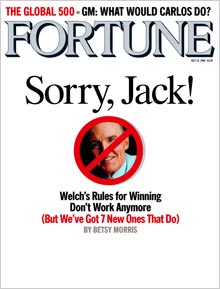
New rule: Agile is best; being big can bite you. Old rule: Big dogs own the street.  NEW YORK (Fortune) -- Until the very end of the last century, big meant good in the business world. B-schools taught the benefits of economies of scale. The greater your revenue, the more you could spread fixed costs across units sold. With size came dominance - of airwaves, store shelves, supply chains, distribution channels. Until the mid-1990s, a company's market value usually tracked its revenue.
Then strange things started to happen. Microsoft's (Charts) market cap passed IBM's in 1993, even though Bill Gates' $3 billion in revenue was one-twenty-second that of IBM (Charts). Scale didn't insulate GM (Charts) from near-catastrophic decline. The big dogs seemed to hit a wall. (The median FORTUNE 500 company is now three times the size it was in 1980, in real terms, and thus much harder to manage.) Citigroup (Charts), built through acquisitions by Sandy Weill to deliver consistent earnings, suddenly found the market focused on whatever bad news emerged in Citi's far-flung units instead of on the smoothness of its overall performance. Big Pharma used to be prized for its unmatched R&D spending; now it is the smaller biotech firms that generate the cutting-edge drugs - and drugmakers Merck (Charts), Bristol-Myers, and Eli Lilly all have smaller market caps than biotech Genentech (Charts), despite significantly higher revenue and profits. Technological advances and changing business models have diminished the importance of scale, as outsourcing, partnering, and other alliances with specialty firms (with their own economies of scale) have made it possible to convert fixed costs into variable ones. Dell, it turned out, was not an anomaly, it was just the beginning - a pioneer at all this, keeping its costs down by outsourcing disk drives, memory chips, monitors, and more, freeing itself to focus on (and clean up in) direct selling and just-in-time assembly. Next: 2: Old rule: Be No. 1 or No. 2 in your market. New rule: Find a niche, create something new. ________________________________________________ REPORTER ASSOCIATE Patricia Neering |
|