|
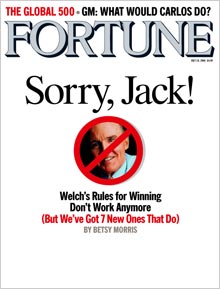
New rule: Look out, not in. Old rule: Be lean and mean.  NEW YORK (Fortune) -- In 1995, Jack Welch "went nuts," as he later put it, over Six Sigma, a set of methods for improving quality - plus a powerful way to reduce costs - that had been developed by Motorola (Charts) in the '80s. At GE's annual managers' meeting in Boca Raton the following January, he told his troops that embracing Six Sigma would be the company's most ambitious undertaking ever. GE's "best and the brightest" were redeployed to put the methods into action. And it worked.
Welch would later write that Six Sigma helped drive operating margins to 18.9 percent in 2000 from 14.8 percent four years earlier. No wonder that after Welch adopted Six Sigma (to which he devotes a chapter of his book "Winning"), more than a quarter of the FORTUNE 200 followed suit. Yet not all firms were able to find the same magic. In fact, of 58 large companies that have announced Six Sigma programs, 91 percent have trailed the S&P 500 since, according to an analysis by Charles Holland of consulting firm Qualpro (which espouses a competing quality-improvement process). One of the chief problems of Six Sigma, say Holland and other critics, is that it is narrowly designed to fix an existing process, allowing little room for new ideas or an entirely different approach. All that talent - all those best and brightest - were devoted to, say, driving defects down to 3.4 per million and not on coming up with new products or disruptive technologies. Innovation is "a meta-stable entity," says Vishva Dixit, vice president for research of Genentech (Charts), who oversees 800 scientists at a company that has created some of the most revolutionary anticancer drugs on the market. "Nothing will kill it faster than trying to manage it, predict it, and put it on a timeline." An inward-looking culture can leave firms vulnerable in a business world that is changing at a breakneck pace - whether it's Craigslist stealing classified ads from local newspapers or VoIP threatening to make phone calls virtually free. "The availability of information and the opening of key markets is exploding," says Clay Christensen, a Harvard Business School professor and the author of The Innovator's Dilemma, "and now you put a few million Chinese and Indian engineers to the test of disrupting us too." No business can afford to focus its energies on its own navel in that environment. "Getting outside is everything," says GE's Immelt (who still deploys Six Sigma). From the day he took over as CEO, he says, he knew the company would need to be "much more forward-facing in the future than we ever were in the past." He explains: "It's not about change. It's about sudden and abrupt and uncontrollable change. If you're not externally focused in this world, you can really lose your edge." Next: 5: Old rule: Rank your players; go with the A's. New rule: Hire passionate people. ________________________________________________ REPORTER ASSOCIATE Patricia Neering |
|