


Less money for consumers?
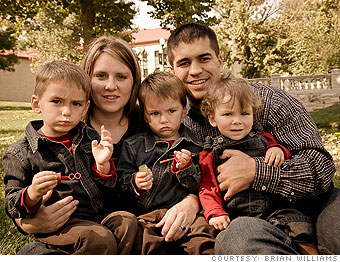
Brian Williams, 31, is a business analyst for Black & Veatch. He is pictured here with his wife, Courtney, and three sons: Ayden, Dylan and Ethan.

Question: "If we are in a credit crunch and unable to get loans, how will the government borrowing money help? Won't they just compete and take the loan that I need to open a business? -- Brian Williams, Baldwin City, Kan.
Expert: David Laibson, professor of economics, Harvard
Answer: "For the foreseeable future, lenders trust the U.S. government to repay its debts. There is also a flight to quality, so the federal government can borrow at very low interest rates. This public borrowing may crowd out some private borrowing, but the crowd-out effect is thought to be small right now.
Indeed, the government borrowing/spending might actually encourage private borrowing by boosting the economy and making private borrowers more credit-worthy."
Expert: Garett Jones, associate professor of economics, George Mason University
Answer: "Yes. As Euguene Fama and John Cochrane of the University of Chicago keep emphasizing, every dollar that someone lends to the government is a dollar that can't be lent to a private business. And on the supply side, every worker working for the government is a worker who can't work for the private sector.
Of course, in our current recession, some of those dollars - like some of those workers - will wind up unemployed unless the government 'hires' them. So if our government knew how to find unused dollars and unused workers, a big stimulus might work out great.
But in an economy where more than 90% of workers are employed and where the supply of bank loans is growing every week, it's hard to imagine that the government is going to find a lot of idle money and idle workers.
So on both the finance side and on the worker side, a big stimulus package could easily shrink the private sector, just as it did during World War II.
At least on the worker side, Congress could help to fix this: They could mandate that 90% of all jobs created by the stimulus be given to workers who have been out of work for three months or more. Then citizens could be pretty sure that the people taking these stimulus jobs aren't just shifting over from the private sector.
Of course, Congress won't do that - government contractors would be knocking down the doors of every member of Congress if they did."
NEXT: Balance the budget?


Last updated April 14 2009: 11:56 AM ET

 RSS
RSS


