
San Diego confab buzzes about 'game changer'
How appropriate that one of the early hits at the much-hyped tech conference DEMO, now winding down in San Diego, is BuzzLogic. The company develops a web analystics tool that helps marketers identify which web publishers are generating the most buzz around a given subject. CNET's Rafe Needleman goes so far as to call BuzzLogic a "game changer." He writes: "It tracks which blogs are the most-read on a particular topic, who influences the influential bloggers, and whom they influence in turn."
Dan Farber at ZDNet provides a comprehensive review, noting that the service indexes over 7,000 sources in its attempt to sort out who is "influential within the millions of conversations taking place in the social Web." All this apparently starts at only $500 a month. No doubt a bargain for the pros, though The Browser has always found that Google and a little elbow grease generally does the trick. Microsoft's cuts Zune's price again - and shudders?
First it was $399. Then it was $299. Now, Microsoft is once more cutting the price tag on its upcoming Zune music player, to $249. That matches the recently discount for a similar 30GB-capacity Apple iPod. At that price, writes JupiterResearch analyst David Gartenberg, there's no way Microsoft is making money, since it won't have the same volume discounts on hard drives and other components Apple enjoys, not to mention the added cost of the Zune's Wi-Fi connection.
Is Microsoft taking a page from the Xbox strategy with Zune? On the surface, yes. But in the videogame business, Sony, Microsoft, and Nintendo take losses on game consoles but make money by charging software developers licensing fees. The more ubiquitous the hardware is, the more money they make from games. In digital media, that business model doesn't work. Apple breaks even or makes a modest profit, at best, on the iTunes Music Store in order to drive profitable iPod sales. Microsoft could easily find itself losing money on Zune hardware and losing money on music sales. All of which should leave shareholders howling for the head of whoever's crunching the numbers in Redmond. Google upgrades silence critics
Web watchers are drooling today over Google's latest upgrades to Google Talk messaging and its RSS reader.
First, Google's RSS: Until now the year-old feed reader, which allows users to review on one page headlines from a variety of sources, has been widely panned - "partly because it really was bad," writes The Guardian, "and partly because it seemed like a display of arrogance." Not so with the new release. "I am impressed," declares Read/Write Web. "It now has a look n' feel very much like Gmail, which I believe is a pointer to this product being prepped for mainstream promotion - and/or merged with Gmail." Beyond upgrading the reader's look-and-feel, the new release could grow Google's audience for RSS readers, which remain largely a tool for sophisticated web surfers. "The Google team went to great pains to explain the use of RSS in the simplest terms ('your inbox for the web')," writes TechCrunch, noting too that Google has also released a demo video - a first for any company product. Now for Google Talk: The upgrades bring the messaging service into the hyper-competitive world of voice-enabled instant messaging clients. Until now, Google Talk was available only to those with Gmail accounts. But the new version of Talk (disturbingly labeled "version 1.0.0.98"), is open to non-Gmail users. In his recent article "Chaos by Design," Fortune's Adam Lashinsky notes that "Google has released at least 83 full-fledged and test-stage products -- none has altered the Web landscape the way Google.com did." While today's upgrades aren't likely to change that, the fast-and-furious release schedule is clearly keeping Google's momentum alive. Apple one-ups Google's Gmail
Back in January, Business 2.0 reported that Apple had found a new set of enemies: "Anyone who makes creative software that doesn't meet Jobs' exacting standards for design and usability." And that included Google, Yahoo, and a host of other Web giants. But in July, GigaOm's Om Malik pointed out that while Apple's desktop-based Mail software is great, Apple's .Mac webmail wasn't exactly living up to the company's reputation for design and ease of use.
Now Apple has promised a a new version of .Mac webmail, and Michael Arrington at TechCrunch says it could give Google's Gmail a run for its money. The most important feature, Arrington writes, is that .Mac lets you manage multiple email accounts, while Gmail restricts you to Google's own email. And best of all, .Mac syncs with Apple's Mail software, so you're not restricted to the Web-based interface. Of course, a .Mac subscription costs $99 a year, while Gmail is free. Based on subscriber numbers, Mac users seem willing to pay the premium for now. But with Google CEO Eric Schmidt joining Apple as a director, boardroom discussions about the future of .Mac should get pretty interesting. iTunes adds video to mobile phones. The iPhone, perhaps?
Ready to watch episodes of Lost on your cell phone? The latest version of Apple's iTunes will let you do just that. FreeState, a participant on the MacRumors forum, discovered multiple references to putting videos on cell phones, Gizmodo noticed yesterday. The updated iTunes has dialog boxes that ask users questions such as, "Are you sure you want to manually manage music and videos on your mobile phone? You will need to manually eject your mobile phone before it can be disconnected safely."
While that's not a sure sign of Apple's long-rumored iPhone, it shows that Apple is getting ready to put content from iTunes on mobile devices of one sort or another. Let's hope that whatever video devices play nicely with iTunes, they'll be less of a stinker than Motorola's iTunes-compatible Rokr. Verizon's new $18 billion bet on fiber doesn't add up
Verizon's spending an additional $18 billion to connect 18 million homes to its new Fios fiber-optic network. That works out to a neat $1,000 per customer, right? Think again, writes networking news site Light Reading. The real cost per actual customer could be as high as $9,650, if you assume that only 1 out of 10 potential customers sign up for service. And at the Nyquist Condition blog, venture capitalist Andrew Schmitt points out that it will cost Verizon another $880 to hook up a customer even after the fiber connection is built. The fiber bills just keep on coming.
Ten thousand smackers is a pretty hefty bill to sign up just one customer. If the goal is to provide television service to compete with cable, Verizon might be better off throwing in 15 years of free satellite TV for every phone customer that doesn't defect to cable. Of course, there is a financially sound reason for Verizon to convert its network from copper to fiber, Schmitt also notes: Fiber is 80% less likely to break and require replacement, leading Verizon to believe it will save $1 billion a year in operating costs by 2010. McDonald's pitches geeks - and they're lovin' it
You've got to hand it to McDonald's marketers: They know their audience. And their targeting has gotten really smart. On the ultranerdy Georgia Tech campus in Atlanta, a McDonald's billboard, captured in a Flickr photo, hawks its Dollar Menu to passing engineers-to-be with the message that "Until you can illegally download food, this is your best deal." A Flickr user reports that the ads have also appeared at Northern Illinois University.
The ad brought chuckles to most, though Flickr user Paladin27 commented, "It will be a sad day when piratebay has torrents for Big Macs and McNuggets. :)" Alas, it's unlikely the popular file-download site will offer fast food at broadband speeds anytime soon. But it does raise the question: Should McDonald's be exploring Web-based delivery on college campuses? After all, the late, lamented Kozmo was a big hit among dorm-room dwellers, and pizza was one of the first foods you could order online back in the 1990s. As it turns out, McDonald's Philippines already offers online delivery orders. So what's keeping McDonald's in the U.S. from offering some tasty, hot downloads? Comcast outage blocks Google, YouTube
A hardware problem in Comcast's Boston-area Internet network got dozens of local cable-modem surfers steamed, according to Bostonist. Google and YouTube were among the sites temporarily blocked. The outage was no big deal, but what provoked major howls was Comcast's do-nothing, blame-everyone customer support. Phone reps blamed users' Firefox Web browsers, telling them to switch to Internet Explorer, or said Google was at fault for the problem. Others told Gmail users to use Comcast email instead. Another rep told Bostonist that Comcast wouldn't do anything to fix the problem until a "critical number of calls" came through. Comcast did finally fess up that it was at fault, blaming a server for the incident.
But that raises a good question: If this kind of blockage can happen by accident, imagine what Comcast could do intentionally to block other websites. There's been a lot of debate about "net neutrality" - the idea that Internet service providers shouldn't favor one set of websites over another, and this outage highlights the problem. And it also raises the possibility of a more passive-aggressive kind of discrimination: By steering customers to its own websites and placing the blame on others instead of addressing its own network-connection problems, is Comcast unfairly undermining its Internet rivals? MySpace claims top spot in web video
Lots of buzz this morning about MySpace edging out YouTube and Yahoo Video to seize the No. 1 spot for video traffic, according to July numbers from comScore Media Metrix (via Marketwatch). Somewhat lost in the debate over bragging rights are the stunning overall numbers: comScore says 7.2 billion videos were streamed in July by nearly 107 million people. By any measure, that's a groundswell - and one that remains largely under-monetized. Marketwatch's Bambi Francisco points out that despite web video's meteoric rise, it still only accounts only "for roughly 2% of online advertising." What gives?
Put another $20 million in the jukebox startup, baby
Ecast, a provider of broadband jukeboxes for bars, lounges, and other out-of-home locations, has just raised $20 million. You'd think that would be good news for the company, but we're suspicious. For starters, the company is seven years old. If it's going to be a success, it ought to be making money, not taking it in. What happened to the $31.5 million Ecast raised in 2000 or the $14 million Ecast raised four years ago? Well, some of that's easy to answer: Ecast used most of the 2002 round to buy RioPort, a pioneering online music store which got steamrollered by iTunes and shut down in 2003.
We don't mean to pick on Ecast in particular. Perhaps a recast Ecast will use the new money wisely to expand its jukebox business. But this could also well be an example of venture capitalists throwing good money after bad. Ads surge, but Yahoo's left behind
The numbers are in, and online advertising appears to be on pace for another record-breaking year, the Internet Advertising Bureau reports. Industry revenue for the first half of the year came in at $7.9 billion, a 36 percent increase from last year. At that rate, online advertising could hit $17 billion this year, since sales in the second half are typically stronger than the first. That's almost triple what the industry pulled in after bottoming out in 2002.
But that optimistic news just casts a gloomier light on Yahoo's recent announcement of softness in the online-media market. All along, people have been asking if Yahoo's problems are unique to that company or sign of a broader problem. The IAB report suggests that Yahoo may be alone in taking it on the chin; the Web giant depends more on display advertising than rival Google, and display ads dropped from 34 percent of the market in the first half of 2005 to 31 percent in the first half of 2006. Ouch. No wonder Yahoo is making employees take a week off. The Browser would need a vacation, too. Del.icio.us passes one million users
It's been less than a year since Yahoo acquired "social bookmarking" site Del.icio.us. At the time of the acquisition, Del.icio.us had 300,000 registered users. Last night, founder Joshua Schachter announced that Del.icio.us had officially hit the one million user mark - a cause for some minor stir in punditville.
"Think only the elite opinion leaders of the tech and online worlds are using social bookmarking services such as Yahoo’s Del.icio.us?" asked Search Engine Journal. "Think again." Indeed, 200 percent growth in less than a year suggests social bookmarking is more than a passing fad, and it suggests that Yahoo's ambitions to pioneer social search have not faltered. That said, with the proliferation of "social" sites of various flavors since the early days of Del.icio.us and Flickr, the boundaries between Web 2.0 innovations seems increasingly fuzzy. One sometimes wonders, for example, where a site like Del.icio.us ends and a social news service like Digg begins - and whether a massive consolidation is likely to happen someday soon. The Browser put this question to Mr. Schacter yesterday when he stopped by for a chat, and he argued the distinction was fairly clear: Del.icio.us is a first key step in social search. "Your attention over time is memory," he said, and social bookmarking is a way to document that attention such "that it is accessible to other people." While social news sites like Digg help people filter today's news, they don't act as a collective memory. "Social news gets thousands of new items a day. We get hundreds of thousand of new items a day." On a more practical note, when asked whether the ad-free Del.icio.us was making money, or would soon, Schachter seemed unconcerned. His job is to focus on the site's utility, he says, and the money would take care of itself. Or at least that was some other Yahoo's job. AOL faces first lawsuit from search-data fiasco
Three AOL subscribers have filed suit against the online service in the U.S. District Court in Oakland, Calif., the Associated Press reports, noting that this is "believed to be the first [suit brought] in the wake of AOL's release of about 19 million search requests made over a three-month period by more than 650,000 AOL customers."
Apparently, AOL's abject apology, the sacking of two hapless employees, the resignation of the CTO, and the company's committment to appoint a "Chief Privacy Officer" did little to assuage the fury of these users, or the litigious enthusiasm of the law firm of Berman DeValerio Pease Tabacco Burt & Pucillo. The plaintiffs are seeking damages and also aim to prevent AOL from keeping any records of user search data going forward. TechCrunch, which neatly summarizes the case, writes that the suit seeks "$1,000 in damages per user affected and $4,000 more per user in California." That may not be much per user - "Privacy is cheap!" writes Marshall Kirkpatrick - but it's pushing $1 billion over all. Ouch! Not that anyone is predicting such a payout just yet. Slashdot readers are, in fact, discounting the suit's chances of success. "Since search inputs are sent over the Internet as plain text, and there are often warnings generated by browsers to explain that this isn't secure, I wonder if AOL has done anything illegal and/or anything that they can be sued for in civil court?" wonders one user. Another adds that, even if the plaintiffs prevail, it's unlikely they'd succeed in preventing AOL or other search engines from storing user seach data: "No one would ever rule against [such archiving] because of its potential use as evidence; especially with the push to mandate retention policies." How Google discriminates
Amidst the brouhaha over whether Google can display news headlines from Belgium, here's some evidence that some Belgians actually welcome attention from the search engine. Netlash, a Belgian Web design firm, has discovered that Google's search results vary not just depending on the country of the searcher, but also on the country where the servers are based.
Netlash believes that Google examines the Internet addresses of websites to determine their physical location. You might have a Belgian Web site with an address that ends in ".be," but if the server's actually hosted in the Netherlands, it won't rank highly when Belgian surfers look for it on Google. Why does Google go to the bother of filtering servers by country? Besides trying to deliver better search results to surfers, Google's also trying to please advertisers, who, even in this age of globalization, usually want to reach a specific national audience. VOIP sounds better than regular phones
The rap on VOIP has been that the sound quality is not great, but merely good enough -- like a cell phone, defenders say, an audio experience to which millions of consumers are accustomed.
So here's a surprise: In a new series of tests by Keynote Systems, VOIP-over-cable-modem service actually scored better than regular phones, Ars Technica reports. For a technology whose chief selling point has been cost savings, not quality and reliability, the test will provide more marketing fodder. It's great news for the likes of Comcast, which has been heavily marketing its triple-play offering of television, Internet, and phone service, and bad news for AT&T and Verizon, which have been trying to persuade customers to keep their regular copper phone lines and add on DSL service. The news is mixed for Vonage and other independent VOIP providers: While the study is a victory for VOIP in general, only cable VOIP outscored regular phone lines, apparently because of cable companies' use of PacketCable-compatible software which optimizes their networks for phone-call transmission, a Keynote analyst said in the report. DivX shares climb post-offering
DivX, maker of a popular digital video format, went public Thursday - at a price above market estimates - and then saw its shares rise Friday. The IPO amounts to a vindication for the grassroots outfit that has thrived despite a lack of support from the major Hollywood studios and daunting competition from Apple's proprietary video format as well as Adobe's Flash video.
PaidContent.org reports that the company floated 9.1 million shares which hit $19.50 Friday before closing at $18.70 - an increase of 16.9 percent over the $16 offering price. The impressive performance has generated buzz for the largely under-hyped company, and also some skepticism. "DivX's stock is far from cheap," writes the Motley Fool. "Assuming that the company posts revenues of $70 million and profits of $15 million this year, the stock would be trading at nine times sales, with a P/E of 41. That's a lot to pay in light of the various risks." Introducing e-mail that leaves no trace
Toss your disappearing ink, and consider upgrading to VaporStream, a new product to be unveiled this week at DEMOfall in San Diego and ideal for the paranoid, and/or those who are simply sick of investing in tape backup. The gimmick is simple: users can send and receive web-based e-mail secure in the knowledge that all record of their communications will disappear from the Internet - and their computers - once their messages have been read.
Here's how VaporStream explains their notion of "recordless" messaging: VaporStream has a feature that separates the header of the message, the who, what and where, from the body of the message. They never exist together and can never be seen together; there is no record connecting the VaporStream subscriber with the content of the message...You also cannot print, cut and paste, forward or save a stream. You can trust that once you read a message it is gone.Interesting, but for whom? Writes The Boston Globe: "Shah and cofounder Joseph Collins Jr. hope that VaporStream's design and low cost, $40 per user annually, will attract companies swamped with the challenge of archiving business-critical e-mails and deleting those that are personal or inconsequential." Right, though, as The Globe points out, many companies are legally required to maintain records of their transactions. Just as Morgan Stanley who earlier this year had to cough up $15 million for failing to hand over archived emails to the SEC in the Commission's "IPO and Research Analyst" investigations. Still, nifty idea will likely find its own, small market. Census Bureau leaks laptops
You would think the Census Bureau would be good at keeping track of things. But no. The Washington Post reports that in the last five years, the Commerce Department has lost 1,137 laptops, many of which went missing from the Census Bureau. Given the agency's work with sensitive data about citizens, the loss is especially alarming: 249 of the missing laptops, mostly from the Census Bureau, had personal information. The Technology Liberation Front blog calls the latest losses "outrageous": "Next time they tell us that we can trust them with personal information and other sensitive things I hope we all remember these incidents," Adam Thierer writes.
PayPal files into the storage business
These days, everyone wants to store your files, from Google to Yahoo to AOL and Amazon.com. Now eBay, through its PayPal subsidiary, is getting into the act. PayPal is offering DropBox, a secure online file-storage feature, to merchants who use PayPal to process online payments, TechCrunch reports. BloggingStocks speculates that small businesses could use the feature to store electronic invoices and other sensitive sales-related files.
It's smart for PayPal to limit the feature to its merchant users, as opposed to consumers who just use the service to make payments, since fees from merchants are how PayPal butters its bread. And the more services PayPal can offer merchants that are integrated with its payment features, the less likely they are to decamp for competitive services. Motorola hawking Razrs in vending machines
 Caught at the airport on an extended layover and fed up with your lame old cell phone? You're in luck: you'll soon be able to saunter over to a Motorola "InstantMoto" vending machine, whip out your credit card and pick yourself up a gleaming new Razr. That's right: Motorola plans to start selling its cellphones and accessories in vending machines in over 20 malls and airports around the U.S. The new machines apparently have the support of the major cellular network providers. Explains ArsTechnica: Cingular, T-Mobile, and Verizon are offering service plans in conjunction with the vending machines...but consumers can also purchase phones sans plan. Cingular and T-Mobile will be able to upgrade...by swapping out the SIM cards from their old phones. Verizon customers will need to call the carrier to have service switched manually, and those who want a new service plan will have to sign up online, negating part of the convenience factor." First thing to note: the vending machine approach stands in stark contrast to, say, the rich retail experience of the new Nokia store. But the main takeaway is not that different companies are trying different strategies, but rather that these manufacturers and their network allies are simply desperate for market share. Where The Browser lives, there are roughly a thousand cell phone retailers per square mile. One wonders exactly how much profit Motorola will make on its InstantMoto sales, and when exactly will this cellphone sales onslaught subside. And, yes, it must be asked: who, outside of the vending-machine crazy Japanese, would actually buy a cell phone from a vending machine? Yale to offer free courses online
Move over Paris Hilton and LonelyGirl15, here comes Yale's Professor Christine Hayes and her class "Introduction to the Old Testament." In the latest sign of the arrival of video on the Internet, Yale University announced Wednesday that it will be posting, for free, course syllabi and videos of lectures for a selected group of classes.
While other schools, notably MIT with its OpenCourseWare initiative, have offered free class materials online, Yale claims to be the first to go with video. ""We think it may make some of our great teachers even better," said Yale's Diana E.E. Kleiner to ABC News. "And think of someone in a small town in China for the first time seeing a Western college lecture!" So, the rural Chinese, should they understand English and have a computer, may learn more about Genesis. But concerned parents dishing out $46,000 for their child's annual stint in New Haven may rest assured that those Internet moochers will not be accruing college credits, as Yale's online "courses" will not count towards a degree. Forgive our cynicism, which is misplaced. Clearly this is a wonderful development, and one that was made possible by a $755,000 grant from the William and Flora Hewlett Foundation. You would think that would mean some welcome press for embattled Hewlett-Packard, except that, speaking of fire and brimstone, the Hewlett foundation more or less divested itself of HP stock in the run-up to "Carly's Big Bet." Cingular cancels caller's service
Consumerist, a crusading pro-consumer blog, has a fascinating story of how Cingular Wireless treats customers who dare to roam off its network. Beckie Edwards received a letter from Cingular telling her that it wasn't "economically feasible" to keep providing her with service, because she roamed off of Cingular's network too much.
Now, let's get into the economics of cell-phone roaming. Wireless companies like to advertise with maps showing how complete their networks are. Roaming agreements with other carriers help them fill in gaps in their networks. When a customer uses another carrier's network, the customer's provider pays that other carrier. This adds up to big bucks, and while carriers don't disclose exactly how much they pay in roaming fees, it's likely that Cingular, with an extensive nationwide network, gets a substantial amount of money from other carriers with customers roaming on its network, even as it pays those carriers a big chunk of roaming fees. Shouldn't Edwards' contract go both ways, obligating the company to provide service, not just requiring the customer to pay her bills? But the Browser thinks this raises a bigger consumer issue: If companies aren't willing to stand behind their "expanded coverage" network maps and no-roaming-fees service plans, should they be allowed to market them at all? And would Cingular really be willing to give up the bucks it gets from roaming, even as it complains about the cost of paying roaming fees? This seems like a dangerous road for Cingular to travel. Exploding laptop adds to Yahoo's woes
The stock price wasn't the only thing going up in flames at Yahoo yesterday: A Dell laptop - yes, the fire-prone variety - exploded at Yahoo headquarters, forcing the evacuation of an eight-story building, according to Engadget. Valleywag relates that the offending laptop did indeed have a Sony battery, the type that Dell and Sony have recalled. While the problem's not likely to be widespread at Yahoo - the Web giant buys HP and Apple laptops for its workers, not Dells, so the machine's widely believed to be someone's personal laptop - it's a good reminder to make use of Dell's battery-exchange program.
Adobe and Symantec ask EU to block Microsoft Vista
Now for something straight out of the late 1990s: Adobe and Symantec are lobbying the European Union to block sales of Microsoft's Vista operating system on antitrust grounds. "Adobe Systems has told EU regulators that Microsoft should be banned from incorporating free competing software for reading and creating electronic documents with Vista," writes the Wall Street Journal (paid subscription required) this morning. The Journal also reports that Symantec will send lobbyists to Brussels next week to stir up resistance to the Vista juggernaut.
Adobe, of course, is worried that Vista's built-in cross-platform document format (dubbed XPS) will steal market share from Adobe's Acrobat. And CEO John Thompson's swagger aside, Symantec is terrified that its Norton antivirus franchise will be trumped by Vista's built-in security tools. Of course, they're right to be worried. Even before Vista steals any customers, Microsoft is already poaching employees, like Vinnie Gullotto, a top antivirus researcher who defected in August from Symantec to Microsoft. Wisely, both companies have opted to fight with every means necessary, and by making their antitrust move in Brussels, where regulators have openly quarreled with Microsoft long after their U.S. counterparts gave up the fight, they're attacking Microsoft's weakest legal flank. Will SAP sue over Ellison's taunts?
An old school playground smackdown has broken out between Oracle and SAP. Fueled by strong quarterly earnings, a reinvigorated Larry Ellison indulged in a fierce bit of SAP-bashing in a call with analysts and investors: "I cannot imagine them holding on to their existing strategy in the face of market share losses and what is turning out to be rather slow organic growth for them," he said, among other mean things. A little while later the home page of Oracle was - and still is - emblazoned with the headline "Oracle grows 10x faster than SAP!" Ouch!
The rhetorical broadside quickly fetched what Webpronews.com delightfully describes as an "I-know-you-are-but-what-am-I" response: "Larry Ellison's statements in today's Oracle earnings press release about SAP's product and acquisition strategy are a complete misrepresentation," retorted SAP's Bill Wohl. And he didn't stop there: "Oracle's statements about SAP and their own Fusion progress continue to be inconsistent and misleading... Oracle needs to adopt one version of the truth, and be honest with the market on its actual progress." Booya! Nothing like a little blood in the water to draw the biggest sharks of all - the lawyers. SeekingAlpha is already predicting litigation: "SAP's rebuke sounds like the beginning of a lawsuit," the blog writes. Cool. And where's the truth? The Browser notes Mr. Ellison has long been a master of propaganda, and that everyone knows the best defense is a good offense. Certainly, Oracle's recent results are welcome news after a prolonged period in which the company struggled mightily to absorb a series of major acquisitions including Peoplesoft and Siebel, and its stock languished. Software is a fickle business, of course, and both companies must maintain a near constant state of aggression. But SAP investors worried by Ellison's taunts may be reassured by this glowing report by Ismael Ghalimi, who is blogging live from the company's TechEd conference. All hail the disposable cell phone charger
 Irresistable, if not urgently needed: Mobcharger delivers 90 minutes of talk time to your dead cell phone, no matter where you are, and it comes in a colorful throw-away pouch. Sure, it would have been even more useful five years ago when annoyingly weak and bulky cell phone batteries were standard, but for those that travel far from the grid, or who tend to forget their plug-in charger, Mobcharger fits the bill. "It comes in different models for the myriad cellphones (one for Samsung phones, one for Motorola, etc.)," writes Gizmodo. There's some disagreement on the price: Gizmodo reports that the charger will retail for $10, whileMinistry of Tech puts the price at $5. Cheap at any price. Disney CEO blabs Apple secrets
Someone's about to get a big frowny-face email from Apple headquarters. Disney CEO Bob Iger, speaking at a Goldman Sachs conference, revealed that Apple's upcoming iTV product, which will connect digital content on your PC with your TV, doesn't just stream programming - it can also store it on a built-in hard drive. That means that Apple's iTV is more than just a "wireless router", but it also sets up the device for controversy in Hollywood. If the iTV can store music and movies, not just rebroadcast them wirelessly to a TV, expect a brouhaha among both studio heads and consumer activists over whatever digital-rights management technology Apple includes.
Iger's revelation also raises questions about what, exactly, the iTV is: A scaled-down Mac Mini? A beefed-up wireless iPod? While you ponder that, we'll leave you with this thought from Valleywag: What, exactly, does the iTV do that you can't already do with a $15 A/V cable from RadioShack? PicksPal taps the wisdom of the few
Nothing focuses the betting mind like the possiblity of a statistical edge. PicksPal.com is an otherwise innocuous Silicon Valley-based Web site for sports fans that enables money-less betting on a wide range of sports. But, according to an effusive TechCrunch, the site has discovered that a small subset of its 100,000 registered users tend to predict sports outcomes with uncanny accuracy. So, beginning next Tuesday, the site will launch Genius Picks. "For $10, users can get access to the collective wisdom of the 30 best PicksPal players over the previous five weeks in a given sport, and get five predictions on upcoming games," reports TechCrunch's Michael Arrington, who believes that the combination of open, user-generated predictions "could change the way we predict sporting event outcomes. And it could therefore have a big impact on sports betting markets."
The news has set off a first-rate debate on the relative merits of the "wisdom of the crowds" among an interesting mix of Web 2.0 loyalists and Vegas-hardened statisticians. "I never bought into the ‘wisdom of crowds’ thing," writes one TechCrunch reader. "And for the same reasoning I _have_ always bought into the ‘wisdom of extremely competent crowds’ thing." Naturally, others are quick to wonder about applying the principle elsewhere: "How about emulate the site for stock markets experts?" asks A Wannabe Blogger. The Browser suspect that it's quite possible that the ease of access and transparency of sites like PicksPal will improve information flow in sports markets, and others. But we are dubious it will somehow confer an advantage on those who pay $10 for a Genius Pick, or otherwise greatly alter the flow of gambling or investing cash flows. As another savvy TechCrunch reader points out: "So the wisdom of the public as generally good at rating their chances of winning.... [But] this is no good for actually making money on the win pool though since it’s a tote - it’ll never pay more than the percentage, combined with the totes rake you lose." We think that means that the odds will always adjust to the prevailing public opinion. It's like they always told us: In gambling, the house always wins. Sprint blogger giveaway backfires
When Sprint started offering free phones to prominent bloggers earlier this year - in the hope that they'd use the phones and then blog about them - BuzzMachine's Jeff Jarvis hailed the plan as "smart" and a "cheap form of advertising." But now Sprint must be regretting every penny it spent on the project.
 Joel Spolsky, one of the phone recipients, published a 3,000-word screed on the terrible phone Sprint sent him, the LG Fusic. Spolsky rails on the phone's cheap plastic, lousy interface, and inscrutable music-playing systems. (The phone has not one, but two different ways of playing music, both of them bad, according to Spolsky.) Joel Spolsky, one of the phone recipients, published a 3,000-word screed on the terrible phone Sprint sent him, the LG Fusic. Spolsky rails on the phone's cheap plastic, lousy interface, and inscrutable music-playing systems. (The phone has not one, but two different ways of playing music, both of them bad, according to Spolsky.)The obvious lesson? "Don’t send bloggers stuff for free unless it’s good," writes Robert Scoble. If you've got a product that's not up to par, solicit private feedback from influential types, but don't invite them to blog all about it before it's ready for prime time Scoble argues. Steve Broback at the Blog Business Summit concurs, concluding that businesses seeking to court bloggers need to "understand their audience" and "have some finesse." One wonders if Sprint is the true villain here. C. Enrique Ortiz, another Sprint-phone recipient, notes that the Samsung phone he received in the same program was "pretty neat." LG's much-hyped Chocolate also has an incomprehensible interface. Maybe the blame should lie with LG's cell-phone software engineers, not with Sprint's blogging-outreach efforts. Apple MacBooks selling fast in advance of an update
AppleInsider has the scoop on the latest Apple notebooks: Expect new MacBooks with faster Intel chips between now and Thanksgiving, in time for the holiday shopping season. Intel is shipping faster chips to Apple, the Mac news site reports, and they should find themselves into souped-up laptops soon. Not that Apple needs the speed boost, it seems: According to AppleInsider, Credit Suisse analyst Robert Semple believes Apple will ship nearly 800,000 MacBooks this quarter, 200,000 more than his initial estimate. With another 250,000 high-end MacBook Pros expected to sell, that puts Apple in a position to sell a million laptops in its September quarter.
The performance bump from new Intel chips should help Apple keep its rapidly improving position in notebook sales. In June, Apple had 12 percent of the U.S. laptop-computer market. "While the company isn't updating its notebooks at the absolute fastest pace possible, it's clear it plans to do so more frequently than in the past," writes AppleInsider. "And it has to, especially if it has ambitions of maintaining recent share gains." Why can't Sony code?
In the last century, Sony's genius at electronics was unparalleled. But now that the tech action has moved to software that links gadgets together, Sony seems to keep stumbling. The most recent gaffe: a security flaw, News.com reports, in Sony's desktop music-management software, including Connect and SonicStage. This follows, of course, on last year's digital rights management debacle, where CDs from the Sony BMG music joint venture exposed fans to hacker attacks. What's next? PS3s taken over by spammer bots and used to send junk e-mail?
The sneaky new HP launches "slimming" camera
In a world of Internet dating, few things carry more weight than the the uploaded photo-of-self. (Please to recall that the Pew Internet Project says three quarters of all single Internet users have experimented with online dating.) Wouldn't it be great, then, if that picture was a bit more flattering? Well, you might have been upset with Hewlett Packard for its deceptive practice of "pretexting," but maybe you'll love them for their new "slimming" camera. The effect is subtle, crows HP: "They say cameras add ten pounds, but HP digital cameras can help reverse that effect."
OhGizmo, however, calls the device "fatalistic," and is a little put off by the whole thing: "You know you’ve lost control over a part of your life when you start finding features, in gadgets, that help you deal with it." Ah, photo-manipulation: It's all part of the new HP Way. Dogster: Social networking jumps the, err, shark?
Dogster, a social network for, yes, dogs - and its sister site Catster - last week closed a $1 million round of financing. Naturally, some are dubious. But Michael Arrington, publisher of top tech blog TechCrunch, is not one of them. In fact, Arrington is an investor in the business, and it was his post yesterday in defense of the company that set off Web 2.0 skeptics. Blog Newsome.org quips: "I had a flying squirrel as a pet when I was a kid. I'm looking forward to Flyingsquirrelster." And Dead 2.0, which appears to be the spiritual descendent of FuckedCompany (and wonderfully lists itself as being in "Feta" as opposed to "Beta"), rounds up the coverage noting simply "Honestly, with all this craziness, it’s entirely possible they’ll get acquired long before they have the chance to fail."
As it happens, Dogster has an impressive Silicon Valley pedigree: it was founded by Web developer Ted Rheingold and counts a who's who of Web entrepreneurs on its board. Reporting last week, VentureBeat's Matt Marshall noted that Dogster and Catster had togther generated $100,000 in revenues in April, (not clear exactly why that's the most recent data.) The secret according to Marshall? "It is all about the dogs, but then it isn’t really," he writes. "Sure, dog owners are flocking to the site so that they can post pictures of their dogs, and check out the profiles of other dogs of the same breed, or of other owners in their neighborhood. But more interestingly, owners are pretending they are the dogs, and writing little diaries, and the diaries are often becoming more about themselves, as seen through their dogs eyes." Well, The Browser is smart enough to know that pet owners are irrational and passionate lot. Already, over 200,000 of them seem to have created pages for their dogs on Dogster. And, unlike the infamous pet-related meltdowns of Web 1.0, there are no heavy bags of dog food here that require shipping at great expense over state lines. So, skeptics aside, just maybe this dog will hunt. Belgian newspapers block Google News
Bad news for the hordes of Belgian news junkies: The WSJ.com reports that Belgian newspaper Copiepresse has won a court order blocking Google from running headlines and links in the Belgian version of its Google News service. Should the search engine not comply within ten days, it will have to pay out a million euros a day.
The debate over "fair use" has been around for ages, of course, and blogland is quick to ridicule the Belgian paper as being just another reactionary publisher, out of step with the times. "One of these days," writes TechDirt, "perhaps, both courts and publishers will learn that having someone link to you is a good thing, especially when it's a site that people go to in order to look for exactly the type of content you produce." Probably true, though you can't blame the Belgians for being a bit defensive, and exactly what constitutes "fair use" may not be quite as cut-and-dry as U.S. bloggers would have it. Mainly, it's nice to see someone other than the French taking a vaguely irrational stand against U.S. tech dominance. Mac version of Office due next summer
It's hard to remember, two decades on, but Microsoft actually got its start writing office software for the Mac, not for PCs. Today, Microsoft has 130 employees in its Mac Business Unit working on the next version of Office for Mac, and in a scoop, Australia's APC magazine reports that Mac Office is due out between July and August of next year.
If you're a Mac fan and you've been chortling over the delays to Vista, laugh no more. Vista's ever-slipping release date has affected Office for Mac, too. Because Microsoft delayed the release of its Windows version of Office to match Vista's release date, the Mac team hasn't had a final version to work from. Vista's now expected next January, along with Office 2007 for PCs, and the Mac version of Office normally ships six to eight months later -- that's why it won't be out until next summer. But the Mac team at Microsoft has had plenty to do in the meantime, including a top-to-bottom rewrite of the code for Apple's new Intel-based Macs. All of this raises a question: Is any desktop software, which takes years to upgrade, worth the wait? Or are we better off using Web-based apps like Salesforce.com, Writely, and Flickr, which can be updated on the fly? Tell us what you think. Is that a terabyte in your pocket?
If your hard drive is filling up fast, you'll be happy to see the latest from Seagate. The drive maker has come up with new storage technology, reports Engadget, that will let you put 2.5 terabytes worth of digital stuff on your desktop computer's hard drive in a few years. Last week, Apple upped the iPod to 80 gigabytes, and Seagate has already introduced a 120-GB hard drive that could find its way into future iPods. But with Seagate's new technology, by 2009, Seagate could be making iPod-suitable drives with as much as 275 GB. That's a heck of a lot more than 1,000 songs in your pocket.
MTV's new online strategy: virtual reality TV
MTV, pioneer of all things edgy on cable TV, has been caught flat-footed by the MySpace revolution. But the network is now poised to go virtual in a particularly intriguing way, reports Richard Siklos of The New York Times.
This week, the network will launch "Virtual Laguna Beach," a massively multi-player virtual reality game based on its TV show "Laguna Beach: The Real OC." As far as The Browser knows, this is the first example of virtual reality TV. The notion has that eerie "this is probably what the future will be like" quality. "You can not only watch TV, but now you can actually live it,” said Van Toffler, president of Viacom's MTV Networks unit, to The Times. Sure, it's a bit of stretch to think an aging cable-TV outfit inside a major media empire won't screw up its virtual reality efforts, but the idea makes sense. And Om Malik notes that it's the first of three such virtual extensions planned by Viacom, where octogenarian boss Sumner Redstone recently axed Tom Freston for having missed the MySpace boat. Here's the best part, though not likely to completely reassure God-fearing parents in the Midwest: Unlike some more racy virtual reality games, Virtual Laguna, built by Makena Technologies, will limit the "physical" contact between avatars to kissing. Despite recall, Segway CEO bullish on future
 So, Segway has recalled all 23,500 of its Human Transporters currently at large due to a software glitch. This is not the sort of publicity that the company, or its marquis investors such as Valley VC Kleiner, Perkins, Caufield & Byers, were looking for in the lead-up to a rumored initial public offering, but the flaw appears relatively minor. (There have been only six reported accidents, the worst on the order of broken wrists or teeth, reports Ryan Blitstein at the Mercury News, and the problem can be solved with a free software upgrade.) Indeed, "writing off Segway...would be a big mistake," argued BusinessWeek in a feature on the company that appeared Monday. (Interestingly, news of the recall was absent from the story, though it seems Segway had been studying the problem for some time. The Browser assumes either Segway somehow didn't know the recall was imminent, or the company simply chose not to offer up that bit of information.) In any event, the story's point remains valid, which is that Segway may yet grow into something more than a small-time vendor of two-wheelers if it can figure a way to apply inventor Dean Kamen's nifty gyroscopic innovations to a wider set of problems. That, at least, is the current strategy of CEO James Norrod: "I look at the technology," says Norrod, "and ask, 'Where else can it be used?"' ... In [Norrod's] view, Segway needn't define a whole new urban ecology or replace the car. It can put its technology into anything that moves. That means unmanned vehicles with potential military or industrial uses, or multiperson vehicles that use Segway's computers and electric engines to glide smoothly over obstacles. ... "If people want four wheels," says Norrod, "I should give 'em four wheels."Very sporting of him, though until they fix this reverse torque problem, we're more interested in the unmanned vehicles. Universal Music boss slams YouTube
What are they putting in the water at that Merrill Lynch Media & Entertainment Conference in Pasadena? First, News Corp. boss Peter Chernin annoyed the Web 2.0 crowd with his off-key vision for MySpace, and now Universal Music head Doug Morris has used his conference talk to essentially threaten YouTube and MySpace over copyright infringement. (Can't we all just work on growing the pie instead of fighting over how to carve it up?)
ln any event, Morris' public sabre-rattling represents the first major move against YouTube, which has long flirted with trouble given the prevalence of copyrighted materials on its site. "We believe these new businesses are copyright infringers and owe us tens of millions of dollars," Morris said, adding: "How we deal with these companies will be revealed shortly." Alex Veiga of the AP, who broke the story, suggests that Morris' get-tough remarks are "a signal that negotiations could be stalled between the world's largest record company and the two online sites." No doubt. Interestingly, Morris appears to be the industry spoiler. Veiga notes that Universal's rival, Capitol Records, has released videos on YouTube, while Universal "has made it a priority to get compensation for content that was once seen as purely promotional." Naturally, the blogosphere is not impressed. Jeff Jarvis at BuzzMachine gets worked into more than his usual lather: "These dimwits just don't get it: YouTube and MySpace and blogs and the internet are their new distribution and sales channels. Want to cut off your noses to spite your faces? Fine. Here's the knife." Most Slashdot readers are right there with Jarvis, though the most fatalistic among them are already assuming that YouTube will get Napstered - that is, sued more or less out of existence. Not likely we think: YouTube has lots of friends in old media, and its sins are far less egregious than Napster's. But, even if so, what do the Slashdot types think will happen then? Says one: "It'll take about a month for all the users to migrate to one of the dozens of alternative sites that act in the same way and have slightly different features." Does it seem like we've seen this one before? Critics rhapsodize over Sonos music player
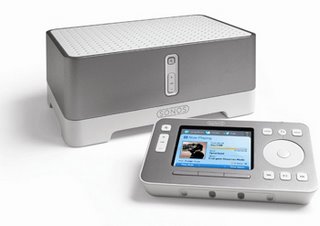 Sonos, maker of digital sound systems for the home, has upgraded its product offerings, adding support for the online music service Rhapsody. The critics are pleased. Sonos devices effectively provide users with a single, wireless remote device that can stream music from personal digital libraries, satellite radio, and Internet music services to speakers in multiple rooms in a home. Today's upgrade makes that streaming easier, says Time's Wilson Rothman who has selected "Sonos 2.0" as Time's Gadget of the Week and is particularly impressed by the service's deal with Real Network's Rhapsody service: "I can pick up the Sonos remote, scroll and click, iPod style, through Rhapsody's bottomless trove of music, playing whatever I want instantly." TechCrunch is similarly enthusiastic noting that Rhapsody has more than two million songs and 100 ad-free radio stations: "Since being founded in early 2002 and launching in January of 2005, Sonos has been growing from strength-to-strength," writes Nik Cubrilovik. Sounds good to The Browser, though, of course, just when they get the home music streaming problem solved, we'll have to figure out how to do the same for digital television. And, should you be ready to delve into the bleeding edge of "mobile TV," paidContent, reporting from Boston's VON conference, has picked up the subject this morning in painful detail. Gawker Media launches music blog
 Gawker Media, the blog empire specializing in snark, has broken a seven-month dry spell, with the launch today of Idolator, a blog dedicated to popular music: "We're as obsessed with the music world as we are with the machinations behind it," proclaims the blog's welcoming message, "and we'll cover the people who are manufacturing the latest band buzz, whether it's an old-guard standby (Rolling Stone), an absurdly powerful new-media turk (Pitchfork), or an agenda-pimping blogger (take your pick)." The launch of Idolator is an apparent return to growth-as-usual for entrepreneur Nick Denton. In late June, Denton placed two of his then-15 blog titles up for sale and issued a surprisingly pessimistic appraisal of online media: "We've never liked crowds, nor believed in their wisdom," Denton wrote at the time. "Gawker launched and expanded in the middle of the web bust; as, four years later, web 2.0 enthusiasm reaches dizzying new levels, it's time for another perversely countercyclical move. We're retrenching...." That statement, followed with the long lag since the February 9th launch of Silicon Valley gossip site Valleywag, had some pundits lately predicting the sale of Denton's company. But with Idolator out today and the rumor of more site launches by the end of the year (the company is now back up to 14 titles), it seems unlikely that Gawker is on the block. Denton himself is declining interviews, though as usual, he's working his behind-the-scenes network to generate buzz for his latest creation (see "Nick Denton, 'Publicity Cat'"), which will face stiff competition from the legion music web sites large and small. ESPN.com rushes to new traffic record
 Football junkies are increasingly getting off the couch and logging onto the Web. LostRemote reports that on September 10th, ESPN.com set a new one-day traffic record with 95.3 million page views, and that "four of ESPN.com's 11 all time most-trafficked days have occurred since Sept. 2." The sports site's strong performance has pushed its parent Go network to the number 31 rank in Alexa's Global 500 rankings. "People who want national sports coverage will not watch local TV - they go to ESPN.com, and to a lesser extent, ESPN on TV," writes LostRemote. "The web now rules pro sports coverage, and it’s changing the game." Techies still vote no on Diebold voting machine
A group of Princeton computer scientists has released a report critical of Diebold's latest AccuVote-TS electronic voting machine, continuing a steady drumbeat of criticism of the company and the machine that began as far back as 2004. The study comes only a day after blogger Avi Rubin penned a damning description of his most recent experience with the machine, prompting TechDirt to quip: "The only positive note in the piece is that many more voters complained about the use of e-voting machines."
While Rubin's critique focused largely on the procedural incompetence of Diebold, the Princeton researchers describe what they call "serious" technical shortcomings of the machines, noting that "an attacker who gets physical access to a machine or its removable memory card for as little as one minute could install malicious code; malicious code on a machine could steal votes undetectably, modifying all records, logs, and counters to be consistent with the fraudulent vote count it creates." According to the Diebold web site, there are 130,000 Diebold machines in use around the country. ArsTechnica provides a complete round-up of the Diebold affair, points out that "the state of California banned Diebold voting machines, and sued the company for machine-related fraud after flaws were found in the AccuVote-TSx machines used in a 2004 election." Ars says the continuing problems "may finally compel other states to do the same." And we thought the end of hanging chads was near. Google and Intuit cozy up to each other
 Silicon Valley neighbors Google and Intuit have announced a major partnership. On a conference call yesterday afternoon, Google CEO Eric Schmidt and Intuit's Steve Bennett sketched out how the next version of Intuit's popular QuickBooks accounting software will connect directly to several Google services, including AdWords, Google Maps, and Googlebase, a free classifieds-like marketplace. Search Engine Watch says the development could have "sweeping implications for local search and small-business online marketing," noting that Quickbooks has 3.7 million active small business users, many of whom are not yet online. Thanks to the integration, small businesses will be able to create ads on Google search pages, and place their businesses directly onto Google maps. SEW says the deal was "quickly put together for the 2007 release of QuickBooks" and will eventually be extended to Intuit's Quicken, Financial terms of the deal were left hazy. Vague comments from Schmidt about revenue and cost sharing were "basically a non answer," says Michael Arrington at TechCrunch, "although it's clear Google is making payments to Intuit pursuant to this deal." Google shares, however, which had been climbing this week, are off nearly 4% today, while Intuit remains largely unchanged. Still, web pundits generally appear to think the deal is a smart one. Perhaps the most intriguing, if entirely speculative, comment comes from a TechCrunch reader and Silicon Valley native: "Just recently I was driving down Shoreline [Boulevard], and remarked that the only way for Google to get some more real estate close to the campus was to buy Intuit...." Interesting point. Could this be a prelude to a much bigger deal? Just say no to downloading
Remember those anti-drug lectures and videos from junior high? Well, the Minneapolis Star-Tribune (via Boing Boing) reports that the Federal government has brought those same get-'em-early techniques to at least one school in Minneapolis in an effort to combat music and movie piracy among kids. The Star-Trib reports that Jon Dudas, director of the U.S. Patent and Trademark Office, stopped off in a Minneapolis elementary school to deliver the message: "You wouldn't take a CD off the shelf without paying for it. And you shouldn't get music on the Internet without paying for it." Apparently, Dudas' audience of 5th graders had already been treated to "an anti-piracy video provided by the U.S. Department of Commerce." Certainly, intellectual property theft is a serious crime, but one wonders whether it is serious enough - and if the issues around copyright protection have been sufficiently worked out - to justify pushing the message into the minds of America's 11-year-olds. What's your take?
Microsoft wins geek praise
With News Corp. handling the evil empire role, Microsoft has gone kinder and gentler, yesterday making an "Open Specification Promise" that was widely praised in the open source development community. The details are fairly technical and arcane, but it boils down to this: In the context of 35 software projects (or standards "specifications") for which Microsoft hopes to rally market support, Redmond has agreed not to enforce any of the relevant patents it owns against software developers who build on Microsoft's code and ideas to enhance or complement the specifications.
The promise moves Microsoft in the direction of open source development, where many parties can contribute to software that no single party owns. Writing from the Microsoft campus, tech blogger Doc Searls crows: "This is original and well-intended work by honorable people who really want the whole market to work, and not just for one company to muscle everybody else. It's also a beginning. Times are a-changing." On Slashdot, Andy Updegrove writes that the move is "all part of a recent wave of such pledges made by companies such as IBM, Nokia, and Oracle, and a significant shift in how Microsoft is dealing with open standards." Bravo, respond most Slashdot readers, though one open promise does not a lifetime of skepticism erase: Another Slashdotter wonders, "So, can somebody tell me why you would have a patent if you are not going to enforce it? Pay no attention to the Patent Lawyers behind the curtains...." Thinking that sounded pretty reasonable, The Browser querried Nicholas Varchaver, our in-house patent expert (see: "Who's afraid of Nathan Myhrvold?,") who fired back some off-the-cuff insight: "There is a very basic - and common - reason to have a patent, even if you have no attention of enforcing it vs. other people/companies. Having that patent allows you to prevent others from enforcing it against you." In short, by having the patents and then making its promise, Microsoft would indeed by clearing a certain market segment of any legal obstacles to innovation. News Corp.'s Chernin: tone deaf Web 2.0 trash talker
Peter Chernin, COO of News Corp., appears to have sketched a very politically incorrect strategic vision for MySpace yesterday, and the Web 2.0 crowd is united in being appalled.
According to Mike Farrell of Multichannel News, Chernin was in Pasadena for the Merrill Lynch Media & Entertainment Conference, where he waxed surprisingly isolationist: "If you look at virtually any Web 2.0 application, whether its YouTube, whether it's Flicker (sic), whether it's Photobucket or any of the next-generation Web applications, almost all of them are really driven off the back of MySpace," Chernin said at the conference. "There's no reason why we can't build a parallel business." Now, in the current era of content "mash-ups" and user-generated titans like Wikipedia and Craigslist, that sort of zero-sum line is at best tone deaf, and it was hardly softened when Chernin added: "Given that most of their traffic comes from us, if we build adequate, if not superior, competitors, I think we ought to be able to match them, if not exceed them." Plenty of people were quick to question Chernin's assumptions about MySpace being the dominant traffic-driver to those apps. (And The Browser suspects Chad Hurley, CEO of YouTube, might be among them. At lunch in NYC last month, we asked Hurley about MySpace's clumsy efforts to block YouTube videos. "It doesn't necessarily hurt us," said Hurley, noting that while a lot of YouTube's initial growth came from MySpace, that was no longer the case. "What we're seeing is the majority of people are watching videos on our site because we’ve become a destination.") But accuracy aside, what bothered the guardians of the Web 2.0 faith was that Chernin seems to miss the whole point of social content. "This is such a ridiculous strategy that it's not even worth contemplating," posted Mashable. "MySpace's openness to third-party extensions (MySpace layouts, MySpace codes) is one of its most popular attributes - squashing that ecosystem may provide short-term benefits, but it will ultimately harm them in the long term." Michael Arrington at TechCrunch was similarly outraged, saying that Chernin's comments sounded "both dangerously arrogant and like a real validation of fears that MySpace dependency is too risky for outside developers." Like Arrington, Om Malik hoped that Chernin was somehow misquoted: "There is a good chance, a lot he said was left on the cutting floor," wrote Malik. "But if (and only if) he means what he says, then all those tiny start ups that are betting the farm on MySpace economy better watchout." Ahh, the woes of being a media titan in a world of messy social networks. TiVo's new recorder: high-def, high-price
 Two years after the first dual-tuner, high-definition DVRs hit the market, TiVo, the beloved-but-money-losing television recording pioneer, has unveiled its own next-generation model. "The Series3 HD box...represents TiVo's first major product upgrade since it released its networked Series2 DVR in 2002," writes USA Today, noting that the machines will have "a 250-gigabyte hard drive - enough to store about 32 hours of high-definition programming or up to 300 hours of standard programming," as well as two tuners, so that subscribers will be able "to record two different shows in HD at the same time while watching a third pre-recorded show." The long delay between product offerings may explain in part why the company remains unprofitable. In the quarter ended July 31st, TiVo reported a loss of $6.45 million on sales of $59.2 million. Will the new box help? While early reviews suggest the S3 is a worthy product, much of the early Net buzz is stuck on the $799 price tag. The console will have to compete based on its good looks and quality components vs. lower-end settop boxes that cable companies give away for the price of a subscription. And there is also the current generation of low-cost media center PCs to consider. One Engadget reader summarizes the math neatly: $799 for the unit + $12.95/month for service = I won't be buying one.Others however, may prove more willing to open their wallets, and TiVo is certainly not shrinking from its high-end strategy. "Our objective was to build a best-in-class DVR," said TiVo's vice president of product marketing Jim Denney to USA Today. "It's reflected in the price and also in the make of the product." Fair enough. Let the market decide, says Engadget (see detailed review): "Units go on sale today at TiVo.com and should be showing up within the next week or so at Best Buy, Circuit City, Fry's, and Ultimate Electronics. Good luck on that decision!" Not your kids' Facebook anymore
With the wounds of its latest upgrade still fresh, popular social network Facebook.com is set to make an even more sweeping change: opening its doors to the masses.
At first, Facebook.com was the exclusive domain of college students. More recently, it began admitting high school students and employees of certain selected companies. Beginning next week, though, AdAge reports that "people will be able to join through roughly 500 regional networks, a number that Facebook expects to grow with time." In short, anyone who lives somewhere, or says they live somewhere, will be able to join. Paidcontent.org, which says the strategy change may be necessary, is among the many to point out that the jittery Facebook membership may not take to the new strategy: "The move takes Facebook a step closer to MySpace's open frontier - something that isn't likely to thrill those who see Facebook as an antidote to the massive News Corp. social network." Indeed, it was the fear of another cool reception that prompted Facebook to delay the launch of "open registration" from this week to next. "We are going to think through how to better inform users, and we don't want to risk expanded registration being a big issue on the heels of last week's changes," spokesperson Marlene Deitch said. Doubters and turbulence aside, the expansion plan makes sense to The Browser, who had a chance to discuss it with CEO Adam Zuckerberg a few weeks back. Zuckerberg likes to describe his site not as a media property but rather a utility more akin to e-mail: a tool that allows users to keep track, for example, of friends' phone numbers and addresses. (Anyone remember PlanetAll?) It's a smart way to distinguish the Facebook approach from the occassionally vague-and-bloated-seeming "media" mission of market leader MySpace. A utility requires scale, so by expanding its domain, Facebook may actually prove of more enduring use to its existing members and a bigger threat to its rivals. This assumes, of course, that it solves the thorny problem of giving sufficient control to members over how they share their personal information - and that the brash Zuckerberg manages not to alienate his membership along the way. TV Guide redesigns web site
 And while we're on the television beat: paidcontent.org reports that a new version of TVGuide.com went live this morning complete with "more personalization, expanded broadband, more community options." In short, the old-school brand is struggling valiantly to keep up with YouTube and the rest of the Web 2.0 crowd. The redesign, overseen by Frog Design and following an earlier upgrade last April, apparently includes celebrity blogs, a new video player, and expanded user forums, not to mention new ad placements. Perhaps most intriguingly, however, is the TV Guide online archive, covering the last 50 years and with "10,000 TV shows, 40,000 movies, 131,000 celeb bios." In a world where our collective TV past is slowly trickling online, TV Guide has all the relevant meta-data. Samsung unveils new memory chips
Samsung unveiled today a working prototype of a new and improved kind of memory chip, called PRAM, which will compete with "flash" memory currently in use in cellphones and digital cameras. PC World gives the geeky lowdown on the new chips, which Samsung claims will be "30 times faster than flash memory, easier to manufacture, and will have a life span 10 times longer." Impressive, but count on rivals Toshiba, Intel and AMD - the top players in the booming flash market - to bring out their own innovations before Samsung's PRAM starts shipping in 2008. All this, of course, is nothing but welcome news for those of us juggling camera memory cards or running out of space on our cellphones for friends' phone numbers.
McGruff, crime dog, goes cyber
 Move over FBI... McGruff the crime dog is jacking in to the Net. In surely the most convincing sign yet that Internet crime has gone mainstream, the National Crime Prevention Council is teaming up - somewhat incongruously - with the Chief Marketing Officer Council to unleash McGruff on a new virtual beat. Move over FBI... McGruff the crime dog is jacking in to the Net. In surely the most convincing sign yet that Internet crime has gone mainstream, the National Crime Prevention Council is teaming up - somewhat incongruously - with the Chief Marketing Officer Council to unleash McGruff on a new virtual beat. Spurred by frightening online crime stats, like the fact that "77% of youths are contacted in some manner by online predators by age 14," the new McGruff campaign has picked up backing by big-name tech firms including Intel, McAfee, Verisign, USA Today and CNET. To match his new turf, the dog has tweaked his old line. He now says: "Take a Bite Out of Cyber Crime." The idea is cute, but the backing is serious. For example, Comcast, reports the Philadelphia Inquirer will ante up $2 million in televised public service announcements. Craigslist shaken by sex scandals
It seems sex scandals are not simply the preserve of for-profit sites like MySpace: now Craigslist.org, the feel-good local community site, has run into its own headaches relating to the online hunt for sex.
The problems began last week with Casual Encounters, an area where adults can post personal ads for distinctly short-term relationships. It seems last Monday one Jason Fortuny, a particularly mean-spirited prankster, posted a message in the forum on Craigslist Seattle passing himself off as a woman seeking male companionship. That alone might not have been the worst sin, but then publishing the ensuing flood of response e-mails, in their entirety, on the public Encylopedia Dramatica was hardly sporting. The fallout has been ugly, says Waxy.org in its detailed report as hundreds of would-be trysters have been unmasked. "Instantly, commenters...started identifying the men. Dissenters emailed the guys to let them know they were scammed. Several of them were married, which has led to what will likely be the first of many separations." Dumb, dumb, dumb, say veteran bloggers like John Paczkowski at Good Morning Silicon Valley to the hapless prankees. But Paczkowski and others are also curious to see what happens to Fortuny. "My guess is Fortuny's going to find himself on the receiving end of a lawsuit in short order," he writes. According to a more recent Boing Boing post lawsuits have already been threatened (though as of yet no confirmed legal motions), while Violet Blue, a sex columnist for the San Francisco Chronicle, has come to the defense of her friend Fortuny arguing "that The Craigslist Experiment is an inevitable form of online natural selection. If you have something to lose, don't do something that could make you lose it. And I also think that if our culture was made to feel less ashamed about sex, Jason's results would be quite different." More issues with Craigslist came to light in Bucks County, Pa., last week, where undercover police arrested twelve women who had been advertising "GFEs" on the site. "GFEs explains the Chicago Tribune (registration required, via AP) are "girlfriend experiences," and require monetary compensation, and the police say that's prostitution. The Trib says "similar sting operations have led to prostitution charges against women in states including Maryland, New York, Oregon and New Hampshire." Maybe it's time to bring in McGruff. Nokia's nifty new store
 Nokia takes a second step in its U.S. retail strategy tomorrow, opening a new, high-gloss store on 57th street in Manhattan. Vigilant Browser readers will recall that we noted approvingly the opening of the Finish cellphone maker's first store, in Chicago, in late June. Well, on our lunch break earlier in the week, we scored a pre-opening tour of the new, narrow-but-vertical Manhattan venue, and we can say emphatically that it beats your typical Radio Shack. The transluscent, plexiglass walls deliver a multimedia lightshow synchronized with music ranging from the meditative to industrial. Lining these walls are the goods: pretty much every Nokia handset available, from the heavily-promoted 8801 to diamond-encrusted $44,000 Vertu models made by Swiss watchmakers outside of London. (For all the gory detail, see Mobilemedia's blow-by-blow description.) Why Nokia would throw down the big midtown real-estate bucks for stores that only a tiny fraction of the world will ever see? No doubt, there's executive ego involved, and the irrational desire to keep up with Steve Jobs' gleaming Apple stores, not to mention the flashy Samsung, LG, and Sony outlets all within a stone's throw. But there is also some sound business logic at work here. Cellphones are getting increasingly complex - are they phone or computer or camera or MP3 player or all of the above? So it's helpful to have a refuge where all of a customer's dumb questions can be answered by a (presumably) well-trained, non-commission-driven sales rep. While the store may not see a significant percentage of all Nokia handset owners, it will appeal disproportionately to the early-adopters and the power users, in other words, the opinion influencers. So consider this the trickle down theory of retail, and go check out those Vertu handsets. IBM vs. Cray in supercomputing showdown
The latest big news in supercomputer land came Wednesday: IBM has won a contract from the U.S. Department of Energy to build the fastest computer on earth, in part by using 16,000 "Cell" micro-processors that would have otherwise found their way into the handheld Sony PlayStation gaming devices.
Supercomputers are sexy, so mainstream press types like John Markoff of The Times picked up the item, noting that the contract was worth roughly $110 million, and the energy-efficient, Linux-driven hot rod, codenamed "Roadrunner," will be installed in a 12,000 square foot air-conditioned room at the Los Alamos National Labratory in New Mexico. One imagines it just down the hall from BlueGene/L, currently fastest in the world, not to mention its cousin Purple the previous IBM-built, multi-million dollar champ. Missed in the various press reports, however, was the devious way in which the DOE has set the stage for an epic all-American supercomputing face-off. Less then two months ago, Cray announced that the agency had awarded it a $200 million contract to expand its liquid-cooled XT3 machine at the Oak Ridge Labratory, and touted this as the first contract-in-hand to deliver a "petaflop" computer. (Supercomputers are measured in terms of their ability to perform "floating point operations per second," or "flops." To date, the fastest machines have achieved "teraflop" speeds, or a trillion operations per second -- BlueGene/L has a theoretical capacity of 367 teraflops. Both the Cray, codenamed "Baker," and "Roadrunner" should be able to break 1,000 teraflops, or one petaflop.) So it would seem the DOE was looking for some healthy competition. Portfolio diversity is a good thing, of course, whether in stocks or supercomputers, and so we applaud this multi-vendor strategy. And we also look forward to the Cray vs. IBM race which should finish sometime in 2008 when both machines are scheduled to be switched on. BlackBerry's Pearl is brainy, but not so beautiful
 Research In Motion announced today that the much-anticipated BlackBerry Pearl will be available next Tuesday from T-Mobile USA. The smartphone, formerly known as the 8100, packs a lot into a small package, following the "thinism" trend that's sweeping the rest of the cell-phone industry. The chief attraction, of course, is RIM's email functions. And the price, at $199 with a service agreement, is hard to argue with. David Pogue of the New York Times dings the Pearl for its awkward keyboard -- each key represents two letters, in an arrangement that's neither the familiar phone keypad nor a full-on 26-key QWERTY keypad. Research In Motion announced today that the much-anticipated BlackBerry Pearl will be available next Tuesday from T-Mobile USA. The smartphone, formerly known as the 8100, packs a lot into a small package, following the "thinism" trend that's sweeping the rest of the cell-phone industry. The chief attraction, of course, is RIM's email functions. And the price, at $199 with a service agreement, is hard to argue with. David Pogue of the New York Times dings the Pearl for its awkward keyboard -- each key represents two letters, in an arrangement that's neither the familiar phone keypad nor a full-on 26-key QWERTY keypad.The ever-insightful Pogue also notes that the Pearl's predecessor, the 7100, was outmatched by its competition: "More glamorous, powerful  multimedia phones like the Treo and Sidekick are bulkier, but offer so much more power." You read it in the Times first, folks: More powerful phones offer more power. Thanks, David! multimedia phones like the Treo and Sidekick are bulkier, but offer so much more power." You read it in the Times first, folks: More powerful phones offer more power. Thanks, David!Getting back to the Pearl, we're not buying the beauty part of the equation. The BlackBerry Pearl is compact, sure, but not that remarkable in its looks. For our money, if you're going to go with a phone named Pearl, how about the sleek, monochrome White Pearl Windows Mobile smartphone from Jaren Goh Design (left)? Sure, at $1,500, it will set you back, but a truly luxurious item should command a premium price. HP scandal, day 2: Media rushes to claim credit
 Perhaps Hewlett-Packard would be better off without a board? That's the conclusion one is tempted to draw after the widely covered airing of directorial dirty laundry - now into its second day of blanket media coverage. But where would the business press be without the HP directors who have inadvertently been the source or subject of some of the Fortune 500's best gossip in recent years? The blogs, of course, are off on a righteous rant. Fired up by Mr. Perkins' letter to the board (now available online), Paul Kedrosky writes, "It's time HP shareholders did what HP's board lacked the balls to do: Call for Ms. Dunn's resignation." Robert Scoble, the former Microsoft blogger now at a startup, wonders smugly "HP, do you have any honor?" Meanwhile the mainstream media are rushing to claim credit for HP's headaches. CNET's coverage explains most of the current drama as stemming from a January 2006 leak to News.com ("The article apparently angered HP chairwoman Patricia Dunn, leading her to authorize an investigation to determine the story's source.") Meanwhile, the Wall Street Journal takes a longer - and most likely more complete - view, though no less self-congratulatory. Alan Murray wrote yesterday that the dismal leak-anger-snoop cycle began during the last days of the Fiorina tenure, with, you guessed it, an intrepid WSJ reporter being at the heart of the problem. Fortune is hardly above self-promotion, of course, so we'll point out in passing that missing from either the WSJ account or CNET's coverage is mention of Carol Loomis' earlier and award-winning cover story, widely thought to have precipitated Fiorina's ouster, or her follow-up "How the HP Board KO'd Carly." Fortune's David Kirkpatrick is now calling for Dunn's head - we'll have to wait and see how that plays out. Moral? Boardroom soap operas are catnip for the business press, and one should be wary of exaggeration on all sides. The winner here, ironically, may well be Fiorina, whose set-the-record-straight book is due from Penguin next month. Could her PR team have dreamt of a better walk-up to the inevitable book tour? The only important question is whether it will sell more copies than Mr. Perkins' Sex and the Single Zillionaire. Katie Couric boosts CBS Web traffic
We don't yet know if new anchor Katie Couric will take "The CBS Evening News" out of last place in the TV ratings after the buzz of her debut, but the new anchor is already boosting website traffic. The webcast of Couric's debut show doubled traffic to CBSNews.com, CBS Digital president Larry Kramer told PaidContent.org. The webcast was marred by glitches, however: Mac users couldn't view the broadcast at all, and traffic was so heavy that the video was choppy for some users. Still, it's a hopeful sign for the new news program: Younger audiences that eschew TV for the Internet may be willing to tune in to Katie online.
Digg erupts over who controls headlines
A heated debate has broken out among users of Digg, the groundbreaking social news site. At the heart of the issue is the question of whether a small number of very active users control which headlines make it to the Digg front page. The uproar began (according to TechCrunch) when conservative blogger Michelle Malkin criticized Digg users for liberal bias in their story selection. This seems to have spurred the blog jp's domain to do a fairly thorough analysis of Digg traffic and conclude that, sure enough, "a small 'aristocracy' controls the vast majority of the content that gets on Digg," and, somewhat more ominously, that "every day it gets harder and harder for new users to have any kind of an impact." While jp's domain was careful to note that it wasn't accusing the most active users of a willful conspiracy ("all this may be innocent"), it struck a chord, and the debate quickly spilled over to other blogs and on to Digg itself, prompting the site's founder Kevin Rose to weigh in with a commitment to change the Digg "story promotion" algorithm to promote greater diversity. This in turn annoyed the site's active users - at least some of whom resented being blamed for their long hours on the site. In fact, the top user, P9, said a bitter goodbye to the site in a public letter to Rose: "As a direct result of your blog this evening. I will no longer [be] supporting Digg going forward. I bequeath my measly number one position to whoever wants to reign."
Who said user-generated content would be easy? This sort of public battle makes newsroom politicking look quaint. Microsoft exec defects to Amazon.com
The world's biggest online retailer has poached an executive from the world's biggest software company - and that's an indication that the two are competing more closely than you'd think. Brian Valentine, a Microsoft executive left without a specific assignment in a recent reorganization of the Windows group, is joining Amazon.com as a senior vice president, the Seattle Post-Intelligencer reports. While Amazon is mum about Valentine's new duties, the company has been increasing its spending on technology and has been building services like online storage and grid computing on top of which startups can build and run software - an initiative that competes directly with Microsoft's Windows franchise.
Valentine is just the latest in a wave of Microsoft executives to leave - and he's not even the first to leave for an online retailer. David Risher, a key early executive at Amazon, was a product marketer at Microsoft. But the new wave of defections at Microsoft is hitting closer to home. Instead of losing marketers, Microsoft is losing evangelists like Vic Gundotra, now at Google, and inspirational engineering managers like Valentine. What's worse, Gundotra and Valentine could be helping build Web computing platforms that undermine Windows. That's the kind of brain drain that really sucks. Google AdWords goes mobile
It's one small step for Google engineers, and one, well, pretty big step for advertising: RCR Wireless News reports that Google has expanded its AdWords advertising marketplace to mobile devices.
What does this mean? As more and more people whip out their cell phones to Google the location of the nearest steakhouse or car wash, AdWords advertisers' messages will be front and center, and very likely geographically targeted over time - though there is no evidence that the initial offering has geo-targeting capability. The Google Operating System blog notes that the mobile ads are simply a stripped-down version of those that would appear on a normal Web search: "When a user searches Google.com from a PC for your keywords, your standard text ads will appear alongside the search results. And when someone uses a mobile phone to search Google.com for your keywords, your mobile ads will appear." Google has for some time offered a cell-phone-optimized version of its search engine, but without ads until now. RCR describes the launch as "quiet," coming without fanfare after an April launch of the service in Japan. The move into mobile advertising clearly calls out for an implementation of "click-to-call" ads, which Google has just started exploring with eBay. And all of this suggests Google will continue to maintain its technological lead in the hot search-ad market over Yahoo and Microsoft's nascent search-ad effort. M&A mystery solved: Who bought a calendar dot-com?
After Kiko.com, an online-calendar startup, put itself up for auction on eBay, people were left wondering about the identity of powerjoe1998, the winning bidder. Wonder no more: Elliot Noss, CEO of software-download website Tucows, revealed in his company blog that Tucows was the one that paid $258,100 for Kiko.
What do software downloads have to do with online calendars? It turns out that Tucows has diversified beyond downloads, offering domain-name registrations, e-mail, and other services. (If you haven't heard of them, it's because they sell those services wholesale to Internet service providers rather than directly to consumers.) Microsoft executive Don Dodge says that Tucows's e-mail offering is what made Kiko a perfect fit: "Kiko as a standalone calendar company wasn't even worth $258K. But integrated with an e-mail service it was indeed worth the price." The disconnect widens at Vonage
Rumor has it that Vonage recently switched PR firms. If so, the new reps for the struggling VOIP company have already scored a coup in the form of an exceedingly friendly interview with Vonage chairman Jeff Citron in the New York Times yesterday. Citron, asked about the stock's post-IPO plunge from $17 to $7, proclaimed himself merely "confused," and he deflected questions about Vonage's struggling business -- like the high percentage of customers who drop the service every month. The interview wrapped up with a question about Citron's upcoming birthday. How nice!
Bloggers, however, were swift to debunk Citron's happy talk. Andy Abramson, CEO of marketing and advertising firm Comunicano, says that Vonage hasn't really invented anything new in Internet telephony. VOIP consultant Jon Arnold points out that Vonage's massive spending on marketing -- $1 million a day -- isn't typical in the industry, pointing to the example of Telio, a Norwegian VOIP firm which keeps marketing spending down to 15 percent of revenues. Vonage spends 63% of its revenues on marketing, in the hopes of signing up enough customers to turn profitable -- 5 million is the magic figure, according to one analyst quoted in the Times piece -- but that goal seems hard to reach when customers are increasingly dropping Vonage's service. What do you think? Does Vonage stand a chance? SanDisk forced to yank MP3 players from show
Listen to this: SanDisk reps flew all the way to the annual IFA consumer-electronics trade show in Berlin to show off their new MP3 players, only to have prosecutors show up and tell them the gadgets were verboten. Digital-Lifestyles reports that Sisvel, an Italian company, persuaded a local court that SanDisk may have violated its patents on audio-playing technology. SanDisk disputes Sisvel's claim, but before the MP3 players can be put on display in Germany, the two companies will have to fight it out in court.
Engadget notes that Sisvel has already gotten some 600 companies to license its patent, including big MP3-player names like Apple, Archos, and Creative Technology. Techdirt says that just shows the importance of fighting bogus patents rather than just settling: "Having other companies license the patents makes people believe that they must be valid, even if they are not." Facebook facelift gets mixed reviews
 Facebook, the social network that's not just for college students any more, launched several new features this morning that have drawn both raves and rants from users. New to each member's home page is a streaming "news feed" that alerts them to changes in their friends' profiles. These changes may be strictly practical, like a changed cellphone number or mailing address, or more distinctive like the notification of a couple's engagement -- or simply a new "testimonial" on a friend's Facebook "wall." Facebook CEO Mark Zuckerberg has been making the media rounds of late, explaining that Facebook's goal is to "help people understand their world," and that this new emphasis on pushing updates to members represents a breakthrough in social networking. But the early response is sharply divided. TechCrunch's Michael Arrington, rarely a pessimist, praises the update. According to Arrington, Facebook redesigned the site with an understanding that "page views aren't the currency that matters but rather how effectively the service allows users to communicate. Facebook users will now have a much easier way of staying up to date on what their friends are up to." (Facebook competitor MySpace has been criticized in the past for poor website design that forces users to click through several pages to accomplish simple tasks like logging in and reading messages.) Others think the new Facebook is an invitation to privacy invasion. Blogger Rishi Kaitan renames the site "Stalkerbook," arguing that the new features turn "social networking into social stalking and that’s just creepy. I think Facebook really needs to re-evaluate how the system works." Then there were those who simply dispute the novelty of the new Facebook features. One clearly annoyed TechCrunch reader pointed out that "Friend Updates" have been available on Friendster since September and more recently on LinkedIn: "Hmmm, not a whole lot of innovation here, surprised it took Facebook this long to catch up, not exactly moving at lightning speed are you, Zuckerberg?" Ahh, trash talking in the social network space. The Browser's prediction: This social networking war is a long way from over, but keep a close eye on Zuckerberg and crew. The "I'm CEO... Bitch" Kid may wax a bit self-confident, but his sense of Facebook as a personal utility rather than a media outlet puts him on a very different trajectory than the MySpace boys, currently in first place. (Zuckerberg likes to point out that two thirds of Facebook members come back at least once a day -- an email-like behavior.) And Zuckerberg's investors, ex-PayPal CEO Peter Thiel and Jim Breyer of Accel Partners among them, are every bit as impressive as the daunting Mr. Murdoch. ChaCha, a human-powered search engine, launches
ChaCha, a new Web search engine, launched today, and thanks to an aggressive PR campaign, the "alpha" site has been unavailable this morning, overwhelmed by more traffic than its servers could handle.
If it weren't for the impressive resume of site founder Scott Jones, the search engine's rocky start and counterintuitive premise might have proven fatal. Jones, a serial entrepreneur now working out of Indiana University, was one of the key early players in consumer voicemail, and then went on to launch CDDB, the database behind the massively popular Gracenote service which fills in track names on iTunes and other online music services. Jones' new vision may yet prove just crazy enough to work. The idea is to build a network of paid search guides who can help users -- in real time -- get results on complex queries. USA Today's Kevin Maney describes it as "combining Google with Wikipedia and a little Amway thrown in." At the heart of the ChaCha vision are two surprising statistics: First, only 30% of web searches are "complex" -- the rest are mostly "search as navigation," as Jones puts it. Of the 30% of "real" searches, Jones says "half of the people don't get the result they're looking for." It seems that even after all this time, Google, Yahoo et. al. still have difficulty delivering the goods. The ChaCha model puts a cadre of live guides in front of the standard search engines. Looking for information on an obscure disease, you can chat in real time with a ChaCha guide who is meant to pass along several promising search results. At heart, the model turns on the creation of a network of experts, each working by the hour, on their own schedule. Jones' incarnation of the long tail involves college students and stay-at-home moms, all working for $5 to $10 an hour, and working their way up from "apprentice" to "master." ChaCha has launched with nearly 3,000 guides, but Jones says he estimates the network could grow to 500,000 guides when the service is fully mature. The blogosphere's response is understandably guarded. Says Mashable: "These social systems are extremely complicated to administer -- even with a hierarchical system in place, it'll be hard to guarantee quality in the results." Can't argue with that -- especially when the ChaCha homepage reads "We're looking forward to helping with your search, but ask that you check back soon." Apple vs. Wal-Mart on movie downloads
Blogland is in a tizzy following a BusinessWeek report that Apple's iTunes will begin selling full length movies -- and that Wal-Mart is, as TechCrunch puts it, pissed. Here's the story: Everyone has been waiting for movies to go legal on the Web, and now Steve Jobs reportedly is ready to pull the trigger on launching an online movie store. Problem is, says BW's Ronald Grover, "Wal-Mart accounts for roughly 40% of the $17 billion in DVDs that will be sold this year." So when Wal-Mart CEO Lee Scott grumbles, Hollywood listens close. Pricing, you see, is the rub.
It seems Jobs wants to charge $14.99 for new flicks and $9.99 for older ones. But Wal-Mart currently pays $17 wholesale for its DVDs. Naturally, Scott & Co. want their wholesale price slashed so they can compete. They also plan to launch their own movie download site, and thus want Hollywood's backing for that as well. (This prospect prompts John Dvorak to quip: "And we all know what a wonderful job Wal-Mart does selling downloads -- instead of cotton-poly T-shirts and disposable diapers.") If the early Web response to Apple's proposed pricing is any indicator, neither Wal-Mart nor Apple will be selling many movies online any time soon. One Dvorak reader puts the issue like this: "I love being on the bleeding edge, but no frigging way am I paying close to retail for highly compressed digital movies loaded with DRM. I don't care if Apple, Wal-Mart or Jesus is selling them. If those are the prices, count me the hell out. I'd rather be branded a thief and download stuff from Usenet or the Russian mob."And this opinion is fairly widespread -- if not always expressed so colorfully. In the heated Digg discussion, one reader points out simply enough that "for $15 a month you can subscribe to Netflix. That will get you around 15 DVDs a month." And another suggests a trip to Blockbuster might actually be more convenient given "how incredibly long it will take to download" feature films. Not that any of these concerns daunts the Apple faithful, who are again frothing at the mouth in anticipation of the release of the new, widescreen iPod, which iLounge predicts may come within days. It seems Apple is busy "inviting members of the press to a special event for new products, to be held on September 12, 2006," at "an as-yet-undisclosed location in Northern California." One thing's for sure, nobody does product launch hype -- not Hollywood, and certainly not Wal-Mart -- better than Jobs. Vista's real price tag as high as $5,000
The Web is already buzzing about how much Vista will cost at retail. But most Microsoft customers either buy its operating systems already installed on a new PC, or through massive corporate deals.
And for corporate customers, the price of the OS itself is just a starting point. At Microsoft Watch, Mary Jo Foley has one fired-up correspondent, an enterprise user: The anonymous "Mr. Biz" contends that for companies, upgrading to Vista will cost $5,000 a pop. Here's his math: To run Vista effectively, you need a dual-core processor, and those aren't cheap yet. He estimates those will cost at least $2,000 per. Add in a new, Vista-friendly version of Microsoft Office and other new software, and you're at $3,000. Add in support costs and new server software, and the bill comes to $5,000, "Mr. Biz" estimates. Microsoft wouldn't comment to Microsoft Watch about Vista's total cost, though a product manager claimed some of Vista's new troubleshooting features might lower support costs. But one thing's clear: Vista's going to cost more than just the price tag on a box of software. MySpace users like to shop
Here's another online embarrassment for Microsoft: MySpace now sends more people to online retailers than MSN, according to HitWise numbers cited by TechCrunch. TechCrunch's Marshall Kirkpatrick notes that the numbers offer proof that users of social-networking sites aren't just there to gab -- they like to shop, too.
It's not like Microsoft is a newbie to e-commerce. The company entered the field 10 years ago with its acquisition of eShop, a provider of software to build online storefronts. And back in April, it launched Windows Live Shopping, a new shopping search engine with a slick interface. Despite that, Microsoft's virtual mall just hasn't become a teen hangout. Where the teen traffic goes, their dollars follow. Valley startup mixes Wiki with geneology
Alarm:Clock reports that former PayPal COO David Sacks has secured $1.5 million in early funding for Wikigenia, a site that allows users to keep track of and edit their own family history collaboratively with other Internet users. The notion of user-generated genealogy is promising, but if Sacks's' resume wasn't so impressive, this startup might not merit a second look. Genealogy websites -- like familysearch.org and geneology.com -- are well-established online. But Sacks is a pro: Prior to working his way to the top of PayPal, "he worked as a consultant at McKinsey and was an aid to conservative US Congressman Christopher Cox," reports the Clock, and he also managed to produce the indie film Thank You For Smoking.
So the guy is no dummy, and perhaps he's been spending time deep inside the WikiMedia website, where the discussion of a "WikiMorial" or "WikiTree" has drawn a crowd. A true breakout genealogy site has yet to emerge. Perhaps Wikigenia will take the prize. 
CNNMoney.com Comment Policy: CNNMoney.com encourages you to add a comment to this discussion. You may not post any unlawful, threatening, libelous, defamatory, obscene, pornographic or other material that would violate the law. Please note that CNNMoney.com makes reasonable efforts to review all comments prior to posting and CNNMoney.com may edit comments for clarity or to keep out questionable or off-topic material. All comments should be relevant to the post and remain respectful of other authors and commenters. By submitting your comment, you hereby give CNNMoney.com the right, but not the obligation, to post, air, edit, exhibit, telecast, cablecast, webcast, re-use, publish, reproduce, use, license, print, distribute or otherwise use your comment(s) and accompanying personal identifying information via all forms of media now known or hereafter devised, worldwide, in perpetuity. CNNMoney.com Privacy Statement.
|
|


 |
| 
