
iPod phone frenzy mounts
The iPod phone has to be the longest-running Apple rumor around. But signs are mounting that Apple really is preparing for the launch of a so-called "iPhone," possibly as soon as August, according to Engadget, which is when Apple holds its annual Worldwide Developers Conference. Even normally tight-lipped Apple executives are dropping hints. CFO Peter Oppenheimer, quizzed by analysts on Apple's most recent earnings call about a cell phone, said: "We do not think that the phones that are available today make the best music players. We think the iPod is. But over time, that is likely to change, and we are not sitting around doing nothing."And last month, Apple released new iPod software, which hardcore iPod geeks dissected in AppleInsider's forums. They found tantalizing references to new iPod functions for displaying signal strength and call history -- telltale clues that an iPod phone could well be in the works.
Apple fans are in a predictable froth about the latest rumors. Rather than wait for Apple to roll out the product and launch a splashy marketing campaign, they're already creating their own iPhone ads. Here's one of the most popular ones -- just click to play it in this window. E3 videogame conference on the rocks
The annual E3 conference is the main event on any videogame aficionado's calendar -- but now its future is in question, the gaming trade magazine Next Generation reports. According to Next Gen, the major console makers -- Sony, Microsoft, and Nintendo -- have decided the show's payoff in PR isn't worth its costs, and are going to stage their own events instead.
Ars Technica scoffs at Next Gen's story, but says that big changes are indeed planned for next year's event. E3's organizer, the Entertainment Software Association, fears that the show is getting too large and unwieldy, Ars Technica contends. The association is wary of following in the footsteps of Comdex, the once-popular computer trade show that spiraled into a fatal decline after major sponsors tired of the crowds. Talk of a smaller, "closed-door" E3 could just be convenient spin for having to downsize the show after major sponsors pull out. But whatever the real story is, Ars Technica has one thing right: "The days of the big consumer technology trade shows are indeed passing." Time Warner's accidental video offensive
More proof arrived today that in big media companies, not only is synergy dead, but the left hand doesn't know what the right hand is doing. Today, AOL is announcing a Friday relaunch of its would-be YouTube killer, AOL Video. The revamped site will first be available as a beta, and then roll out on August 22. Meanwhile, CNN is expected to announce CNN Exchange, a section of CNN.com where users can submit their own videos.
AOL, CNN and, for that matter, The Browser are all owned by Time Warner. But the company eschews coordinated efforts between its divisions these days. A recent article in the Wall Street Journal captured Time Warner president Jeff Bewkes' feeling about synergy: "While Mr. Bewkes thinks cooperation should be encouraged, he's blunt in assessing the synergy message his predecessors preached to shareholders: "It's bull-." And while the two video services may have surfaced on the same day, there's actually little similarity between them. AOL Video looks to be a broad, mass-market entertainment play, part of the ongoing transformation of AOL into a content provider. (Time Warner is expected to update investors on plans for its AOL division on Wednesday.) CNN Exchange hopes to collect user-filmed videos to improve its news coverage. CNN had already begun to use YouTube clips in its on-air coverage of breaking news from the Middle East, notes News.com. Now it aims to source its own videos directly from viewers. We can only hope this means video sharing will evolve into something more redeeming than Ask a Ninja. Laptop battery fires spreading
 It's been a bad year for laptop batteries. Apple, of course, has its "you can fry an egg on it" MacBooks, but the problem is clearly not brand-specific. In a widely syndicated report, the Toronto Globe and Mail recently tallied up the recall numbers, finding that "laptop companies have recalled more than 150,000 batteries since Jan. 1, 2005. Hewlett-Packard recalled 15,700 of them in April alone. Dell recalled 22,000 batteries in December and Apple recalled about 120,000 batteries in 2005." Boing Boing resurfaced the flaming-laptops story this weekend, running some gory photos of "self-immolating" Dells. Even more worrisome, the problems don't seem to be limited to laptops. One singed Boing Boing reader tells of his near miss with a flammable PDA: "I can tell you that a PDA with a lithium-ion battery burst into flames without any warning, apparent cause or reason while I was wearing it, lighting my shirt on fire and singing some chest hairs before I quickly ripped my shirt off and tossed the whole thing into the kitchen sink." Ouch. No wonder consumers' tempers are getting heated up. Lithium-ions are also suspected in the case of the UPS airplane that caught fire in February. Here's the irony of the situation: Just when laptops and PDAs had reached the pinnacle of svelteness, they suddenly require a bulky new peripheral: a fire extinguisher. Photo by sizemoresr Apple: iPods last "for years," not "four years"
Updated.
A story on iPod repairs that originally ran in the Miami Herald earlier this month and got picked up on the Chicago Tribune's Red Eye had a sensational quote from Apple spokesperson Natalie Kerris about the iPod's lifespan, reporting that she'd said iPods were meant to last "four years." The Tribune's Web story, published on Monday, prompted a number of reports across the blogosphere, including one right here in an earlier version of this post in the Browser. But on Friday, Kerris started telling bloggers that she'd been misquoted. Kerris claimed that she'd told the Herald that iPods are meant to last "for years," not "four years." That's one heck of a convenient homonym, but the Herald and Tribune ran corrections. The report nonetheless raised the awkward topic of iPod failure rates, sparking conversation on numerous blogs. Kerris, for her part, claimed the iPod failure rate was a "normal" 5 percent, but the Tribune cited a Macintouch survey suggesting a higher number: "The survey reported a failure rate of 13.7 percent, roughly half of which were battery-related, while the other half were hard-drive-related." The newspaper then found another expert who claims 15 percent is the industry average for device failures. One out of six gadgets a dud? Is that really acceptable for any manufacturer? The bottom line, writes Matthew Himmler at Bloggingstocks, is that Apple should worry more about the failure rate. Himmler, a self-described iPod junkie, points out that should the problems persist, the chances for Microsoft's Zune look that much better. What do you think? Do iPods fail too often? School blog ban could block Amazon, Yahoo
A bill aimed at keeping MySpace out of schools and libraries could well end up booting Amazon.com, Yahoo, and other major commercial websites off those computers as well. The U.S. House of Representatives on Thursday approved the Deleting Online Predators Act in a 410-15 vote, with the goal of keeping kids from logging on to social networking sites.
But the bill, if passed into law by the Senate, could end up deleting vast swaths of the Internet, ZDNet reports. It turns out that the social-networking features the bill targets, like creating profiles and engaging in online discussions, would require the blocking of any number of websites that let their users interact with each other on the site. (For that matter, the Browser could well end up banned, since it dares to let you, gentle reader, comment on our posts. Thanks, Congress!) It's not just Web businesses that are alarmed by the bill. On the Cool Cat Teacher Blog, schoolteacher Vicki Davis argues that the bill is misguided, and will result in the blocking of her blog, where she tries to educate other teachers about using blogs as educational tools, from schools. What do you think? Will the blog ban help or hurt education? Radio days for Google ads
If you live in Detroit, the ads you hear on your commute could be coming from Google, News.com reports. The Web-search giant has struck a deal to sell radio ads for Greater Media, which owns 19 radio stations across the country, and the ads are already airing in the Motor City. It's the first radio deal for Google since it bought dMarc Broadcasting, which runs an automated system for buying radio-advertising time, for $102 million in January.
If Google's radio efforts spread beyond Detroit, it will be the first time the company has succeeded at selling anything other than Web advertisements. An earlier attempt at brokering print ads failed miserably, notes Bill Wise on MediaPost. But radio may be better suited to Google's efforts: The online bidding it uses to sell advertising works well for markets with some element of scarcity, argues Wise, and radio, with its narrow drive-time windows for reaching large audiences, is well-suited for such auctions. U.S. to cede control of Internet -- eventually
At what The Register breathlessly describes as a meeting that "will go down in history," the U.S. government conceded Wednesday that it would give up its "control" of the Internet. The Internet Corporation for Assigned Names and Numbers -- the outfit that doles out domain names and numerical IP addresses -- has long been overseen by the Department of Commerce, an arrangement other countries find most unsatisfactory. Ars Technica, however, notes that the issue of U.S. dominance over the Internet comes up regularly, and that this week's concession makes no short-term promises. For now, "things are not about to change."
Naturally, the conversation is heated on Slashdot. Some applaud the internationalist spirit: "We actually did something in the spirit of cooperation with other countries," writes one wag. "I think my head is going to explode." Others are more cautious, however. "I fear that Internet regulation will devolve into Internet bureaucracy and politicization, a la the United Nations." Finally, some commenters are downright revolutionary: "I've often said that the only way you can solve most of the issues revolving around the Internet today is to make it a sovereign nation." Who do you think should govern the Internet? Newsflash: Microsoft as pushy as ever
 You'd think that coughing up $1.1 billion in small bills to Californians upset about its anticompetitive behavior would make Microsoft more cautious about its business tactics-- not to mention the recent pledge it made to play nice. But no. Microsoft is pushing a new version of its Internet Explorer Web browser -- the very piece of software that got it into hot water with antitrust cops -- as a Windows "Automatic Update." That means Windows users will get Internet Explorer 7 whether they want it or not. (A post-publication update for the nitpickers: For whatever it's worth, Microsoft notes that it's adding an extra step to ask whether users want to install the automatically downloaded update, but the Browser maintains that it's highly unlikely the average user -- who just wants to click as fast he can to get rid of all the alerts his PC throws at him -- will pause to read the installation alert, let alone meaningfully consent to it.) "This method of distribution is considered aggressive and is likely to result in the majority of users proceeding to install the application," writes VNUNet. Controlling the operating system on most of the world's personal computers sure is helpful when it comes to software distribution, isn't it? Rival Firefox browser has to take out ads in the New York Times to garner downloads. The news came, very 2006-style, on Microsoft's IEBlog, where corporate IT types are now huddling with their questions. Even though Microsoft claims IE7 is more secure, for systems administrators, installing any new piece of software comes with headaches as they have to test how it works with all the other software their employers run. Microsoft is providing corporate accounts with a blocker that prevents the automatic download, but installing that, too, is another headache for IT staff. So far, the Web reaction has been less focused on Microsoft's abuse of power and more on how to cope with the impending deluge of new, untested software. At least one commenter on Microsoft's blog, however, expressed his dismay at the move: "Very nice IBM, erm... Microsoft." That comment, of course, picked up on yesterday's raging "Is Microsoft becoming the old IBM?" debate. Microsoft, apparently, is still capable of being a little pushy. New MacBooks, iPods delayed
Intel is rolling out a new, faster notebook chip tomorrow -- but Mac users will have to wait until the holidays to buy MacBook Pros with the new chip inside, says Mac blogger Jason O'Grady. That's because Apple is still trying to fix problems with the circuit boards in its current Intel-powered laptop designs. That's not the only bad news for Apple fans. American Technology Research analyst Shaw Wu tells the International Business Times that new iPods won't come out until next year. Wu believes that Apple is rolling out a long-rumored widescreen iPod -- but not until early 2007, because of challenges in increasing the screen size and extending battery life at the same time. A new, scratch-resistant iPod Nano with a magnesium casing will come out around the same time, but like the MacBook Pro, the Nano is also reportedly delayed by chip-design problems.
So the question is, can you wait that long for new Apple gear? Or are you itching to buy something from rivals like Dell and Creative? Verizon limits unlimited wireless
What do you get when you pay $79.95 a month for Verizon Wireless's unlimited broadband? A severely limited service, Joseph Enochs reports at ConsumerAffairs.com. Verizon cancelled one of Enochs's pricey accounts, claiming that he'd sent and received more than 10 gigabytes of data in a month, contrary to its terms of service. But Verizon's own logging software told Enochs he'd only used 2 gigabytes over the past month. More likely, Enochs had violated one of Verizon's other restrictions, which forbid watching online video and using VOIP software -- so no YouTube or Skype, for starters.
"The wireless spectrum is a limited and finite service," Verizon Wireless spokesman Jeffrey Nelson told Enochs. Hmmm. Then why, pray tell, is Verizon promising users "unlimited" service? Techdirt wonders why no one's gone after Verizon for "false advertising," noting that Verizon's restrictions are laid out in the legal materials it sends, not in its splashy marketing. The Browser would really like to upload a videoblog entry or Skype someone to express its outrage, but it seems we're not allowed to. India says no to Negroponte laptops
 Nicholas Negroponte's dream to outfit children in the developing world with their very own, low-cost, open-source, brightly colored laptops took a big hit yesterday when the Indian government decided its money would be better spent elsewhere. According to The Register, the Indian Ministry of Education found the project "pedagogically suspect," with one official telling the Indian newspaper The Hindu, "We do not think that the idea of Professor Negroponte is mature enough to be taken seriously at this stage and no major country is presently following this." India is not alone in its skepticism. CNET readers last month worked themselves into a lather pointing out that Negroponte had "never brought a product to market," and that the One Laptop Per Child project was all "feel good." But the dream is not over yet. There are still plenty of laptopless children in Africa and the rest of Asia. And if all those governments agree with India? There are always the underprivileged children in Negroponte's own backyard. Photo: One Laptop Per Child Is Microsoft becoming the old IBM?
Back in 2000, Microsoft chairman Bill Gates reportedly despaired of his company's growing bureaucracy, asking underlings, "When did this company turn into IBM?" Six years and tens of thousands of employees added to the payroll later, Gates's fear is more true than ever, according to SeekingAlpha. Carl Howe writes there that Microsoft is set to lose the software business much like IBM lost the personal-computer business to rivals like Compaq in the 1980s. Apple has released five versions of Mac OS X since Microsoft's Windows XP came out, and Google is endlessly improving its search and advertising technologies while Microsoft struggles to come up with something workable. As Fortune's David Kirkpatrick points out, Microsoft's new self-regulation efforts are hardly going to help the company move faster. Already, the company has spent $20 billion on R&D in the last five years, SeekingAlpha's Howe argues, with no amazing new businesses to show for it.
Howe also points to the threat from Google's recently launched spreadsheet and word-processing software. But Jeffrey McManus doubts that people are ready to switch away from Microsoft Office: "The apps we're seeing today seem to say, 'Behold! I bring you an in-browser version of Word for Windows 2.0 circa 1991. Bow down and worship me, losers!'" What do you think? Is Microsoft's software business toast? How to make money off YouTube
Who says there's no money to be made off YouTube? Goldman Sachs has led a $130 million round of financing for Limelight Networks, the servers-and-bandwidth company behind such sites as MySpace, Facebook, and Microsoft's Xbox Live online-gaming service. Limelight is also rumored to be the content-delivery network behind YouTube, reports TechCrunch. We hope TechCrunch is right: Then at least someone would be making money off of all those Daily Show clips. According to Red Herring, Limelight booked second-quarter revenues of $14 million, up 35 percent from the first quarter and 200 percent over the same quarter last year.
But on GigaOm, Om Malik says there's a fly in the ointment: A patent-infringement lawsuit filed against the company by Akamai. Akamai previously sued rival Speedera, and ended up buying the company. Maybe Akamai will be the one who ends up making money here. U.S. spam problem getting worse
The United States accounts for 23.2% of spam sent around the world, according to a new report by security firm Sophos. That's bad, writes VNUNet, but even more discouraging is the fact that, for the first time in two years, the volume of spam made in the U.S.A. actually increased in the last quarter. Could there possibly be anyone left in America who clicks on e-mail offers for sexual-dysfunction pills and cheap mortgages?
Still, even spam is continuing to get offshored. Sophos says China is the world's second-largest spammer, churning out 20 percent of the total unwanted-message traffic. After that it drops down quickly. "The third through fifth spammers -- South Korea, France, and Spain -- (combined) generated only 17.5 percent," notes InformationWeek. One worrisome trend: Spammers are switching from text spam to images, which are harder for email servers to filter automatically. Apple, Facebook fight summertime blues with free music
Ah, summer: When temperatures soar, vacations abound, and traffic to youth-oriented websites dwindle as college students scatter to the four winds. That's why Facebook and Apple are teaming up to give away as many as 250 million songs. Facebook users will get a free 25-song sampler from Apple's iTunes Music Store when they click on a banner on the social-networking website. Apple's no doubt hoping to make sure that iPods remain more popular than beer on college campuses. In order to sign up for the promotion, Techdirt observes, you have to join an Apple "group" on Facebook -- a great way for Apple to keep its brand front-and-center whenever Facebook users log into the site. Facebook, meanwhile, has a more subtle motive, says Peter Cashmore on the Mashable blog: Beating MySpace at the music game by getting users to think of Facebook as a place to discover cool bands.
Can YouTube fetch $1 billion?
How much could popular online video website YouTube sell for? A cool billion dollars, says the New York Post. In your dreams, says Business 2.0 columnist John Battelle-- the big media companies are too afraid of the copyright lawsuits plaguing YouTube, and Google in particular doesn't understand how to run a community-driven website like YouTube. Techdirt says YouTube's following in the hype-driven footsteps of Skype, which managed to score a massive payday by floating a billion-dollar price tag for the company -- and then tripling it to $3 billion when nobody bit. That managed to land Skype a $2.6 billion payday from eBay, so the strategy seems to have worked.
Then again, Skype didn't have YouTube's problems -- which include restive users and a brouhaha over the rights that YouTube claims on every video that's uploaded to its service. What's worse--according to Valleywag, which cites a YouTube insider--YouTube's in-house ad salespeople didn't bring in a single dollar of revenue last month. Is that what you get for a billion dollars these days? Tell us what you think the future holds for YouTube -- leave a comment below. Real-estate website Zillow lands $25 million
How much is knowing the value of your home worth? For Zillow's investors, the answer is $25 million. That's how much the real-estate website, which offers estimates of home prices displayed on neighborhood maps, has raised in its latest round of venture-capital financing. Zillow is giving real-estate agents the willies, writes Boston.com's Business Filter, because home-price estimates used to be something you could only get from an agent.
MortgageNewsDaily, however, contend that Zillow's estimates are often inaccurate. That said, Zillow also has abilities that far surpass anything you'd get from an agent. For instance, it can display a "heat map" of neighborhoods showing where homes are priciest, and its home values are now integrated into Yahoo's search results, so you can see home prices arrayed on a map in Yahoo's real-estate website. If you're in the market for a new home, you may still be better off getting a professional opinion from a real-estate agent, but at least Zillow will give you a better idea of where to start looking -- valuable information, now that real estate is turning into a buyer's market. Monopoly: The electronic banking edition
Forget about counting out those orange Monopoly-money $500 bills with glee. Instead, you'll be paid with plastic. Hasbro, the maker of the classic Monopoly board game, is going modern.
"Monopoly money will be phased out in a new version of the game in a bid to keep up with the times," reports the BBC. "Instead, players will use mock Visa debit cards to keep track of how much money they are winning or losing." Apparently, the new version -- which is called Monopoly "Here and Now, Electronic Banking Edition" -- comes complete with a card-swiping machine. "We wanted to design a more relevant version of Monopoly to reflect modern society," said Hasbro brand manager Chris Weatherhead to the Beeb. Astute MySpace blogger Darren notes some other attempts by Hasbro to get with the times. For one thing, whereas players once started with a bankroll of $1,500, they will now begin the game with a cool $2 million. Also, some of the actual playing pieces have been rethought, with the dog replaced by a hamburger and a handiron replaced by a cell phone. For those playing with real money, the makeover was good news: Yesterday, Hasbro shares were up 9 percent. Motorola, Nokia roll out slick new phones
Trash your Razr and ditch your Nokia 6600: The giants of the cell-phone world are rolling out hot new models. If you've ever wanted a Razr that slides up rather than flips open, you'll dig Motorola's new Rizr. For those who want to stick with the flip, there's the Krzr. Both have a two-megapixel digital camera built in, which should make for high-quality photos.
Nokia, meanwhile, is upping the ante with its N73 and N93 models, both of which sport 3.2-megapixel digital cameras. The N73 is designed primarily as a cameraphone, with Carl Zeiss optics, while the N93's screen flips up and to the side for videocamera-style shooting of digital movies. Engadget notes that the N93 has some features you'd normally find only in a laptop, like Wi-Fi and a video-out connector for playing videos on TVs. Blog search engine Technorati retools
Hoping to stay relevant, Technorati celebrated its third birthday yesterday by unveiling a redesigned home page. The new look was no doubt paid for in part by the $7.6 million the company raised just a week ago. The flurry of activity reflects the company's effort to carve out a sustainable niche in blog search alongside competition like, well, Google.
"While those that have been with the site since its inception may not find the site difficult to use, those new to blogging complain that the site is not usable by the everyday Web surfer," reports BetaNews. Reader opinion on TechCrunch is split on the virtues of the redesign, with some applauding it and others calling the site's new colors "gaudy." Of course, a rainbow-colored logo worked for Google. But will the new Technorati draw in new users without offending the old guard? For its new investors, that's the $7.6 million question. MySpace down? Send in the Marines!
 MySpace was intermittently unavailable over the weekend, apparently due to a power outage at its main data center. "Hear that? That's the sound of 80 million people hitting the refresh button," wrote a snarky Pete Cashmore at his Mashable blog, who suggested that such a crash would never happen with Google or Yahoo. "With MySpace, however, it's almost expected: Users regularly see errors and the code is notoriously poor." Om Malik also wondered how such a thing could happen: "It is hard to believe that a service this large could just have one data center. Have they not heard of redundancy?" The good news? The Marines are on the job. Yes, that's right: The U.S. Marines have established a MySpace page, and they've already attracted 12,000 "friends." Apparently the Army is coming next. If only MySpace's Web servers could get the hang of this "semper fi" thing. Podcasters look for their own awards
A new medium deserves its own award show: That's the kind of thinking which led to the reeking atrocity of the Webby Awards. Now podcasters apparently feel that even the Webbys aren't good enough for them, and they're looking to start their own awards show. The Podcast Peer Awards dismisses other websites' top-10 lists of the most-downloaded podcasts, noting that "there are over 50,000 audio and video podcasts available. Most of them are lousy." True enough. But the backers of the Awards are proposing to have the producers of those same lousy podcasts vote on which ones are the best.
Our advice? If you believe in the wisdom of the crowds, stick to the top-10 lists to see which podcasts are the best. Podcast listeners, not creators, are the best judges of a podcast's worth -- and they're voting every day with their headphones. Cuban now seeking to cure cinema's woes
Mark Cuban, the Internet bubble boy turned media mogul, is wrestling with an intractable problem -- how to get people into movie theaters without losing money. Movie studios regularly spend two to three times more in marketing than they make from their cut of ticket sales, Cuban points out -- a $60 million marketing budget might get 5 million people into theaters on an opening weekend, which works out to $12 a person. So he's looking to hire a new-media marketer who can figure out a way to promote movies on the cheap. (Here's an idea -- cut ticket prices.)
But it's clear that Hollywood is slowly figuring out that the Web is a good way to generate buzz -- take "Snakes on a Plane," a hotly anticipated action thriller that generated endless discussion online the moment its title was revealed. But this approach also threatens the whole movie-theater model, as the audience may turns to short clips on YouTube rather than venturing outside the house. “Their nightmare is a direct feed from moviemaker to audience,” novelist Walter Kirn tells the New York Times. Would any amount of marketing get you into theaters? Or would you rather just watch videos on the Web? Patent pain for Boston Communications Group
Friday was a tough day for Boston Communications Group. First, BCGI, a fast-growing provider of cell-phone billing services, coughed up $55.3 million to Freedom Wireless to settle an ugly patent dispute. That payout was actually part of a larger $87 million settlement, reports the Boston Globe, involving several other wireless companies, all of whom were allegedly infringing Freedom's patents on prepaid wireless services. " (Is it just us, or has it been a good year for patent holders?)
The good news for BCGI? TheStreet.com notes it had already accrued a $64 million charge related to the case - so the company actually came out $9 million ahead. The stock doubled on the news, jumping $2.09 to $4.01, its largest-ever gain since it went public in 1996. But then came more bad news: The SEC has begun an "informal" review of the company's option pricing practices. Who said life in Boston was sleepy? The "none-touch" iPod revealed
 Sometimes Apple seems to just patent things for the heck of it. But its latest invention -- a "touchless" touchscreen for its iconic iPod music player -- could be headed to market in short order. In its recent blockbuster earnings call, Apple CFO Peter Oppenheimer hinted at new iPods coming soon. And last month, Terry Gou, the chairman of Hon Hai, a major contract manufacturer for Apple, blabbed about a "none-touch" iPod on its way in the second half of the year. Apple's new patent shows a tablet-style iPod with a virtual scrollwheel that's activated by the mere proximity of a finger -- so you can manipulate the player without actually smudging the screen by touching it. If the patented device is the same as Gou's "none-touch" iPod, this idea could become reality in your pocket in a matter of months. MySpace blocks YouTube -- again
Conventional wisdom holds that MySpace beat Friendster at social networking by allowing users far more freedom in modifying their profile pages -- which is why its first attempt at blocking YouTube drew howls of protest. That time, MySpace not only prevented users from embedding YouTube videos on their profile pages, it censored any mention of the word "YouTube." The effort was so ham-handed that MySpace quickly backed down.
Now, it seems that Rupert Murdoch's embattled social network is trying a more subtle approach. MySpace has upgraded its own video-sharing technology -- and has found a clever technological way to bounce YouTube off its friends list. Boing Boing reports that MySpace is effectively blocking YouTube and other video-sharing rivals by upgrading to the newest version of Adobe's Flash technology. While the official announcement cites security concerns, tech blogger Alice Marwick is having none of it: "MySpace can say all they want about wanting to protect users, but really this is about them protecting their advertising dollars." MySpace has a point about security -- hackers have been using vulnerabilities in Flash to lure MySpace users into clicking onto potentially dangerous websites. But it's definitely in MySpace's business interest as well to keep users firmly planted on its website. Is MySpace protecting users -- or just trying to prevent them from leaving its website? Leave a comment below to tell us what you think. eBay tests its users' loyalties yet again
 In yesterday's dullish earnings report, eBay CEO Meg Whitman announced an increase in certain fees for eBay sellers. The fee hike was targeted at cheaper items sold conventionally, not at auction: A $10 CD, for example, will cost 28 percent more to sell. eBay's rationale for higher fees: Auctions account for 91 percent of all merchandise sold on eBay, but the site's listings are dominated by fixed-price store inventory which take forever to sell. And if the goods don't move fast, eBay doesn't make money. "The marketplace has been overwhelmed with identical, often poorly-priced items that have diluted the magic of the eBay experience," said Whitman, with a turn of phrase betraying the her years at Disney. Another interpretation: When profits are down 14 percent and Google is breathing down your neck, every penny counts. So up went "insertion fees," which are charged for each listing, whether or not it sells, and eBay also increased the cut it takes on store sales, which now runs as high as 10 percent of the item's selling price. Add in the PayPal fees for credit-card processing, and eBay could be taking $1.64 out of a $10 CD sale -- a sixth of the purchase price. With eBay taking such a large slice of the pie, will sellers stick around? At least some say no. "Bye bye eBay," writes Brian Groce, "As soon as I have the time I will be closing my eBay store." An acceptable loss, or a grim sign for future earnings? Tune in to Meg's next magical quarter. PayPal users vulnerable for years
Not a day goes by when the Browser doesn't receive an email purportedly sent by PayPal. They're almost all transparent fakes, sent by hackers trying to trick PayPal users into giving up passwords so that they can seize control of their accounts. The hackers, however, are getting more sophisticated, and lately the fear is that some may have been using a formidable attack called "cross-site scripting."
And Netcraft, a British security-research company, says that PayPal had a security vulnerability to cross-site scripting attacks that went undetected for two years before Netcraft pointed it out and PayPal fixed the problem. Computerworld notes that Chris Marlow, a concerned PayPal user, tried to notify the company of the problem back in 2004, but wasn't able to get through to anyone. Is PayPal being responsive enough to potential security problems? Leave a comment below. Is the iPod dominant -- or dead meat?
What's iPod's market share? It depends on whom you ask. NPD Group says that Apple has 75 percent of the music-player market. But wireless consultant and author Tomi Ahonen says that iPod's true share is a mere 14 percent -- and plummeting fast.
How could there be such a vast discrepancy? Ahonen includes music-capable cell phones in his count, a category that's exploding as Motorola, Nokia, Samsung, LG, and others put MP3-playing features in more and more of the phones they sell. The Unofficial Apple Weblog, however, points out a massive flaw in Ahonen's analysis: All iPods are used to listen to audio content, while only a small percentage of cell phones are used for that purpose. According to one study, not quite one out of five cell-phone owners use their phones to listen to music. Still, there are clearly some cell-phone-using music fans out there: More than half of the songs purchased digitally are downloaded directly to cell phones, according to music-industry statistic -- and that figure doesn't even take into account the vastly larger market for ringtones.. Last year in Japan, wireless downloads counted for 96 percent of of the $211 million digital-music market. If other countries follow Japan's lead, the iPod's reign could be short-lived indeed. A snipe at eBay's Skype hype
VOIP watchers were looking forward to hearing about Skype's progress towards becoming a real business when eBay reported its latest quarter Wednesday night, but they were sorely disappointed. GigaOm did the math on Skype's $44 million in quarterly revenues and figured out that revenue per registered user rose a mere 5 percent over the previous quarter, from 37 cents to 39 cents. Skype Journal points out that at the current rate Skype is adding users -- 6 million a month -- it will miss its year-end target of 200 million users by miles, ending up with 149 million users instead.
And there's more competitive trouble ahead: VOIP software maker Gizmo Project announced that it will offer free VOIP calls in the U.S. to regular phones. Skype has a similar free-calling promotion that it has said will stop at year's end, but now it looks like Skype will have to continue to offer free calling in the U.S. indefinitely, a move which may win it more U.S. users but won't garner any revenue. In the U.S., Skype scraped together a mere $6 million in sales for the quarter by charging some Skype users to place international calls and to receive calls at a regular phone number that forwards calls to their computers. At this rate, it's not clear when Skype will ever pay off its bubbly $2.6 billion purchase price, or live up to the profit expectations eBay laid out when it acquired the company last year. What's next, a splashy TV ad with a sock puppet pushing free calls? What do you think? Did eBay make a bad call in buying Skype? Leave a comment below. Google News out of beta -- but still buggy
When Google News ended its three-year-long testing period in January, it had already become legendary for spending such a long time in beta. Now, though, it looks like it's time to send Google News back to the shop. InfoWorld columnist Jon Udell points out that his magazine's stories still don't appear in Google News. He quizzed a Google rep, who conceded that InfoWorld met all of Google News's unpublished requirements for inclusion, and that InfoWorld's stories weren't being indexed correctly.
Let's run through Google News's post-beta track record on the sources it includes: Respected computer-trade publication, no; made-up press releases, yes. Until it gets better, we're going to keep calling Google News a beta. Microsoft promises ... not to break the law
A goodwill-hungry Microsoft yesterday committed itself to a dozen competition-friendly principles that will govern how it builds and sells its Windows operating system. Most of them, however, are just a rehash of commitments Microsoft had already made, which suggests that Microsoft cobbled together the list for PR purposes. Perhaps that's why Microsoft detailed top lawyer Brad Smith to make the announcement in Washington, D.C. News.com points out that "the announcement comes just a week after the European regulators slapped the company with a $357.3 million fine for noncompliance with a 2004 antitrust ruling."
The Microsoft Monitor Weblog notes that most of Microsoft's supposedly new principles are things that it had already promised or was required to do in antitrust-case settlements. Chris Nerney at Datamation understatedly suggests that skepticism is in order: "In the long history of commerce and corporations, I think it's fair to say that self-policing tends not to be the most effective method of ensuring fairness toward competitors or customers." Sun talks trash in Microsoft country
"When there's trouble on the home front, wage war," goes the old saying. And so Sun Microsystems has launched a highly targeted ad campaign promoting OpenOffice.org on buses in Redmond. OpenOffice is, of course, the would-be open-source alternative to Microsoft Office. The ads' slogans seem targeted at persuading users to drop Microsoft for OpenOffice: "Stop giving a bully your lunch money", "Compatible with expensive, closed, memory loving software", and "Prehistoric reptilians welcome." But the ads only appear on the sides of commuter buses that run from Seattle to Microsoft's suburban Redmond campus. Writes The New Marketing blog, which broke the story, "Maybe this is crazy talk, but I get the idea that these ads are aimed primarily at Microsoft employees. They're like propaganda leaflets dropped over enemy territory. Sun isn't trying to win customers, it's trying to demoralize the enemy!"
But the enemy is hardly demoralized. It didn't take long for a loyal Microsoftie to suggest some new ad slogans for Sun, which has wavered in its support for the open-source Linux operating system: "Solaris, er, Linux, no Solaris, no Linux, uh Solaris, no, aw never mind." Digg readers, naturally, enjoyed the mudslinging, but were worried by Sun's tactics: "What is Sun's gain? Is Sun simply desparate?" wondered one. Maybe so, but perhaps Sun CEO Jonathan Schwartz feels it's better to be desperate with a sense of humor. India "accidentally" cuts access to blogs
The Indian government is now saying it simply meant to block a small number of inflammatory blog postings, but that overeager ISPs went too far. ABC News reports this morning that in "scrambling" to comply with an order to block 17 anti-Muslim web sites, "some of India's Internet service providers have simply blocked users from looking at entire domains such as blogspot.com - and the thousands of blogs, or online web journals, hosted there."
When it comes to censorship, bloggers are a touchy and enterprising lot. "Since I don't feel like linking to an mp3 of a wakeup call let me write this in caps - this is CENSORSHIP," wrote Neha Viswanathan who has been following the situation at withandwithout.com. "If this isn't censorship, I don't know what it is." Boing Boing has also joined the fray, offering a clearing house for rumors as well as strategies for "routing around" the blockage. The government's response to the response has also been swift. In an email message sent to Columbia University journalism professor Sree Srinivasan, A.R. Ghanashyam, India's Deputy Consul in New York describes the inadvertent blocking of all blogs as "unfortunate" and says the "Department of Telecommunications have now clarified the issue and the error is being rectified and it is expected that normalcy in respect of blogs will soon be restored." Of course, that does leave the question of whether the blogs actually targeted really did "create serious law and order problems," as Ghanashyam and the Indian government have maintained. Opinions anyone? Calacanis makes desperate bid to woo Digg fans
We've reported there was a war on between Digg and the new Netscape.com. Now Jason Calacanis, Netscape.com's maverick boss, is using cash as a weapon by offering $1,000 a month to the top contributors on Digg, as well as several other popular "social news" sites.
What does it mean? Michael Arrington at TechCrunch notes that on Digg, "a relatively small group of users submit a large percentage of the stories that end up on the Digg home page." He points out that Netscape doesn't have those power users, and has therefore gained little traction with users. Thus, says Arrington, "Jason’s post is a sign of desperation more than anything." Richard MacManus at Read/WriteWeb, on the other hand, thinks Calacanis may be playing some "offensive defense," hoping that the news of his proposition will give the media (and bloggers) something to pay attention to other than the disgruntled users who miss the old Netscape.com Web portal. For his part, Calacanis is characteristically blunt: "I don't have a complicated relationship with money or capitalism: I love them both and see them as simply as fuel and the process by which fuel is produced." Google executive clashes with inventor of the Web
You'd think that people at Google would be grateful to Tim Berners-Lee for inventing the World Wide Web. But nooooo. Google executive Peter Norvig doesn't think much of Berners-Lee's latest big idea, the so-called "Semantic Web," which is an attempt to make Web pages easily understandable by computers so that they can handle more of our day-to-day transactions in a standardized way.
Norvig claims that Berners-Lee's concept is flawed, because most webmasters aren't competent enough to handle the extra programming that the Semantic Web would require -- and those that can handle it would likely use the Semantic Web deceptively, much as people already try to trick search engines into directing Web traffic to their pages. We've got a different take on Norvig's stance, however: Google's specialty is taking regular Web pages and processing them so that they're easily understandable by computers -- Google's computers, that is. Berners-Lee's Semantic Web would make it easy for anyone to find information on the Web, not just Google. No wonder Google isn't fond of a technological leap that threatens its bread-and-butter business. Valleywag's advice to Google: If you want to tangle with the inventor of the Web, bring out the inventor of the Internet -- Vint Cerf, who now serves as Google's chief Internet evangelist. Microsoft's looking for a Google fighter
Some companies compete by assigning people to make better products. Microsoft, on the other hand, competes by hiring people to obsess over its rivals. Since April, Microsoft has been looking -- apparently without success -- for a "Google Compete Lead" in China. A "lead," in Microsoft parlance, is a middle-management position which usually has a couple of program managers reporting to it, so the job is hardly high-profile. But the very idea that Microsoft is trying to hire a specific person to manage its anti-Google efforts in China, a key market, speaks volumes about why it's failing. If Google is such a threat to Microsoft, shouldn't everyone at the company be working to compete with Google?
AOL sales tactics revealed: When no means yes
Snarky consumer champion Ben Popken at the Consumerist blog has published excerpts from AOL's Customer Retention Manual -- the bible of customer-service reps trying to dissuade AOL members from canceling service -- and in the process has set off a gleeful stir in blogland.
Why is AOL's customer service so much in the news these days? It was just last month that blogger Vincent Ferrari called AOL customer service to cancel his account. The AOL rep was reluctant to let him go, and the recording Ferrari made of the resulting phone call wasn't pretty. Ferrari's customer service nightmare became an instant sensation, and the man made the tour of CNN, Today, and finally Nightline. The Washington Post wrote: "Not since Linda Tripp chatted with Monica Lewinsky has a recorded phone call attracted so much attention." The rep who spoke to Ferrari was fired, but now we're beginning to think it was for incompetence at selling, not for treating a customer badly. Courtesy of Consumerist's scoop, the world is now privy to AOL's heavy-handed sales techniques. Among the priceless bits: "If you stop and think about it, every Member that calls in to cancel their account is a hot lead. Most other sales jobs require you to create your own leads, but in the Retention Queue the leads come to you!" The Web's response, which includes outrage on Digg, has also drawn out a confession from a former AOL "retention specialist." Popken and others hope that all the negative publicity will teach AOL -- and others -- a lesson. This is called learning the hard way, no? Report: Apple to launch online movie rentals
An iTunes movie-rental store will take the stage at Apple's upcoming Worldwide Developers Conference, a gathering for Mac software programmers, according to Think Secret. That Apple is planning to rent movies, rather than sell them - if indeed this is the case - comes as something of a surprise, since Apple CEO Steve Jobs has previously badmouthed subscription and rental plans for music. But, says Think Secret, the movie studios have insisted on rental plans rather than permanent downloads, and Jobs -- who now oversees a major movie studio as a Disney board member -- has finally given in.
Virtual Economics calls Apple's rental plan "flawed," saying that the movie studios have failed to learn from the music industry's experience with iTunes, where selling permanent downloads got people to stop using file-sharing services and pay for music instead. But Carlo Longino at Techdirt says that the "studios' insistence on playback restrictions" actually benefits Apple. While Jobs may not be thrilled with the rent-not-buy requirement, other restrictions -- like limiting movie playback to video iPods -- will suit Apple just fine, since online movie rentals will help it sell more of its portable media players. Mideast violence drives Microsoft, Intel underground
The escalating violence in the Middle East has forced tech companies with operations in the region to take extraordinary precautions. According to News.com, Microsoft has evacuated its Beirut offices, and both Microsoft and Intel have increased security at facilities in Israel. Meanwhile, picking up a Reuters report, EETimes writes that "staff at Intel's Haifa research center...are working from underground bomb shelters equipped with a wireless network." Also affected is IBM, which apparently has 400 engineers in Haifa, but has kept its security response confidential. Digg, meanwhile, also has problems maintaining peace on its boards, as a discussion about Microsoft's departure from Beirut devolved into racist name-calling.
Microsoft wants to clone the iPod, not kill it
As more details emerge about Microsoft's Zune music player, one thing is clear: Microsoft is trying its best to copy Apple's playbook for the iPod. For starters, Digital Music News reports, it's gutting its PlaysForSure licensing system, which lets Windows Media play music on gadgets from Creative and Samsung, and download music from any online store. Songs downloaded from RealNetworks' Rhapsody, Napster, MusicMatch and others reportedly won't play on the new Zune. Instead, the Zune will have its own branded store that's off-limits to other players -- much as song downloads from the iTunes Music Store are meant to play on iPods only.
After Microsoft gets done stabbing its former partners in the back, however, it's hardly planning to do more than poke at Apple. Strategy documents leaked to Digital Music News say that Microsoft is only hoping to capture 20 percent of the iPod market, concentrating on the 18-to-28-year-old demographic. And even those modest ambitions may be a bit high, since, at $399 for a 30-gigabyte player, Microsoft's first Zune will cost $100 more than a comparable iPod. A better way to capture cash-strapped teens would seem to be offering a cheaper player, not a more expensive one -- but the Wi-Fi networking features in the Zune apparently boosted the cost. Does Microsoft's new music strategy have a chance? Leave a comment below and tell us what you think. Digg, battling Netscape, adds sports and graphs
Last month, Netscape unveiled a new version of its home page, closely modeled after the social news site Digg.com. Within weeks, Digg rolled out its own long-planned upgrade that took the news-discussion site from its tech roots into politics and world events. Now, as the battle heats up, TechCrunch reports that on July 24 Digg will be rolling out more new features, including sports topics, as well as two Flash-based "news visualization" tools. "The release, along with user stats that show massive growth," writes TechCrunch's Michael Arrington, has "pushed Digg into the consciousness of mainstream Internet users for the first time."
Some Digg regulars are skeptical of their site's broader ambitions. "I think Digg should have stuck to their core market - technology news," comments one TechCrunch reader. "The stories from every other category are, in my opinion, almost always sensational and worthless," says another. Others however welcome the broader mandate: "Now I won't ever have to go to any other websites. Digg will have everything I need," reads one Digg post. With community-filtered news edging towards mainstream acceptance, it seems likely that the pro-expansion camp will carry the day. What do you think of the new Digg? Wal-Mart on the Web: Always low traffic. Always.
Wal-Mart, eager to get more teen shopping dollars, is diving into social networking, according to AdAge.com. But its first effort looks likely to get laughed out of school. The Hub (School Your Way) website features a choppy, distorted video of kids talking about clothes they just bought and invites teens to submit their own videos to win a prize. Teen critics like Amy Kandel say the site doesn't ring true: "Are these real kids?" she asked an AdAge.com reporter. ConsumerGeneratedMedia.com says Wal-Mart's site is the latest example of big brands like Coke trying to capture the popularity of user-generated content websites like YouTube.
But will Wal-Mart's create-your-own-video contest take off virally? Not likely. Today's kids are utterly savvy about the economics of peer production. Molly Morgan, 14, tells AdAge.com: "It, like, takes a lot of time, and it's not very likely you'll win." YouTube hits 100 million videos a day
 YouTube, the indie poster child for the Web video craze, announced yesterday that it's now serving over 100 million videos per day. Of course, the site has been reporting astounding growth numbers since it hit critical mass last fall, but let's put this in perspective: According to yesterday's Reuters report, the typical YouTube video lasts about two minutes. The site has 20 million users, which means that the average YouTube viewer is spending five hours a month watching videos on the site. How does that translate into market share? HitWise estimates that YouTube serves roughly 60% of all videos watched online. The big question, though, is what YouTube's worth. Screenwerk points out that "the site has started showing banner ads and has struck a deal with NBC" to post the network's clips, and thus figures it could "now fetch an astronomically high purchase price." That's the same logic that "led gossip blog Valleywag last Thursday to notice that YouTube's founders had scored invites to Herb Allen's high-powered retreat for media execs in Sun Valley, Idaho last week. Perhaps, said the blog, founders "Chad Hurley and Steve Chen got invited so that between the white-water rafting and the barbecue ... they'd sell the company to one of their camping buddies." As of Monday morning, there's no news on the deal front, but the notion is hardly farfetched. Amazon.com: Wal-Mart of the Web, or Web 2.0?
Would someone help us figure out if Amazon.com is a Web 2.0 player or just the Wal-Mart of the Web? With the latest additions to its lineup -- groceries and DVDs of old TV shows -- it's looking more like the latter.
After beta-testing its grocery store in June, Amazon officially launched the store today with a $10-off promotion. The company claims to include a wide selection of natural or organic products among the more than 14,000 items it stocks, but its virtual shelves mostly carry nonperishables it can safely ship from its warehouses. The store may encourage more customers to sign up for Amazon Prime, the retailer's $99-a-year membership program that gives discounts on faster shipping. After all, who wants to wait for diapers and mac-and-cheese mix? Amazon's other new retail venture is selling DVDs of old CBS news shows -- but there, it's applying some clever innovation. Shoppers can buy DVDs of entire shows, or select specific news segments and have Amazon subsidiary CustomFlix Labs burn a custom DVD for them. We're not convinced that there's much of a demand for permanent copies of old CBS news segments -- but if do you want to make your own collection of "60 Minutes"'s greatest hits, have at it. FeedBurner acquires blog-tracking startup
For blogs and other publishers who want to distribute their content through RSS feeds and track the traffic to it, Chicago-based startup FeedBurner has become the gold standard. But now, FeedBurner is venturing out of its safety zone and acquiring Blogbeat, a startup which tracks Web traffic for blogs. The motive behind the deal is to provide online publishers with a one-stop shop where they can track readers both on the Web and via RSS feeds. And why bother tracking readers? To better sell advertising through both feeds and Web pages -- a business in which FeedBurner has rapidly growing ambitions.
Gracenote ties up online rights to song lyrics
 Burning music CDs would be a far less satisfying experience without Gracenote, one of the quiet success stories of the first Internet boom. Gracenote maintains an online database of album information that makes it possible for software such as iTunes to automatically identify album titles and track names. Now, the company (which, amid some controversy, transformed itself from an open-source project to a commercial venture in 1998) has locked up the online rights to song lyrics from dozens of music publishers. Says Ars Technica: "The deal could open the door for download services such as Apple's iTunes Music Store ... to offer music lyrics to their customers along with song downloads. It represents the largest effort so far to create a legal system of lyric distribution on the Internet." That's all good, but Ars and others point out that the deal could mean an end for the cottage industry of unauthorized song lyrics sites. On BetaNews, commenters have greeted the news with a fair degree of derision, generally agreeing that lyrics should be free. "What record labels fail to recognize," writes one, "is that lyric sites help promote sales anyway. How many times have you heard a song and had no clue who the artist was, so you Googled it? The music industry really does have a knack for shooting themselves in the foot." Are song lyrics meant to be free -- or just another commodity? You tell us. Apple's MacBooks hot enough to fry eggs
Call it iFry: The undersides of Apple's new MacBook laptops is apparently hot enough to fry an egg on. While you're at it, the Unofficial Apple Weblog notes, you can "keep your coffee warm by placing it on top of your MacBook power adapter." The brouhaha was launched by a joke video of someone frying an egg, but the MacBook's 159-degree temperature is no laughing matter for users. Why is Apple taking the heat for having laptops that run hot? For one thing, its momentous switch to Intel chips was prompted largely by the promise that Intel could deliver processors that ran cooler than IBM's.
Apple's hardly alone in its heat problems -- we're eagerly awaiting the first reports of someone grilling hamburgers above a flaming Dell. Now, though, reports of hot MacBooks are spreading. Apple's standard response in these cases is to instruct users to call its AppleCare support line. But shouldn't Apple be fixing the problems back at the assembly line? Amazon.com redefines the word "store"
"Store" has two meanings -- a place you shop, and a place you keep stuff. Now, Amazon.com wants to live up to both definitions. The company best known as an online bookshop has won admiring reviews for S3, its new Web-based information storage service. Unlike most Web-storage services, however, S3 isn't offered to consumers. Instead, Amazon.com sells storage space to other companies, especially smaller Web startups that can't afford their own mass storage. On Wednesday, Amazon announced that S3 now stores more than 800 million "objects" -- images, documents, and other files -- in the database, and that a growing crowd of companies had signed up to use it.
Bloggers Om Malik and Nick Carr both pronounce themselves impressed. Says Carr: "Because it's the same infrastructure used by Amazon's store, it's exceedingly robust and reliable. And it's cheap." Meanwhile, Malik says that despite being skeptical early on, "the growing number of early-stage start-ups signing up for Amazon S3 indicate[s] that something big is afoot." Google and Microsoft, of course, are both slated to release Web storage services for consumers which will heat up the market. (A sneak preview of Google's GDrive was inadvertently leaked Monday.) But by getting to market earlier, and focusing on small businesses, Amazon may succeed in carving out a defensible -- and lucrative -- niche. In a seeming irony, even a small division of Microsoft is using Amazon's service to help college students download Microsoft programming tools -- which makes sense when you consider that Microsoft's storage service is targeted at consumers, not businesses like itself. Technorati scrapes together more cash
Blog search engine Technorati is the ego-boost of choice for bloggers who use it to track how many other blogs link to their posts. So the news that the startup raised $7.6 million in a third round of venture financing, according to the PE Week Wire newsletter, is a hot topic. Garnering more cash normally bodes well for a startup, but this investment doesn't seem to spell good things for Technorati, which, TechCrunch notes, hasn't seen the increases in traffic that other blog-related businesses have enjoyed.
How could more money be bad news? For one thing, the money came from earlier investors Draper Fisher Jurvetson and Mobius Venture Capital. When venture capitalists aren't able to convince buddies at other firms to sign up for a new round of financing, it likely means that the startup's a dog. And the $7.6 million investment isn't much more than the $6.5 million the company raised in 2004, which means Technorati's backers may now have a controlling stake in the company -- and thus could force a sale. Skype gets hacked
 The VoipWiki blog is reporting that a Chinese company has reverse-engineered the client software for Skype, the wildly popular Internet telephone service purchased last year by eBay for $2.6 billion. The detailed blog report appears credible. Assuming it's true, though, it's not entirely clear what the impact of a Skype clone would be on the company's fortunes. The Skype software is a free Web download, and allows free calls between Skype users. The skipped service enables a Skype client to call regular landline phones for a fee, but the new Chinese client does not appear to support that functionality. VoipWiki, however, says the cloned software could pose problems for eBay's plans to embed ads inside Skype's software, displayed as users make calls: "Now that there is the prospect of a competing client available, there is little doubt that there will be an ad-free alternative to Skype should advertisements on Skype appear in the future." Om Malik has picked up the news, calling the potential for a Skype "crack" the "2.6 billion-dollar question," and noting the irony of the original guerrilla telecommunications software itself coming under attack by a guerrilla programming effort: "[The] virus has mutated," writes Malik. "And the parasite has a parasite." But Skype has ways to fight back, say VoipWiki readers. "Skype won't sue," comments one. "They'll release a new version of Skype which boots the Skype clone off the air. The Chinese company will then get caught in a cat-and-mouse fight. Most people will migrate back to Skype because they won't want to deal with the up/down spiral and having to wait for new fixes to come out." Welcome to the brave new world of Internet telephony. We've come a long way from Mabel at the switchboard. Google eyes homeland security market
The U.S. Patent and Trademark Office has made public twelve -- count 'em -- twelve patent applications filed by Google in late 2004, as well as two filed by Microsoft. Search Engine Watch, which outlines the pending applicatons in excruciating detail, says they "focus upon geographical information and local search." If nothing else, the volume of patent activity suggests the many fronts -- legal and technical -- on which the consumer portal wars are currently being fought.
Steve Bryant at GoogleWatch, however, has perhaps the most interesting take on the news. Quoting Google observer, consultant and book author Stephen Arnold, Bryant notes that "while the technology covered in Google's recent patents applies to ads and consumer local search products, Google will likely apply the technology to other applications...." Like, for example, homeland security applications. (Where exactly are those bad guys who are emailing each other about blowing up subways?) While Arnold wouldn't "comment explicitly on how Google may or may not be working with the federal government," Bryant points out that Google is currently looking for sales managers to cover the Pentagon: "According to the job descriptions, those salespeople are responsible for generating and closing sales of the Google Search Appliance and Google Earth among U.S. Department of Defense government agencies." Why your broadband costs too much
Pay just $18 a month for broadband? Don't buy it, says Techdirt. Aside from short-term introductory offers, most consumers still pay $35 to $40 a month for the service, and while DSL fees have dropped a bit, prices on cable Internet access have barely budged.
Public Knowledge, an advocacy group, calls the situation "a duopoly by any other name, noting that cable and telephone companies don't even compete in all areas, since some neighborhoods are only served by one type of broadband. Also, to get the cheapest rates on DSL or cable, consumers often have to buy phone or video service alongside it, which are often more expensive than alternatives like VOIP and satellite television. The result? Even though you're saving on Internet access, you end up spending more. This situation calls for real competition -- bring on the fiber-optic lines and WiMax! Arc de VC: Paris's Silicon Alley
One so rarely hears anything hopeful about entrepreneurial activity in France -- the land of labor strife and student protests -- that it's encouraging to hear that a small venture-capital hub has taken root in the center of Paris. Alarm:Clock Euro reports this morning that some enterprising blogger at French venture firm Chausson Finance has put together a Google Maps mashup showing a cluster of VCs right there in the 8th Arrondissement. Put this data point together with last week's news that Parisian Mayor Bertrand Delanoe wants to blanket the city with Wi-FI, and you've got a trend. Watch out, Palo Alto.
Podcasting more popular than blogs? No way, say bloggers
The news made for catchy headlines: podcasting is more popular than blogging, research firm Nielsen/NetRatings claimed. Could it be, really, that more people create and upload audio and video clips than dash off musings on websites? No, in fact, it couldn't, as bloggers immediately pointed out. Nielsen erroneously compared the number of people who listen to podcasts -- content consumers, to use the technical term -- to the number of people who write blogs -- content producers. "Lame beyond belief," writes Robert Scoble, who recently jumped from Microsoft to a podcasting startup. "Podcasting doesn’t need the false hype," he adds. "We need real numbers, real research, with organizations we, and advertisers, can believe."
Frank Barnako called Nielsen/NetRatings, and got a confession from PR people there: They screwed up the language of the press release, confusing the term "podcasters" -- the people who create podcasts -- with "podcast listeners." Estimates put the actual number of podcasters somewhere around 10,000 -- a pittance compared to the millions of active bloggers. So much for the podcasting revolution. Long live blogs! Prince shuts music website
Prince, the first artist to release a CD on the Web nine years ago, has abruptly shut down his award-winning NPG Music Club website. It's a shocking move for a musician who has been held up as an exemplar for other artists in taking control of the distribution of his creations. In 2004, Prince told Business 2.0 that he launched the website, which offered original music unavailable elsewhere, because he "needed a worldwide distribution service that works as fast as we do."
But now, Prince asks, in his unmistakable orthography, "In a world without limitations and infinite possibilities, has the time come 2 once again make a leap of faith and begin anew?" News.com, which dubbed the club "the music site formerly known as Prince's," notes that Prince, after a long fight against music labels, released his most recent album through Universal Music Group. And Hypebot, a digital-music blog, reports that there's a legal dispute between Prince and the Nature Publishing Group over a trademark application Prince filed for the "NPG Music Club" name. Meanwhile, Music Club members who plunked down $25 for a "lifetime" membership may wish they, too, could begin anew -- but if they're thinking about asking refunds, Prince will no doubt tell them that "money don't matter 2night." Free AOL? Just kidding, says Time Warner
As the blogosphere continued to pick apart AOL's plan to offer free e-mail this week, Time Warner investors have been getting increasingly nervous. So Time Warner put out a press release telling investors, in essence, to pay no attention to the rumors and wait until August 2 for an update on AOL's business strategy. It's as if the company was asking the market for a time-out, writes market commentator Frank Barnako on his blog.
And no wonder, given the sudden drop in Time Warner shares yesterday to a 52-week low of $16.56. But Time Warner's approach--casting aspersions on the press reports without specifics--hardly seems like an effective investor-relations strategy. Uncertainty, writes Bloggingstocks, is what's driving the media company's shares downward. And if all Time Warner is telling investors is that everything they've read is wrong, that adds more uncertainty, not less. (Time Warner, we should note, signs The Browser's paycheck, and funds our 401(k) plan with company shares.) Phone chargers of the world, unite!
The Japanese are just plain smarter than Americans when it comes to cell phones. To wit: A government ministry is cracking the whip on Japanese cell-phone carriers to standardize their phone chargers, so customers don't have to buy a new charger every time they replace their phone. "Fantastic! That means by 2026, we'll finally get the same thing in the States," Gizmodo opines sarcastically. Digg users, however, point out that phones like Motorola's Razr are increasingly using USB ports -- a popular standard for hooking up printers and other peripherals -- as a charger and to sync phone contacts with a computer. Needless to say, you shouldn't wait for this mess to get sorted out before you recharge your phone -- you'd need one heckuva battery.
Wired magazine gets wired again
Yesterday, after a prolonged pursuit, Conde Nast, owner of Wired magazine, acquired Wired News from Lycos for $25 million, reuniting the magazine and its website after eight years apart. In 1998, Conde Nast had bought Wired magazine from Wired Ventures, leaving it the online properties; later that year, Lycos announced the acquisition of the online group. But because Wired News kept the Wired brand, many were unaware that Wired magazine didn't own Wired News, which had retained the right to publish the magazine's archive online.
According to Wired News's own report, Conde Nast will pay South Korea's Daum Communications -- Lycos' latest parent company -- $25 million for the website. The tech blogger community has greeted the news mainly with pats on the back for Wired editor Chris Anderson. Leave it to several skeptical Digg readers, however, to rain on the Conde Nast victory parade by wondering how an operation with only a handful of staffers could fetch $25 million. "Remember when Wired was cool?" writes one. And another: "Ugh... glad they're getting away from Lycos, but frankly, I'm less than thrilled with what Conde Nast has done with the print version." Online poker alliance ups the ante for U.S. Congress
Congress is expected to begin debate Wednesday over legislation that would definitively ban online poker -- and so the Poker Players Alliance, certainly not ignorant of how to play a political hand, has released a report suggesting that such a move would "deprive the government of over $3bn in federal and state revenues," reports VNUNet. Instead of prohibition, the Alliance favors a policy of regulation and taxation, which turns out to be the route taken by "over 80 countries and jurisdictions" -- including the U.K. where online gaming is now big business. ABC News notes that the would-be tax revenue numbers are only likely to increase as online poker is projected to grow "15 percent to 20 percent a year" going forward. Large as it is already, however, one expects that pot will have to get a lot larger before U.S. anti-gaming activists think about folding.
Dell's new blog boring as...Dell
News flash: Dell has a blog. News flash: It's boring as ... Dell. PR expert Steve Rubel says that Dell's new One2one blog reads like "a corporate brochure," with infomercial-like videoblog posts and jargon-filled reminiscences about the 10th anniversary of Dell's website. Here's a sample of the unreadable muck Dell has posted: "We ended up concreting the cow path." Say what?
While there's a long disquisition on Dell's PowerEdge servers -- of minimal interest to anyone who's not running a data center -- there's not a word on Dell's lousy customer service or its flaming laptops. On the Dell blog's comments, customers immediately started complaining: "This seems to be a failed attempt to get back in touch with the customers you have lost," writes one. "Where's Michael Dell? I don't see the point in blogging if the big guy isn't posting," says another. Time to send this website back to the recycling bin. Details emerge about Microsoft iPod killer
When gadget-rumor sites do battle, everybody wins. Engadget and Gizmodo are in a froth trying to land details about Microsoft's long-rumored iPod rival. Engadget has a close-up shot of the MP3 player, which it says is codenamed "Argo"; Gizmodo, meanwhile, says that the name "Argo" has already been scratched, and the player is now called "Zune."
The most intriguing scoop: Despite the unit's origins in Microsoft's Xbox group, the device's user interface doesn't show any game-playing options. That means that for now, it's just another MP3 player -- which hardly lives up to Microsoft chairman Bill Gates' vision of starting a game on your Xbox and picking it up again on a mobile device. Google finds more pliable programmers in the Rust Belt
The news that Google is opening up a headquarters for its Edwards advertising unit in Ann Arbor, Mich., is being desperately spun by local boosters as a high-tech shot in the arm for the region.
But there's another side to this story: Google has struggled with keeping its engineers -- to whom it grants unprecedented freedom to work on funky, exciting side projects -- focused on its core search and advertising markets, where it faces increasing competition from Microsoft and Yahoo. Projects like building maps of Mars are just more fun. And Google CEO Larry Page -- who graduated in 1995 from the University of Michigan -- appears to be tiring of cajoling cantankerous Silicon Valley engineers into working on bread-and-butter projects. In Michigan, Page can find legions of college graduates to order around -- and according to the Detroit Free Press, he only has to pay them an average salary of $47,000 -- a pittance in the Valley. Mozilla's revenge: Firefox on one out of six PCs
Warming the hearts of anti-Microsoft partisans across the Web, the open-source Mozilla group's Firefox Web browser saw its market share in June jump at the expense of Microsoft's Internet Explorer. According to the latest monthly poll by Web research firm OneStat, Firefox now claims nearly a 16 percent share of the U.S. market, against Internet Explorer's 80 percent. And abroad, Firefox has even higher market share: In Germany the browser has 39 percent of the market, and in Australia 24 percent. Worldwide, Firefox gained a full point of market share in June, while IE lost more than two points. The competition is only likely to heat up, says BetaNews, as "both Mozilla and Microsoft hope to have new versions of their browsers -- Firefox 2.0 and IE 7 -- released to the public by the end of 2006."
Thank goodness for the competition, writes one Digg reader: "Personally I hope that we never get a 95% hold from ANY browser again. Choice is always good." And how is the once-dominant Netscape browser faring these days? A dwindling 0.16 percent. That's certainly a motivating statistic for the Mozilla crew. Web gaffe reveals Google's GDrive
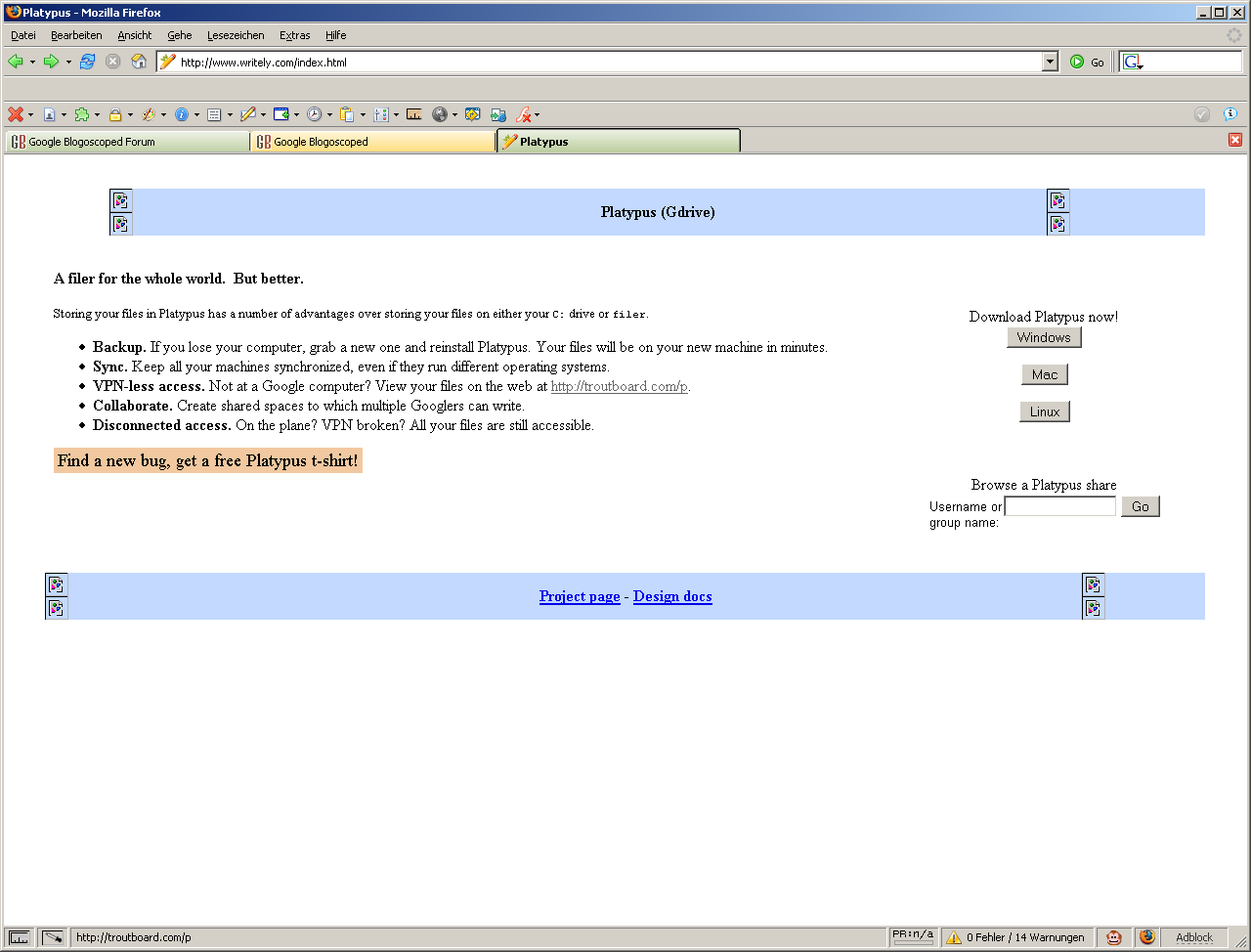 Google's GDrive online file-storage system, rumored since documents about it leaked all over the Web in March, has made an equally unplanned public debut, thanks to a security error at Writely, an online word-processing startup that Google recently acquired. But don't count on scoring unlimited online storage right away. For now, it seems that the system, codenamed "Platypus," is restricted to use by Google employees. The screenshot, first posted on the Geekness blog, mentions access when users are "not at a Google computer" and the ability to "create shared spaces to which multiple Googlers can write." ("Googlers" is the word Google employees use to refer to themselves.) CyberNet Technology News found further details by looking at the page's HTML source code, which suggested that Googlers could also use Platypus for file-sharing. Still, Platypus surely won't stay within Google's corporate firewall forever. Google's popular Gmail, after all, started out as an in-house e-mail system. If Google repeats its practice of testing products internally before rolling them out in a public beta, GDrive may be coming to your hard drive's rescue soon. Mobile phone operators win World Cup
Soccer aside, the fiercest competition at the World Cup this year may well have been between mobile phone operators. And the verdict is in: They all won.
Cup sponsor T-Mobile fought Vodafone to deliver the fastest text message reports from games as well as video coverage. And fans around the world tuned in. Agence France Presse reports this morning, for example, that traffic on Vietnamese cell-phone networks spiked five-fold during the World Cup. The surge came as "tens of millions" of fans "sought football updates or placed bets on matches." In England, SMS messaging hit an all-time high even before the World Cup, notes Cellular-News, with a record 3.3 billion messages delivered in May thanks largely to national and European soccer competitions in the run-up to the Cup. With text messaging one of carriers' most profitable services, the surge in traffic can only mean that chief financial officers across the industry are joining the fans in shouting "Goaaaaal!" Next: The talking iPod
When Apple introduced the iPod Shuffle player without a screen, some declared the device "the new radio." Now an Apple invention really could do away with on-air DJs once and for all. The Scotsman reports that Apple has patented text-to-speech conversion that lets iPods tell listeners the name of the band and track it's about to play. The computer-speech technology keeps listeners from having to glance down at the screen while exercising or driving -- and it could make screenless iPods like the Shuffle even more popular. MacDailyNews notes that Apple's Nike+iPod kit, which integrates iPods into a workout routine, already reads off pace and mileage information. Will this newfangled function give the iPod a boost in the face of increasing competition from challengers like Microsoft?
ABC wants to skip the DVR's fast-forward button
During television's recent upfront sales, ABC tried to get advertisers to pay for ads that DVR users watched on fast-forward, MediaDailyNews reports. That effort flopped, so now ABC sales chief Mike Shaw is trying a new tack: He's trying to get cable companies, which supply most of the DVRs in consumer homes, to ban the fast-forward button altogether. Shaw argues that most DVR viewers use the device so they can watch shows at times of their choosing, not for the fast-forward feature. But Forrester Research found that DVR users skip 92 percent of the ads on recorded programs. Sure, TV networks may need to sell ads to make money. But is ABC really ready to campaign so publicly to kill a popular feature?
NBC to buy struggling social network
The Web has been buzzing that NBC is poised to pay a pittance for Tribe.net, an online social network that has seen its growth stall. The story has been trickling out since early last week when Valleywag reported that NBC had signed a letter of intent to buy the business. NBC isn't spreading its wings to embrace Tribe's small user base -- mostly the crowd of ravers and Burning Man devotees from which the site grew. Rather, the Peacock wants to pluck Tribe's social-networking software to beef up iVillage, the women's site for which it paid $600 million in March. PaidContent.org followed on Thursday suggesting the company might fetch as much as $50 million, but quickly revised that number downward by Friday to "less than $5 million." That sale price is nothing to rave about.
The fire sale suggests how tricky it is to get social networks to "go critical" -- that is, attract enough users that peer pressure starts drawing others in, as happened with MySpace. It also stands as another cautionary tale for old media. In late 2003, when MySpace was not yet a gleam in Rupert Murdoch's eye, Knight Ridder, The Washington Post and venture firm Mayfield Partners put $6.5 million into Tribe in the hopes that it might emerge as a Craigslist competitor in local markets. That hope has now gone up in a puff of funny-smelling smoke. Can NBC make good where its newspaper rivals couldn't? One TechCrunch reader expresses his skepticism in caveman-speak: "...old media desperate. Old media should stick to wheel, leave fire to professionals." eBay not buying Google Checkout
It's yet another sign of the tension between web giants: eBay has decided not to allow its sellers to use Google Checkout, the payment service launched last week by the prolific search engine. Most bloggers see the eBay move as a transparent attempt to protect PayPal, eBay's own payment service. "This is eBay flexing their ... muscles to control the way sellers take credit cards ... if they feel it starts to infringe on the PayPal asset," writes Scot Wingo at eBay Strategies. (The outspoken Wingo, CEO of ChannelAdvisor, a company which helps large companies sell on eBay and which has taken an investment from the e-commerce giant, also points out that it is "ironic they would do this here, and in the same breath go to Congress and fight the Net neutrality battle.")
While eBay's move came without an official explanation, careful eBay observers like AuctionBytes point out that eBay has quietly changed the name of its "Safe Payments Policy" to "Accepted Payments Policy" -- suggesting that safety or reliability was not at issue. All is fair in love and Internet competition, writes Microsoft exec Don Dodge: "Any company can set any rules and policies they want as to how to accept payments and how to issue refunds or credits...or not." But Ars Technica thinks the move may be shortsighted: "At best, eBay comes off looking petty and frightened of potential competition from Google. At worst, the online auction house could lose large customers." Google's "party jet" launches lawsuits
When SiliconBeat reported last year that Google founding duo Larry Page and Sergey Brin had bought a Boeing 767 jet, tongues wagged in the Valley about the seemingly frugal pair's new purchase. At the time, Page defended their purchase, saying that the economics "make a lot of sense," since the jet could carry 50 people at a time more cheaply, per person, than a Gulfstream, and could help the Google founders' charitable efforts in Africa.
But now the truth is coming out: the Google guys' jet is a "party airplane," according to none other than Google CEO Eric Schmidt, a lawsuit over the jet's retrofitting alleges. Aviation designer Leslie Jennings made the claim in a filing amidst a legal dispute with Blue City Holdings, the company which technically owns the 767 and which fired Jennings last October as costs soared on the redesign. Jennings claimed that Page and Brin made odd requests, like hammocks suspended from the ceiling, and fought over the size of the bed in Brin's room, a conflict Schmidt had to referee. All part of a day's work, apparently, for the CEO of the world's biggest search engine -- even though Google has said the company has no connection to the plane. Friendster wins a patent
 The last two years have been rough for early social-networking leader Friendster as it struggled to upgrade its technology, watched upstarts like MySpace zoom past it, and nearly ran out of cash. But yesterday, Red Herring reported that the San Francisco-based company had been awarded a patent covering some parts of online social networking. The patent "would seem to cover the activities of many other sites," writes the Herring, "especially those like LinkedIn that allow people to connect within a certain number of degrees of separation." While the patent history of social networking is anything but simple, dating back to early filings by boom-era companies like Six Degrees, Friendster's new asset may prove useful in the ongoing social networking wars. In theory, Friendster could try to seek licensing fees from rivals, or sue them for patent infringement. Backed by Silicon Valley venture powerhouse Kleiner Perkins, which recently doubled down on its investment, Friendster is not likely to fade gently from the scene. Consider this one more potential headache for Mr. Murdoch's overworked lawyers at MySpace. Suing rivals for patent infringement is no way to make friends -- but it is a way to make money. Nokia can't hold the phone
Noises famous for making phones, so when it came out with a handheld computer, the Nokia 770 tablet, that eyebrows raised in the tech world. But apparently old habits are hard to break: Nokia is turning the tablet into a phone, Techworld reports. An updated version of the 770's operating system includes support for VOIP, allowing users to make calls over the tablet's Wi-Fi connection. It has Google Talk instant-messaging software built in, and will soon add support for the Gizmo Project VOIP software. The Smart Home Blog points out a major downside to the upgrade: For current 770 owners, installing the VOIP upgrade will wipe out all of their current applications. But for new buyers, the 770 could be a smart way to make calls anywhere there's a Wi-Fi connection.
New iPod design patents filed
Apple has filed a series of patents on new iPod designs, AppleInsider reveals. Most notably, the designs avoid the iPod's iconic click-wheel in favor of a series of other interfaces: a 12-key layout similar to cell phones; rectangular scroll "strips" similar to laptop trackpads; a four-way button that looks like some videogame controllers; and most intriguingly, a design with no buttons or touch-sensitive area at all. The latter could be an iPod which uses voice commands -- an invention made possible by an earlier Apple patent. Ready to ditch your iPod Nano already? Apple could have a replacement soon.
Intel, Motorola put up $900 million to save WiMax
The news yesterday that WiMax startup Clearwire dropped plans for an IPO that could have raised $400 million, and instead took a $900 million infusion of capital from Intel and Motorola instead has wireless wags buzzing. WiMax, a wireless technology with a longer range than Wi-Fi, has long drawn critics, and Clearwire, backed by AT&T Wireless founder Craig McCaw, has been something of a lightning rod. The biggest criticism: WiMax uses private radio frequencies that firms must pay to use, unlike Wi-Fi, which uses free, unlicensed radio spectrum.
Techdirt's take is that Intel, which has heavily backed the WiMax standard and hopes to make chips to power WiMax communications gear, put up the money to keep WiMax from looking bad in a dud of an IPO. For Intel's venture-capital arm, which put up $600 million of the total, this is the largest single investment ever. And it follows a pattern set by an earlier Intel investment in which ClearWire agreed to buy WiMax gear from Intel. "In other words, Intel was paying Clearwire to buy its WiMax technology," says Techdirt. Now, Intel's investing in Clearwire to keep it from having to take its chances in an IPO which, if it went poorly, might give both Clearwire and WiMax technology a black eye. Wi-Fi Networking News's Glenn Fleishman has a more charitable take, saying that Intel's large investment guarantees that Clearwire will be able to build out a nationwide WiMax network. At part of the same cash infusion, Motorola has bought Clearwire's NextNet Wireless, which makes the receivers that Clearwire customers install at home to receive high-speed Internet access, and it also invested in Clearwire through its venture-capital arm. Clearly both Intel and Motorola are betting they'll profit from Clearwire as a customer. But as an investment? That remains to be seen. Click fraud: the boring billion dollar problem
Internet advertisers last year spent upwards of $800 million on phony "clicks" according to a study released yesterday by Silicon Valley research outfit Outsell. Among other news outlets, TheGlobeandMail.com summarizes the study today, noting that the nagging problem of click fraud has shaken advertiser confidence in the fast-growing online advertising industry, and prompted many advertisers "to reduce spending with Google Inc., Yahoo Inc. and other websites."
While a satisfyingly quantitative reminder of a nagging problem -- click fraud results when publishers click on their own ads to drive illicit revenues, or when rivals click on each other's ads to increase the cost of advertising -- the Outsell study has mainly generated eye-rolling among Digg users, for whom "click fraud" is a tired issue. "I consider click fraud an inherent risk when paying for advertising," writes one. "Advertisers just need to learn to start budgeting for such things when starting online ad campaigns." Rocketboom crashes as videoblog partners break up
Until last Friday, Rocketboom, a cheery three-minute Web video news broadcast anchored by geek hottie Amanda Congdon, was the poster child for the Next Big Thing: video blogging, or "vlogging", as some lamentably insist on calling it. Programmed by 20-something Congdon and her 35-year-old partner Andrew Baron out of Baron's Manhattan apartment, the vlog became an instant hit online, as well as a conversational reference point for media execs in New York and Los Angeles who have their eyes on the future. Rocketboom had also started to draw interest from advertisers. But there's some old-fashioned trouble in videoblog paradise, as Baron and Congdon have split up in a particularly public, new-media way.
Congdon broke the news of the split yesterday in a plaintive video posting at her new, hastily assembled site, Amanda UnBoomed. Although she claims in the video that Baron was no longer willing to work with her, it seems Baron, who owns 51 percent of the venture to Congdon's 49 percent stake, was taken by surprise by both his partner's abrupt departure, and her video. He has since said so in at least one interview, leaving a gossip-hungry blogosphere to bicker over the assignment of blame. Meanwhile, opportunistic blog-mogul-turned-AOL-exec Jason Calacanis has leapt into the fray, publicly offering Congdon a job at the relaunched Netscape.com while waxing boosterish with some unsolicited "you're a star, you deserve to get paid" advice. On the Rocketboom home page, dark since Friday, Baron generously allows that Congdon will be missed "sorely," but adds "Rocketboom goes on." No doubt. And so too will the rise and fall of Web video celebrity, just as it always has in every other media. Sony PSP ads spark cries of racism
 A new Sony outdoor advertising campaign in the Netherlands for its PSP handheld gaming device has drawn accusations of racism from online critics. The giant billboards show a very tough looking white woman, dressed in white, gripping a black woman, dressed in black, by the jaw with the slogan: "PlayStation Portable White is coming." The PSP Updates blog describes the ad as "horrifically ill-advised," and notes that it comes hard on the heels of similarly tasteless campaigns in the U.S. and Italy. While Sony pulled some of its Italian ads, the company appears to be defending its White vs. Black campaign: "A variety of different treatments have been created as a campaign to either highlight the whiteness of the new model or contrast the black and the white models," a Sony spokesperson told Gamesindustry.biz. "Central to this campaign has been the creation of some stunningly photographed imagery, that has been used on large billboards throughout Holland." "Stunning" does sum it up, don't you think? Apple MacBook shipments soar
Taiwan is the epicenter for the contract manufacturers who actually make the laptops sold by Apple, Hewlett-Packard, and others -- and that makes it the place to go for the latest scuttlebutt on sales data. According to DigiTimes, a local technology publication, shipments of Apple's new MacBook laptop have jumped 20 percent month-over-month, and overall sales of both MacBooks and MacBook Pro laptops are expected to jump to 3 million units in 2006, a 39 percent increase over last year. Apparently, reports of problems with discolored cases on some MacBooks haven't slowed sales, as Apple quickly moved to replace the plastic it used with a more stain-resistant material. At the Apple Core blog, Jason O'Grady says he's not surprised by the MacBook's brisk sales: "Pound-for-pound the MacBook probably has the best-price performance ratio of any Mac ever released." Could the MacBook be cheap and powerful enough to boost Apple's market share?
Microsoft campus gets crowded
Microsoft is spending $1 billion to expand its headquarters campus in Redmond, Wash., the New York Times reports. What the Times doesn't mention is that Microsoft is stuck footing such a big bill thanks in part to a short-sighted decision in 2004 not to build out a second campus in nearby Issaquah, Wash. Microsoft had an option to buy nearly 90 acres of land on the opposite end of Lake Sammamish from Redmond, but decided to forgo that route. Now, it's paying through the nose to acquire more real estate around its home campus -- as well as drawing bad feelings from neighbors in Redmond who blame Microsoft for burgeoning traffic problems.
Paris, city of lovers, goes Wi-Fi
Paris, beacon of municipal planners for centuries -- and capital of the country that gave us the Minitel -- has announced the mother of all Wi-Fi plans. Mayor Bertrand Delanoe has vowed to make Paris the most connected major city in the world by the end of 2007, reports Reuters. Delanoe, the most recent of a long line of Parisian chieftains that stretches back -- in complicated ways -- to the 13th century, intends to set up 400 Wi-Fi access points to blanket the city with free wireless. No longer, then, will would-be Hemingways toil with wine-stained Moleskine notebooks along the banks of the Seine. Non. They will now flip open wireless laptops and email their lovers that there is nothing quite like Wi-Fi in the springtime.
Some, however, take a less romantic view of this development. Canadian blogger Mark Evans wonders why Parisians should get free Wi-Fi, while rural Frenchmen still languish on dial-up connections. Perhaps it isn't fair for urban dwellers to get such a surfeit of high-speed Internet access. Besides, do we really want to stay glued to our laptops when the Parisian streetscape beckons? Still trying to unwire the Valley
You'd think Silicon Valley would be bathing in Wi-Fi at this point. But aside from Google's Mountain View network and MetroFi's coverage areas in Cupertino, Santa Clara, and Sunnyvale, all that the denizens of tech's epicenter can get for the most part is the odd coffee-shop hotspot here or there.
That's why Wireless Silicon Valley, a government and industry consortium, is taking bids to build out a 1,500-square-mile Wi-Fi network covering a broad swath of the suburbs and office parks that sprawl between San Francisco and San Jose. The San Jose Mercury News reported that seven bidders submitted proposals on Friday. MetroFi was among those who threw their hats in the ring, but curiously, the 21talk blog notes, Google and EarthLink, which partnered on a winning bid to build a Wi-Fi network in San Francisco, stayed out of the bidding this time. Perhaps Google, which recently discovered that it will have to install more pricey access points to provide adequate coverage in Mountain View, is losing its appetite for expensive Wi-Fi projects. Gawker Media reorgs blog empire
It's the kind of corporate move that Gawker, the popular New York media-and-celebrities blog, would ruthlessly chronicle: An up-and-coming new-media company closes some properties and shuffles its staff. Except that the up-and-comer in question is blog publisher Gawker Media itself. Former Financial Times journalist turned Internet entrepreneur Nick Denton, who started Gawker in 2002, explained the move on his weblog. He's putting Sploid, a tabloid-news blog, and Screenhead, a collection of Internet video clips, up for sale -- or closing them if a buyer doesn't materialize. He has also fired an editor at flagship blog Gawker and reshuffled his staff of bloggers.
Has Denton turned bearish on blogging? Sploid, one of the titles due to be sold or closed, posted an item about double-digit traffic declines at popular blogs. But Denton himself says he's just preparing for a possible downturn: "Advertising is a fickle thing. Particularly the entertainment advertising upon which so many websites depend." And Gawker Media is planning to launch a music blog, according to a leaked email from managing editor Lockhart Steele. Nintendo to launch November 6
Nintendo, which is bravely continuing to fight a videogame-console war against both Microsoft and Sony, still has a hardcore group of fans who watch its every move and are hotly anticipating the new Nintendo Wii. So when Sports Illustrated for Kids (owned, like CNNMoney.com, by Time Warner) printed a firm launch date of November 6, the fans went wild. Gaming news site Cubed3 had previously reported the same launch date, and tales of a drunken Nintendo sales rep who let word slip of an early-November U.S. debut had circulated around the Net, but seeing the date in print struck many as more convincing. A November 6 launch for the Wii would let Nintendo steal some of Sony's thunder, since Sony's new PlayStation 3 console is scheduled to launch 11 days later.
Netscape relaunch continues to draw backlash
First, a beta test of the "new Netscape" got panned by the digerati. Now, the harsh reviews are coming from longtime users of the site, says the Read/WriteWeb blog.
Last Thursday, after Netscape replaced its familiar news-weather-and-horoscopes homepage with a Digg-like site featuring user-selected headlines, fans of the old Netscape immediately began using the site's new interactive features to complain about the change and even to promote an online petition to bring the old Netscape portal back. Cleverest of all, a Netscape user found that a version of the old homepage is still available at isp.netscape.com. To Netscape's credit, Valleywag notes, the team of anchors overseeing the new Netscape site kept the negative headlines up and let the critics have their say. 
CNNMoney.com Comment Policy: CNNMoney.com encourages you to add a comment to this discussion. You may not post any unlawful, threatening, libelous, defamatory, obscene, pornographic or other material that would violate the law. Please note that CNNMoney.com makes reasonable efforts to review all comments prior to posting and CNNMoney.com may edit comments for clarity or to keep out questionable or off-topic material. All comments should be relevant to the post and remain respectful of other authors and commenters. By submitting your comment, you hereby give CNNMoney.com the right, but not the obligation, to post, air, edit, exhibit, telecast, cablecast, webcast, re-use, publish, reproduce, use, license, print, distribute or otherwise use your comment(s) and accompanying personal identifying information via all forms of media now known or hereafter devised, worldwide, in perpetuity. CNNMoney.com Privacy Statement.
|
|


 |
| 
