
Wilson, Clinton honored with 2007 TED Prizes
We've always been a big fan of E.O. Wilson, the Harvard biologist who gave the world The Ants, the Pulitzer Prize-winning tale of what goes on inside those hills. Wilson's just added to his own mountain of awards: He's won one of three 2007 TED Prizes, a kind of mini-Nobel for the Silicon Valley set. The winners were announced this week at a ceremony hosted by TED founder Chris Anderson. Also recognized were former President Bill Clinton and photojournalist James Nachtwey - they'll all collect $100,000 plus a "pledge of support" from the "TED community."
This is all good stuff, of course. Over at the Conferenza blog, though, Gary Bolles reasonably wonders whether honoring Clinton (and, really, Wilson too) might be akin to taking coal to Newcastle. This being the blogosphere, Anderson himself has logged on to reply that it's not about what TED can do for the prize-winners, but rather "which individuals can best inspire the TED community to make a difference in the world." Hmm, we're siding with Bolles on this one. Internet Explorer's new security trouble
Is Microsoft's new browser, Internet Explorer 7, more or less vulnerable to attacks? Shortly after IE 7's release, security research firm Secunia charged Microsoft with, among other things, failing to fix a security hole in IE 6 that made it possible for hackers to do evil using pop-up browser windows. Microsoft disputes some of Secunia's claims, but says it's investigating Secunia's report that hackers can put deceptive website addresses in pop-up windows - something that might facilitate phishing, or attempts to trick users into giving away their passwords by imitating popular banking or e-commerce websites.
Does that leave you rattled about using IE 7? TechRepublic has the cure: A list of 10 ways IE 7 is more secure. Our favorite one is one-click removal of all personal information, from cookies to cached webpages. TiVo's new DVR and the age-old question: Can the company survive?
TiVo is beloved by users for its thoughtfully designed digital video recorder. But in the gadget press, it's more beloved for its Perils-of-Pauline drama. Can TiVo survive in the face of el-cheapo DVR boxes that cable and satellite rent to subscribers for a low monthly fee? In the glass-half-full camp is ZDNet, which approvingly quotes analysts saying that TiVo's deals with pay-TV companies like Comcast and Cox will keep it alive. In the glass-half-empty camp is Gizmodo, which says that TiVo's new Series 3 DVR is way overpriced at $799, and doesn't deliver much more than the high-definition recorders cable companies already offer.
The most serious charge: TiVo is messing with perfection by rearranging the buttons on its vaunted remote control. Longtime TiVo fans are giving a thumbs-down to a change that makes the channel and volume controls less convenient. It hardly seems as serious as, say, losing millions of future DirecTV subscribers, but alienating hardcore TiVoids who are willing to shell out $799 for a DVR hardly seems like a smart move. Spot Runner to bring pre-fab TV ads to the Web
What if you could buy a 30-second spot on TV and then schedule it to run on local television around the country - all via a Web browser and in less than half an hour? That's more or less the premise of Spot Runner, a Los Angeles-based startup which just picked up $40 million from savvy investors like Allen & Co and Lachlan Murdoch and a slew of big advertising shops, among them CBS, Interpublic Group, and WPP.
CEO Nick Grouf gave The Browser a tour of Spot Runner this past summer, and we were impressed. The company's service allows users to choose from various pre-fab templates to create their video ads (think wizards, as in MS Word or Powerpoint) - and then connects them to the scheduling systems of broadcasters across the country. At the time it seemed smart, but strangely retro given the focus on conventional local TV as opposed to the Internet. GigaOm reports, however, that the company plans to "use the new investment to bring its ads to online video, video on demand, and IPTV." That approach makes a lot of sense. Way back when, in 1995, Grouf co-founded a company called Firefly who's neato concept of an Internet "passport" was picked up by Microsoft and became a key element of the Redmond giant's lumbering .NET initiative. Clearly, Grouf is no stranger to the trials of platform development. You thought MySpace pages were tiresome, get ready for 30-second video personals to start appearing on a channel near you. Behind the scenes of the Goog-Tube deal
Leave it to Mark Cuban to find more meat on the well-picked bones of the Google-YouTube story. The maverick boss of the Dallas Mavericks has cut-and-pasted to his blog a nitty gritty post-mortem of the deal that originally appeared on something called the Pho List (an insider listserv for new media pundits that you can't get to from here). The post was penned by an anonymous "veteran digital media executive."
The recount purports to tell the inside story of the YouTube-Google talks, in which $500 million of the $1.65 billion stock purchase was supposedly set aside to fend off lawsuits from media companies upset over copyrighted videos appearing on YouTube. This modern-day Deep Throat goes on to claim that, with the promise of future Google equity, YouTube was able to buy legal peace from the major labels before the Big Deal was announced. But are any of these juicy tidbits true? Don Dodge, erstwhile senior exec at Napster, offers his assessment. Financial blogger Nick Carr starts by pronouncing the post "fantasy," but then takes a closer look at another claim made by the anonymous media exec: that the labels, in striking an equity-sharing deal with YouTube in return for calling a truce, effectively cut off their artists from sharing any of the deal's proceeds. Says Carr: "All I can say is that if I was one of those musicians I'd be asking somebody some questions." Brightcove wants Internet video to grow up
Brightcove might finally be living up to its potential. The video-on-the-Web player long deemed a YouTube also-ran, CNET reports, has released tools that "make it easier for video producers and Web sites to insert ads into their Internet videos, syndicate their content and sell clips."
Think of Brightcove as a sort of Internet-centric cable TV company. That's how CEO Jeremy Allaire, onetime Chief Technology Officer of Macromedia, explained the business to The Browser last summer: "We have from our inception focused on enabling content producers and programmers to launch broadband programming businesses, what we describe as Internet TV." So instead of individuals sharing videos, they help people create and distribute "channels," just like on TV, with ads. In exchange - either for syndicating shows or selling them via downloads - Brightcove gets a fee. That Brightcove also has a nicely designed video-sharing site is beside the point. The company's vision is to be a "platform," and they're very prudish about copyright violations. With former senior execs from News Corp, Comcast, Lycos, Disney, and the Discovery channel on board, we're tempted to think of the company as an adult version of YouTube. It's also tempting to assume that YouTube - which never bothered to talk in terms of ad insertions and programming tools - was superficial in its approach, and likely overvalued by Google. But then again, when was the last time a pack of "senior industry execs" ever pulled off a game-changing startup? Ego, preconceived notions, and children often seem to get in the way. We can't wait to see how Brightcove grows up. Adobe Flash + PDF = $100 million for startups
Want to know how Adobe's capitalizing on last year's acquisition of Macromedia, the maker of Flash? It's cooking up a PDF reader that uses Flash, Read/WriteWeb reports. That's a clever way for the desktop-publishing giant to capitalize on Flash's ubiquity. While Adobe's PDF format is widespread, it hardly matches Flash's reach on the Internet - some 700 million PCs and cell phones, by Adobe's estimates. That explains why Adobe CEO Bruce Chizen is talking up Flash these days.
Flash technology is just a stopgap for Adobe's next big thing - Apollo, a converged reader that combines Flash and PDF into a single technology for displaying all kinds of Web documents. Apollo has yet to hit the streets, but GigaOm reports that Adobe has set aside $100 million to bankroll startups that adopt the technology. That's a lot of dough for a technology that's still not quite baked. 'Tis the season: The deluge of online shopping sites begins
Just in time for the holiday shopping splurge: an excess of new websites to help buyers score the latest deals. BugMeNot, the popular site that lets Web surfers bypass registration forms by offering logins and passwords supplied by other users, is launching RetailMeNot, a site which lists coupon codes for popular e-commerce destinations. And then there's Glimpse, a soon-to-launch shopping portal which carries news about sales, deals, and in-store events at Macy's, Sur La Table and other retailers.
What's behind these sites? The gradual breakdown of e-mail marketing. As fast as offers flood into inboxes, users are hitting the 'delete' button: Only 1 percent of e-mail marketing actually generates a sale these days. But newcomers like RetailMeNot are entering a crowded field, Digg users are quick to point out. FatWallet, DealCoupon, and other sites have long carried online coupon codes, and currently have vastly more listings than RetailMeNot. RetailMeNot does have BugMeNot's user-friendly reputation behind it, and Glimpse seems more elegant than most sites. (Users may recognize Glimpse as the former domain name of a defunct gay dating service.) Does elegance or ease-of-use matter? In The Browser's experience, Googling the name of a store and the words "coupon code" reliably knocks a few dollars off the bill, but the website that helped close the deal never gets bookmarked. Both of these websites are going to have a hard tough time becoming one-stop shops. The Browser's first New Year's prediction: Come 2007, these sites will be more fizzle than sizzle. What do you think? A Vista revolt begins?
Well, well: The Browser isn't the only one who's asking hard questions about Vista two months before it's available to consumers. PC Pro reports that an executive at Acer is saying Microsoft's cheapest version of Vista, Vista Home Basic, doesn't bring anything new to the table. "The new [Vista] experience you hear of, if you get Basic, you won't feel it at all," Jim Wong told the UK-based PC trade publication. That means customers will be paying for a system that's not a substantive upgrade over Windows XP at all. But what's really galling, according to Wong, is that Microsoft is increasing by 10 percent the wholesale license fees it charges PC makers for Vista Home Basic, which will cut into PC makers' already razor-thin margins. (Analysts estimate the average wholesale price of Windows at $70.)
But do PC makers have any choice? They could continue to sell Windows XP, of course, since Microsoft has yet to discontinue that product: It will still be available for a year, according to Microsoft policy. But PC makers will be hard-pressed to sell XP systems when competitors have Vista systems next to them on shelves. Looks like the PC crowd is out of luck. To PC-industry executives like Wong, Linux must be looking better and better every day. Google's Blogger: Always bogged down
How does The Browser blog its way to you every morning? Believe it or not, it's through one of the simplest and easiest blogging programs - Google's Blogger. But despite Google's reputation for rock-solid, always-available Web apps, for months Blogger's been up and down like a ... well, insert your own unseemly metaphor here, folks. InfoWorld is the latest to take a look at Blogger's woes. It turns out that Blogger never moved off of its old infrastructure after Google acquired the service in 2003, and that lack of investment is now becoming increasingly evident in nonstop random outages.
The (unofficial) Google Operating System blog documents the copious apologies posted on the official Blogger Buzz blog. There's a light at the end of the tunnel, writes Google's Pete Hopkins: A new version of Blogger, still being rolled out in beta, will fix these outages for good. Still, we have to ask: Wouldn't it have been a good idea to patch up the old version before spending time on a new version? Amazon.com gets tagged by activists
When Amazon.com added tags to its site a year ago, it was an innovative move to embrace a trend that, until then, had been relegated to cutting-edge sites like del.icio.us or Flickr. With arguably the largest collection of product reviews online, Amazon wanted to give their prolific reviewers a fresh new tool to organize their content. Plays by Shakespeare could be tagged "drama" and dishwashers could be tagged "appliance."
The company probably didn't anticipate that the tags would be coopted by activists, but that's what happened in recent days. The anti-DRM group, Defective By Design, has launched a campaign to tag "defectivebydesign" all of the items sold on Amazon.com that have anti-piracy protections it deems unacceptable. As Boing Boing notes, it's a small campaign: "So far a few dozen Amazon users have tagged over 150 products containing DRM (Blu-ray, HD DVD, FairPlay, and more)..." but it's easy to see how the strategy could catch on with other groups championing other causes like safety, decency, price.... Social media is always full of surprises, but The Browser wonders if this sort of co-opting is appropriate or not. What do you think? Will it help or hinder Amazon sales? A good argument can be made that the activist tags add information for the shopper, and a quick look at some of the tags on Amazon's page for the Microsoft Zune shows that customers aren't shy about using tags to express other opinions. Take a look at garbage, and overhyped, and beats apple. Call us true believers, but The Browser concludes that this sort of unruly passion can only be good for Amazon. Blog wars: Six Apart vs. MySpace
 Welcome to Web 2.5. Software maker Six Apart has just unveiled a new member of the fast-converging worlds of blogging, social networking, and photo/video sharing: Vox, a website that's a slick descendent of GeoCities and makes MySpace seem so yesterday. Mashable enthuses: "Vox is a simple blogging platform and social network that's designed for non-technical people and families." And The Blog Herald gushes: "If one were to remove the ugliness from MySpace, add in the simplicity of Google as well as the rich features of Yahoo!, you would end up with Six Apart's new kid on the block, Vox." Those sort of comments must unnerve Fox Interactive boss Ross Levinsohn. And if not those, then perhaps this one from a Lifehacker reader: "Bye bye myspace. This is really good." What do you think? Is it time to declare Rupert Murdoch's investment a bust? Six Apart is another one of these small tech innovators with multiple balls in the air, and that's cause for concern about longevity. "The only question is whether Six Apart needed to roll out a whole new site," wonders Mashable, "or whether they could have integrated this impressive functionality into existing services like TypePad, their hosted blogging service...Vox is an amazing service, but it’s just not clear whether Six Apart has a grand plan here." Product line confusion is rampant in the new media space, where fast iteration is critical to survival. The $580 million question, of course, is whether the first wave Web 2.0 giants are quite as sticky as their current valuations suggest - or whether the Web 2.5 gang, led by Vox, will simply steal their members away. Stop me before I start-up again!
Hey kids! Want to start a company? Why not two, or three, or eleventy hundred?
Forget focusing on one thing for years and working hard to make it successful. That's so old media. Nowadays, if you're not working on at least two startups, you're just out of it. Take Digg cofounder Kevin Rose: He's also got Revision3, an online-video startup. The San Jose Mercury News recently examined the conflicts Rose faces in running multiple startups. And then there's Evan Williams, the creator of Blogger, who's using the money he got when Google bought his first company to buy back Odeo, his second company, from his venture-capital investors. Williams himself admits he screwed up Odeo, and recently, his attention has wandered to Twitter, an Odeo spinoff. Now he's creating Obvious Corp. as an umbrella for Odeo, Twitter, and other projects, arguing that the Internet business is increasingly hits-driven, so it makes sense to have multiple projects going at once. We can see that argument for financiers, who need to spread their risk. And if the Internet business is hits-driven, maybe the new model is Hollywood, where studios back multiple projects at once. But you don't usually see directors and stars filming multiple movies simultaneously. You get one movie in the can, and then you move on to the next one. Williams, of course, is using his own money to back his multiple-startups theory, and says he's just in it to have fun. Well, all right then. But we'd point out to would-be imitators that if your goal is to have fun on the job, don't count on getting other people's money to do it. Dell's viral video makes viewers sick to stomachs
Ready for a trip from Proprietaryville to Global Standardopolis? We didn't think so. But Dell wants to take you there anyway, with a video on YouTube posted by DellVlog, the official Dell videoblog (click to play):
Leave aside the faulty premise - that customers are "trapped" by single-vendor Unix solutions and are desperate to get led to the land of Linux. (The Browser knows plenty of happy Unix customers who like the systems they have because they're stable and familiar to their technical staff.) What's really sickened viewers is the blatant ripoff of JibJab, the popular online cartoon creators behind "This Land." "Someone in Dell marketing is going to get fired, because if this was meant to be viral I want a vaccine," writes Valleywag. Guardian Unlimited calls it "a trip into cartoon hell." But Gizmodo makes the most trenchant comment, asking "who this ad is actually for" - consumers, or big businesses? If it's the latter, Dell's using the wrong vehicle to spread its message. DellVlog, try again after someone launches Fortune500Tube. DVD Jon hacks Apple - and pushes Banana Bread
With just a bit of code, Norwegian Jon Lech Johansen, a.k.a. DVD Jon, has done what the French parliament was unable to do, despite all their Gaullist sound and fury: he has broken the three-year old locks that tie Apple's iPod exclusively to iTunes, and vice versa. The story has hit the wires this morning, though Fortune's Robert Levine laid out the deep background earlier in the week. In a nutshell, Johansen, who became famous in 1999 for breaking the security around DVDs, has launched a company called DoubleTwist that hopes to license his latest hack, which sidesteps Apple's Fairplay rights management system. "I don't like closed systems," he says. Fair enough, but Levine gets at the fascinating point:
There's an obvious question: Isn't opening the iTunes system illegal? There is no obvious answer. FairPlay is not patented, most likely because the encryption algorithms it uses are in the public domain. (Apple would not comment for this story.) And Johansen says he is abiding by the letter of the law - if not, perhaps, its spirit.Expect to hear more from the Apple suits. Meanwhile, the news has revitalized the ongoing digital rights management (DRM) debate on Slashdot, a boisterous conversation that includes the usual entertaining diatribes, and even some exhortations to political action, as in: No, DRM isn't evil, but it does subvert the intent of the law (to provide new works to the public) and replace it with the capitalistic, lucrecratic belief that profit is the only ends we work towards....That said, yes, the best bet is to change (or clarify) the law...Sitting in the basement burning tracks doesn't help! Get out there; vote; talk to politicians and your voting friends and family. If you don't, the law will be written by the corporations, and they do not have your best interests at heart.The most charming tidbit in all this? Johansen maintains his own outpost on the web, a blog appropriately named So Sue Me, to which he posts ... recipes for baked goods. Perhaps Steve Jobs is looking for a recipe for Banana Walnut Bread? It doesn't get any better than this. Are RSS newsreaders stealing content?
Almost all blogs and websites are offering RSS feeds - stripped-down, article-by-article streams of content that people subscribe to using specialized software called a newsreader. There are even Web-based newsreaders, like Bloglines and Newsgator, which let people read those articles on a Web page. Wait a second - isn't that what we used to call a website?
Exactly. And that's why there's a massive food fight brewing over who gets to sell advertising on those pages. Publishers already place ads in their RSS feeds. But the tricky part comes when Web-based newsreaders start selling their own ads on those Web pages where they republish those feeds. Weblogs Inc. cofounder Jason Calacanis says that's stealing, and called out Newsgator for putting ads on his feeds without permission. Newsgator quickly backed down and took the ads off, saying they went up by accident. But Calacanis wasn't satisfied. Why, he asked, aren't Web-based newsreader companies striking commercial deals with publishers to sell and split ad revenue? Good question. How do you feel about ads in RSS feeds? Leave a comment below. Rocketboom's traffic claims spark blog spat
Remember Rocketboom, the videoblog that gained renown for either firing host Amanda Congdon or having her quit the show, depending on whose story you believe? After replacing Congdon with new host, Rocketboom producer Andrew Baron has courted controversy anew.
Now rival videoblogger Ze Frank is claiming that Rocketboom's traffic stats are inflated. Baron responded that Rocketboom had 10 times as much traffic as Rocketboom, and said he had the server logs to prove it. Of course, Frank may have just been engaging in his usual brand of satire, but he raises a good question about the validity of videoblog traffic counts. Many subscription services automatically fetch copies of the latest episode, but there's no guarantee that anyone's actually clicking "Play." Should that count? Leave a comment and let us know what you think. Yahoo Bookmarks + del.icio.us = confusion
Yahoo has upgraded its bookmarking service - and it's not del.icio.us, the Web 2.0 poster child that the Internet portal swallowed last year. Yahoo Bookmarks, a venerable old feature of the Yahoo toolbar, got the makeover instead. Who says Google is the only Internet giant to embrace chaos and let 1,000 flowers bloom?
The good news for Yahoo is that the early reviews are positive. LifeHacker pronounces itself "very pleased" with the new tool, while the Search Engine Journal says Bookmarks goes beyond most bookmarking tools, integrating seamlessly with Yahoo web search and allowing users to save thumbnail images. But Yahoo's attempt to cleanly delineate the two products would seem a bit disingenuous. "The all new Yahoo! Bookmarks will focus on personal saving, organization, and recovery while our comrades at del.icio.us will concentrate on meeting your social bookmarking and sharing needs," writes the Yahoo Search Blog. That may sound good, but it's not entirely clear that users will get the point. Or even other Yahoo execs. The Browser recalls del.icio.us founder Josh Schachter noting recently that the power of his service is that it relies on users' self-interest, i.e. their desire to manage their own bookmarks. Ah, well. Meanwhile, the integration of visual bookmarking by an Internet biggie isn't great news for a cabal of upstart visual bookmarking services led by pioneer Wists. Yahoo's move is likely to push them even further into "social shopping," and away from general utility bookmarking. Is Digg in play? News Corp. sniffs around
 $5 million or $150 million? That's the question the blogosphere woke up to this morning. TechCrunch reports that Digg, the red-hot social news site, is either looking to sell itself for $150 million-plus, or will land a $5 million round of financing led by Greylock Partners. Rupert Murdoch's reportedly sniffing around, but Digg's sale price is a turnoff. The big unknown? Traffic numbers. Digg claims 20 million unique visitors, but ComScore says it's closer to 1 million. $5 million or $150 million? That's the question the blogosphere woke up to this morning. TechCrunch reports that Digg, the red-hot social news site, is either looking to sell itself for $150 million-plus, or will land a $5 million round of financing led by Greylock Partners. Rupert Murdoch's reportedly sniffing around, but Digg's sale price is a turnoff. The big unknown? Traffic numbers. Digg claims 20 million unique visitors, but ComScore says it's closer to 1 million.Ahh, where would Web 2.0 be without the juicy fisticuffs over traffic estimates and company valuations. Michael Arrington of TechCrunch calls Comscore "notoriously flaky," and argues that its number is "almost certainly significantly under-reporting Digg traffic." Of course, Digg users are up in arm, arguing that $150 million short-changes the site. "That number seems so low compared to Facebook's 1 billion dollar request doesn't it?" asks one, while many others simply get worked up over the hypothetical prospect of Fox censoring the site. "Keep Digg real," pleads another Digger. Meanwhile, Search Engine Journal anoints Google - which recently struck a deal with News Corp. to supply ads to MySpace - is the better company to buy Digg: "If Fox Interactive were to acquire Digg and somehow spin it into a MySpace partnered news site (no, not Fox News) which is monetized in part by Google AdSense…wouldn't it make much more sense for Google to acquire the company, bring Kevin Rose [Digg's founder] into Google… and have Digg and YouTube sit right across from each other in some really groovy Google 2.0 IncubatorPlex?" Did you follow that? OK, just to reiterate: no money has actually changed hands - yet. Apple can't stop loose lips
You've got to hand it to Jason O'Grady: He nailed a prediction this morning that Apple would upgrade its MacBook Pro laptop line to Intel's latest Core 2 Duo chips. Sure enough, the official announcement came shortly afterward.
While it's not an earthshaking surprise that Apple would keep upgrading its hardware with the latest chips available, it seems that ever since Apple switched to Intel chips, rumors about its hardware releases are on the rise. We have to wonder: Is this because partner Intel is a leaky boat? Or is it simply that because Intel releases chips on a set schedule, it's not hard to predict when Apple will get in line? (With IBM and Freescale, Apple's former chip suppliers, Apple was their lone consumer-PC customer, so it was a lot harder to guess when new chips would be ready.) Whatever the reason, it's worth noting that industry whispers about the famously tight-lipped Mac maker seem to be coming true faster than ever. President Bush's "the Google" gaffe
In every election season, politicians start dropping Internet references in the hopes of demonstrating their techno cred - and the Internet crowd inevitably groans.
Here's the latest gaffe: President George Bush's reference to "the Google" - yes, complete with definite article - as a search engine he uses to pull up maps. We at The Browser aren't sure if this is good or bad for Google: Will the cool kids start calling the world's favorite search engine "the Google". Will Democrats start avoiding Google Maps? All we know is that this phenomenon is almost as old as the World Wide Web. Remember 10 years ago, when then-presidential candidate Bob Dole flubbed his website address on national TV? It's hard to forget. Jingle gets $30M, and the 411 on free directory assistance
 The tech blogs are chattering about the infusion of another $30 million into Silicon Valley startup Jingle, which provides free directory assistance through 1-800-Free411. TechCrunch reports that the latest round brings Jingle's total funding to $60 million, giving the company a valuation north of $150 million. The tech blogs are chattering about the infusion of another $30 million into Silicon Valley startup Jingle, which provides free directory assistance through 1-800-Free411. TechCrunch reports that the latest round brings Jingle's total funding to $60 million, giving the company a valuation north of $150 million.The Browser thinks they're worth every penny. We HATE paying $1.25 for lame directory assistance, and we'd happily sit through a 15-second ad for 1-800-Flowers.com to get help gratis - which is how Jingle proposes to turn all that free assistance into cash money. But don't take our word for it: Talk to Goldman Sachs or the Hearst Corporation, both of which helped finance the latest round. Or talk to George Garrick, Jingle's CEO. That's what Matt Marshall at VentureBeat did, and he learned that the service is now handling over 450,000 requests a day - the "tipping point" in terms of growth. Hence the need for serious development money, says Garrick, who also told Marshall that Jingle is on track to bring in $1 million to $5 million in revenues this year, and "ten times that" next year. That's quite a revenue spread given we're in the home stretch of 2006 - and given the debate about whether 15-second spots will pay for all the computer bandwidth that Jingle's going to need. What's more, the smarties at TechCrunch predict that Google will get into this space. (Screenwerk does them one better with an "an informal test" that compares Jingle to a hypothetical speech-enabled mobile search service from Google.) The Browser's response? We're going with our gut: One dollar is far too much to pay for a telephone number in the Google era. We sure wouldn't want to be earning our living off conventional 411 right now. Tech's $100 billion waste
Gartner, the market research firm, made quite a splash today when it estimated that IT managers will overspend by $100 billion on technology over the next five years. Gartner recommends instead that customers buy boring stuff like "WAN optimization tools," whatever those are.
At the All Nortel All the Time blog, Mark Evans points out that this can't be good news for telecom-equipment vendors. We at the Browser couldn't agree more. $100 billion? Is that all? How on earth is the Fortune 500 going to provide its employees with delay-free YouTube viewing with anything less? Ill-conceived spending by muddle-headed managers on needless equipment has long been the fuel of the tech economy, after all. Why not throw another log on the fire? What could be more American, after all, than buying something you don't need? This coming spending spree makes the $5 billion that Google, Yahoo, Microsoft et al. are shelling out to beef up their Internet data centers seem like spare change. Bring it on, whether we need it or not! The real reason why IBM is suing Amazon.com
So IBM is suing Amazon.com over five patents which Big Blue claims the online retailer is violating. You'd think that IBM would try to cultivate Amazon as a hardware customer rather than sue it. But IBM takes the business of intellectual property pretty seriously, since it earns more than $1 billion a year from patent licensing. That might seem like reason enough to risk the bad press of suing Amazon, which has a number of hardcore fans among its shoppers.
At Bloggingstocks.com, Brian White has another take. Amazon.com, White explains, could be the next IBM with its plans to rent out server space and computing power. That's an emerging business for IBM, too, and the distraction and expense of a patent lawsuit could prevent Amazon from pouring more resources into this field. But The Browser thinks there's more to this than just chasing lucre or hurting a new rival. Could IBM be aiming for a settlement that involves cross-licensing some of Amazon.com's vaunted e-commerce patents, like its famed one-click-shopping routine? There's one patent in particular on which IBM might have its eyes: A method for buying and selling Web services in a marketplace. IBM's been hyping "service-oriented architecture" for years - a vision of programming where people write "Web services" to connect software programs over the Internet. No doubt IBM sees itself as a better middleman to run a bazaar of Web services for its consulting clients. In that light, suing Amazon over other patents could be a smart way to get access to an even more valuable patent. What do you think are IBM's motives for suing Amazon? A voracious Oracle devours VoIP, IPTV player
Oracle has made a $219.2 million cash offer to buy MetaSolv, a telecom infrastructure player that specializes in hot technologies like VoIP and IPTV. The announcement comes just as the database giant kicks off its week-long OpenWorld conference at San Francisco's Moscone Center. And President Charles Phillips took advantage of the public forum on Sunday to defend the company's acquisition strategy, telling attendees that the company remains committed to growth by acquisition. "We get proven R&D [research and development] which supplements what we've already invested in," he said. "We also get industry experts with decades of experience - a phenomenal asset for us."
Well, they certainly get growth. InfoWorld reports that MetaSolv is Oracle's 20th acquisition in the past two years. And if the ROI on Larry Ellison's liberal spending remains uncertain for Oracle shareholders, it certainly seems to be good for San Francisco. The Chronicle notes that OpenWorld has gotten so big that it has shut down traffic on Howard Street, and "is expected to generate $60 million in revenue for the city's economy in the form of spending on hotels, restaurants, shops and tourist attractions." AOL boss: Time Warner spin-off is 'possible'
Here we go again. Rumors that Time Warner will unload its troubled AOL unit reignited Sunday when AOL honcho Jonathan Miller intimated that a split from Time Warner is up for consideration: "It's possible, going forward. It's not a discussion that Time Warner has a problem with understanding or engaging in," he told The Sunday Telegraph. Miller was in London, wrapping up the $2 billion sale of AOL's European Internet access businesses - in keeping with AOL's head-first dive into the business of free, ad-supported content.
An AOL spokesman immediately threw water on the "de-merger" flames, telling Bloomberg that Time Warner has no immediate plans to sell AOL. Still, the rumor was off and running, and Slashdotters had a field day contemplating the prospect of the split and an indie AOL. Perhaps the best snipe spoofed AOL's notorious hard-sell tactics on those who would cancel their service: AOL: Hi this is AOL, how can we help you?And on it went. The grief must be particularly bitter for those very same tele-sales operators, 1,300 of whom were sacked last week as AOL closed down call centers in Arizona and New Mexico. Ouch. Transition is tough. Rock band Keane releases single on USB fob
Think digital downloads are the end of CDs? Try USB flash-memory fobs you can plug into your computer and play. Keane has released a new single in the U.K. on a flash fob, the BBC reports, for 4 pounds (about $7.50). Instead of clicking through an online store and waiting for the song to download, fans can just buy the single at a store, plug the fob into a PC's USB port, and listen away.
Keane's not the first band to do this - Barenaked Ladies sold an album for $29.98 on small, portable memory devices last year - but its single release is by far the cheapest flash-fob release to date. And it's unlikely to be the last. Unlike CDs, whose manufacturing costs have been flat over time, prices on flash-memory chips continue to fall. As the price of flash fobs drop, expect to see more of them carrying tunes on store shelves. Sony's funny Xbox math
Artful spin, dodgy claims about rivals, mudslinging and outright lies - either we're in the midst of an election season, or the middle of a videogame-console war. A quick look at The Browser calendar tells us....we're in both!
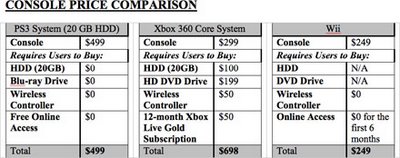 Sony's latest whopper, Engadget reports, is that Microsoft's Xbox 360 costs $698, $200 more than Sony's upcoming PlayStation 3. That's something of a headscratcher, considering the retail price of an Xbox is $299, which is $200 less than the $499 PS3. Sony's new math is that to get as many features with the Xbox as you do with the PS3, you have to add an external hard drive, an HD-DVD player, a wireless controller, and an online subscription. But Sony's new math doesn't add up, Engadget points out. For one thing, none of those extras are required to play videogames on an Xbox. And for $399, you can get an Xbox system which includes a hard drive, a wireless controller, and a basic online subscription. Granted, watching high-definition movies will cost you extra, but is that why gamers buy consoles? Where Sony really crosses the line is when its so-called "fact sheet" claims that Xbox users are "required to buy" these extras. The Browser's question is this: "Required" in what sense? Is Sony still smarting over the fact that Microsoft beat them to a punch - by a full year - with the Xbox? BlackPlanet: A potent MySpace rival?
 One of the more credible threats to MySpace world domination is Community Connect, the company behind ethnically-targeted social networks like BlackPlanet.com and migente.com. The company hit the media radar in late September when BusinessWeek proclaimed niche networks the "second wave of social networking," and noted that, with an estimated $20 million in revenues, Community Connect could well be the third-largest social network by sales. One of the more credible threats to MySpace world domination is Community Connect, the company behind ethnically-targeted social networks like BlackPlanet.com and migente.com. The company hit the media radar in late September when BusinessWeek proclaimed niche networks the "second wave of social networking," and noted that, with an estimated $20 million in revenues, Community Connect could well be the third-largest social network by sales.This week the company launched music sub-sections on BlackPlanet and MiGente, hoping to exploit their niche advantage. The headline stat is that more than 175,000 Hip Hop artists are already promoting their music on BlackPlanet.com. The Browser doesn't follow the urban music scene as closely as we'd like, but, if we did, we'd no doubt choose BlackPlanet over MySpace for browsing Hip Hop. The same would be true if we were into "Dirty South," which is a sub-genre we'd never heard of until browsing the site this morning. There's not much blogosphere buzz yet about the new Community Connect initiative, and the content is a bit thin beyond the label-built pages for Diddy and LL Kool J. Still, this sort of move makes sense for Community Connect, and bodes ill for MySpace. As a grizzled vice president of sales at a top media conglomerate once told The Browser: targeted content always wins out over general interest media. San Francisco mucks up free Wi-Fi project
Thought that Google's going to blanket San Francisco with free Wi-Fi any day now? Think again.
San Francisco resident and tech enthusiast "Davis Freeberg" - the nom de blogue of a local investment advisor - has detailed the woes Google and its partner EarthLink have faced in getting permission to roll out a free, citywide Wi-Fi network. The city's infamous politics, Freeberg writes, look ready to sandbag the project, with the Wi-Fi network's backers "discovering that dealing with the local San Francisco political scene is about as fun as being set up on a blind date with Mike Tyson after being rubbed down in meat sauce." Freeberg attended a "town hall" meeting where a parade of local eccentrics laid out their conditions before Google would be permitted to give the residents of the city free Internet access: "Some of the crazier demands that were suggested at the meeting included a 'requirement' for every San Francisco renter to sign a lease addendum with their landlords before being allowed to install a WiFi card in their PC, forcing Google to agree to transport kids back and forth to the Zoo in their Google busses and a requirement for EarthLink to pay the electrical costs for running computers in order to prevent brownouts." The Browser would understand if Google decided to pack up its routers and go home to Mountain View, where residents are asking for technical help with connecting to the network, not a set of loony-tunes demands. But Freeberg reports that Google executive Chris Sacca bravely soldiered through the meeting, deflecting technically impossible or financially punitive requests with grace and patience. Luckily for the City by the Bay, Google is soldiering on. Freeberg does have one suggestion: Next month vote out the supervisors who allowed this humilating charade to take place. Hear, hear. Logitech + Slim Devices = fat margins?
Engadget is reporting that Logitech, the giant computer-peripherals maker best known for its computer mice and keyboards, has acquired Slim Devices. For Engadget, it's all about the gear, and they give a nice rundown of the companies' competing wireless music systems. But what's the deal really about? Slim, famed for the Squeezebox music player which connects your PC's music library to your living-room stereo, is known for smart software, not just hardware. And as Apple proved, to really succeed in digital music, you have to pair sleek hardware with equally well-designed software.
People used to scoff at the hardware-plus-software approach, saying that open platforms like Microsoft Windows - for which anyone can build compatible hardware - would win out in music players, too. Rrrrright. That explains why iPod sales are up 35% and Microsoft is now aping Apple's approach by rolling out its own Zune player in November. Logitech's Slim buy also recognizes another truth of the hardware-plus-software equation: Done well, combining the two yields higher margins, as consumers pay more for unique, software-driven features. That should help Logitech in arenas beyond just digital music, as it aims to keep rolling out upgraded gear that can command a premium on computer-store shelves. Yahoo bets on Google-curtailing technology
Yahoo's drubbing in the market and the media continues, but the portal is finally throwing some deft counterpunches. Yesterday Yahoo announced two savvy maneuvers involving ad technology. One was the buyout of AdInterax. In the second deal, Yahoo led a $45 million round of investment in Right Media, a New York-based ad-network .
Both deals are intriguing. AdInterax, says ClickZ "is a hosted technology provider that enables non-technical users to create rich media ads through a drag-and-drop interface." Apparently the idea is to create a self-service tool that would allow Yahoo advertisers to create rich media ads - much as they currently do for text ads. Sounds promising. Meanwhile, The Browser has been following the story of Right Media for some time. Founded by Michael Walrath, a former DoubleClick exec, the company has built an open network for ad trading. Think NASDAQ for ads. Instead of both advertisers having to interact with Google - and to play by Google's rules - a true open market lets participants contract directly with each other. AdAge notes the Right Media's network is now trading two billion ad impressions each day, and that Walrath and his crew believe they can one day trade offline ads too - like TV or radio. (For background, look here.) Word has it that the $45 million invested by Yahoo and Red Point gave them a 20% share -pegging Right Media's valuation at $225 million. Video iPods get sick - and Apple blames Microsoft
The Browser just loves a good round of mud-slinging. Apple has just disclosed that a number of video iPods shipped since mid-September are infected with the RavMonE virus, and is quick to take aim at its arch rival to the north for the problem, reports CNET.
The RavMonE virus affects only the Windows operating system. It turns out, a Windows machine at an unidentified contractor that manufactures iPods might be at fault. Apple says there have been fewer than 25 reports of a problem. In an apology posted on its web site, Apple takes the blame but drags Microsoft down with it: "As you might imagine, we are upset at Windows for not being more hardy against such viruses, and even more upset with ourselves for not catching it." The Browser looked but there isn't a nice juicy plug for OS X in that partial mea culpa. But we're pretty sure that Steve Jobs & Co. are going to be eager to make its opinions of Vista, the long-overdue operating system that's due out soon from Microsoft, well known. Apple's newest servers fall apart - how cool!
As anyone with a pulse knows, Apple makes some pretty slick consumer electronics. But servers, too? Yep. Apple's latest server, the XServe Xeon is finding a lot of love from one top critic, InfoWorld's Enterprise Mac blog. InfoWorld's Tom Yager has taken a close look and likes what he sees.
Apple has taken the iPod Nano design and applied it to the XServe. With one key exception: instead of slipping easily into your pocket, the XServe is easy to take apart. That means faulty parts can be removed and replaced without undoing ribbon cables and unscrewing tiny fasteners with special tools. Instead, the parts slide out of position with just a little pressure - but stay in place during ordinary operation. Talk about "ease of use" for the data center. There's just one small problem, notes Yager. Apple's XServe, at $2,999, costs twice as much as competing Xeon servers. It's not a given that sysadmins will flock to a more expensive server when they could easily junk and replace a cheaper one - and avoid the hassle of disassembling the XServe to fix a faulty part. Google's worst enemy: Google
The Google monolith marches on....eMarketer reports that the search giant's share of online advertising should hit 25 percent this year and 30 percent next year. Can anyone stop it? Yahoo hasn't, although it's just released early - make that "less late than expected" - its Panama search-ad system. Ask.com, meanwhile, is getting rave reviews for its latest upgrade, but isn't reaping the ad dollars that typically follow, Virtual Economics notes.
When it comes to competition, Google doesn't have a lot to worry about. What should keep Sergey and Larry up at night, though, are their bungling employees. Look at Google Video - a $1.65 billion debacle given the price the company had to pay YouTube just to get in the game. Google's subpar attempts at non-search services have been amply documented: Orkut, Google Talk, Google Finance, Froogle, and other me-too products haven't gained traction. Even Gmail and Google Maps haven't unseated their top competitors. On a less serious note, there's the "crafty chica" who works at Google and got the blogosphere worked up when she accidently posted a recipe for white-chocolate sugar skulls to the official Google Blogger blog instead of her personal blog. Hardly a marketplace disaster, but it raises questions about the intellectual capacity of Google's army of new recruits. The end of fiber-optic?
Here comes very bad news for Verizon and the cable companies: A new technology called DSM, or Dynamic Spectrum Management, could allow ordinary copper telephone wires to transmit data at gigabit speeds, GigaOm reports. Call it DSL on steroids: DSM solves problems with electromagnetic interference in copper lines that has been the biggest obstacle in souping them up for ultra-high-speed Internet connections.
Such a development could obviate the billions of dollars Verizon is spending on a new fiber-optic network. It also poses a threat to cable companies, which may not be able to upgrade their hybrid coax networks to gigabit speeds as cheaply as phone companies could with DSM. AT&T's move to slow down its fiber rollout looks prescient in light of the potential DSM threat. The "laptop" dies and Sony squirms
It's official: The exploding-battery scandal has killed off the term "laptop" once and for all. An authority no less august than the Consumer Products Safety Commission has issued a diktat: "Do not use your computer on your lap."
As The Browser ponders this government commandment from a notebook computer that - all right, we confess - is not securely stationed on a heatproof surface, we're looking for someone to blame. And Sony looks like a fat, juicy target. We're not the only ones steamed: Macworld UK has picked up a Reuters report that Toshiba may sue rival Sony after recalling more than one million notebooks with Sony-made batteries. Apple, Dell, Fujitsu, Hitachi, and Lenovo have also been affected - they've just quietly extracted payment for the cost of their recalls from Sony. The latest victim? Sony itself. Also a computer maker, Sony is recalling some of its Vaio notebooks. And the cost of the battery disaster may put a large dent in earnings: The company earlier pegged the cost at $257 million, but that doesn't take into account the latest recalls. How NOT to name a Web 2.0 startup....
The fine people at Folksonomy have done a lovely job putting together seven rules for naming your new Web 2.0 company. Our favorite is rule number two:
When Flickr exploded in popularity, quite a few entrepreneurs seemed to think that it set some sort of de facto standard for Web 2.0 naming conventions. It didn't. Naming your service Locatr, Bookmarkr, Zooomr, Preloadr, or Frappr doesn't put you next in line on the Yahoo acquisition queue. Either go for an expensive generic name that accurately describes what you're about, or be creative by choosing an effective and unique name that stands out.For the record, witty posts about web site naming conventions is one of the clearest signs of tech market frothiness. And that's particularly true when names like GreedTube start popping up. While you're on Folksonomy, check out their interview with GreedTube co-founder Noah Hayes. Update: Close readers may have noticed that we didn't actually link to the GreedTube site above. That's because we noticed that it re-directed us to YouTube, and comments on the site suggested that, Google triumph aside, the YouTubers weren't too pleased with the knock-off. We emailed Noah Hayes at Axle Networks to find out more, and he confirmed our suspicions: "I recently received a cease and desist order from Youtube, so the site has been shut down. This probably isn't much of a suprise. However, within the next month, my company will be announcing a new venture which involves user generated content and paid incentives. Unlike GreedTube, we've been working on this new site for a few months now...."We'll keep you posted. -The Mgmt. Sequoia pours $5 million into Sugar Media
The Browser is having some deep thoughts about the blogosphere today. Has the time come for consolidation? It seems blogging has grown so fast, so soon, and is now so fragmented that most are past the point of positive ROI.
What got us pondering the meaning of it all was news of the latest blog to strike an enviable VC deal. Sugar Media, a year-old blog network noted for its celebrity gossip site PopSugar, has raised $5 million from Michael Moritz, the resident genius at Sequoia Capital (you know: Google, Yahoo, YouTube....). Michael Arrington reports that Sugar already draws three million unique monthly visitors and has plans to "launch four new blogs in the next month or so." Such aggressive growth plans makes particular sense in light of Om Malik's comment that the Mortiz M.O. is to put "business model on the backburner and instead focusing on market share." In other blog news, John Battelle's Federated Media - the blog advertising shop that powers sites like Digg and Boing Boing - has signed a deal to manage the ads on something called SportsBlogs Nation. It's time to ask the question: Barely three years into the commercial-blogging revolution, is the blog network roll up already upon us? After all, how many celebrity gossip blogs can there be (not to mention tech business blogs....). How about some fries with that virus-infected MP3 player?
Here are two words that are sure to make for an unhappy meal: viral infection. That's what "winners" of a McDonald's MP3-player giveaway in Japan got along with their free tunes, Engadget reports. Some of the MP3 players apparently came with a copy of the QQPass trojan-horse software, which copies user passwords and e-mails them to a hacker.
Sadly, this isn't the first time an MP3 player has shipped with a virus. Creative Technology released some infected Zens last fall. At the Browser, we're starting to think that our all-beef patties get more thorough inspections than our music players. 4 signs that Sony's on the comeback
Here's an odd turn of events: People are blogging about Sony - and the buzz is good. Kotaku notes that Sony's PlayStation 3, previously criticized for being overpriced and hard to program, won Best of Show at the DigitalLife conference. And Eurogamer says that the PS3's online features at least match Microsoft's Xbox Live service. Meanwhile, Sony's instant-messaging and VOIP device, called Mylo, is now winning praise from the likes of VOIP blogger Andy Abramson for smartly bundling a year of free T-Mobile Wi-Fi service. (Mylo had been dinged for only working with Wi-Fi hotspots, not high-speed cell-phone networks). And the Sony Reader, though still considered overpriced at $350, is getting good reviews from the ink-and-paper crowd.
Now if only Sony could deliver a music player that's worth buying, we'd say Howard Stringer has a shot at delivering on his promise of "champion products." Wal-Mart PR firm pulls fake blog stunt, and runs for cover
Update: Richard Edelman has in fact finally issued a public mea culpa: "I want to acknowledge our error in failing to be transparent about the identity of the two bloggers from the outset. This is 100% our responsibility and our error; not the client's." Ouch. Early comment seems to be of the "better late than never" variety. We can't fail to notice the sound business judgment in taking the fall for Wal-Mart.
Ah, the wrath of a blogosphere scorned. Earlier this month BusinessWeek told the story of the faux blog, "Wal-Marting Across America." Ostensibly the blog was the down-homey diary of a couple RV-ing across America by way of Wal-Mart parking lots. As it turns out, the couple was getting financial incentives from Wal-Mart's public relations firm, Edelman. (This of course reminds The Browser of ugly faux blog disasters past.) Once the blood was in the water, it didn't take long for the sharks to attack. First the couple was outed, and then the blog went abruptly off-line. Now PR industry blogger Shel Holtz is laying it on thick, wondering why in this era of transparency Richard Edelman and his braintrust haven't stepped up with a mea culpa. It's great stuff. There's nothing like a public spat between PR gurus. And it's particularly informative to learn what the PR kings do when their own scandal erupts: stay silent. A MySpace teen doesn't like Bush, and the Secret Service comes knocking
Between sexual predators and touchy Secret Service agents, maintaining a MySpace page can be tough. That's what 14 year-old Julia Wilson discovered last week when two Secret Service agents pulled her out of a high school class. They wanted to interrogate her about the image of the President she had posted with "Kill Bush" scrawled across the top and a dagger stabbing his hand. "I wasn't dangerous. I mean, look at what's (stenciled) on my backpack — it's a heart," a teary Wilson told the Associated Press. "I'm a very peace-loving person. I'm against the war in Iraq. I'm not going to kill the president."
OK, so the Feds could have been a little more sensitive, but the bigger question is how many agents do we have tracking "Kill Bush" postings on MySpace? And are teenage girls really in the right demographic for would be assassins? Wouldn't a call to the parents have sufficed? A faux fracas over Time Warner and YouTube
The UK's Guardian has an intriguing little story today: Time Warner CEO Dick Parsons (who, one must disclose, signs the Browser's paychecks) is negotiating with YouTube to deal with the problem of videos that infringe his company's copyrights, and now that Google's buying the video-sharing site, Parsons says he's going to move those negotiations to his company's partner, which owns a 5 percent stake in Time Warne's AOL unit. A sensible approach, and smarter than suing, right?
But once the story got released into the blogosphere, "in negotiations" somehow got translated intto "Dick Parsons to Sue Goobe." That was the inaccurate scream from GigaOm. (Not to mention ineloquent: "Goobe" for the combination of Google and YouTube?) John Battelle's headline at Searchblog, inaccurately picks up the meme from Boing Boing: "Sour Grapes: Time to SueTube?" Pete Cashmore at Mashable is one of the few to get the story straight: "What Parsons hasn't said to the press is that he's necessarily going to sue Google: he just says he'll pursue the infringements." It's a case study in how the blogosphere propagates errors. Click-hungry bloggers scan their RSS feedreaders, pick up on each other's headlines, and don't bother to read the original source material. If they bothered to read the original Guardian article, they'd see that Parsons is hardly prepping for his day in court. Which isn't surprising. Parsons, a lawyer by training, knows that it's better to get what you want in private negotiations than in the drama of a courtroom - though the latter would make for more entertaining blog posts. Will IceWeasel freeze out Firefox?
The Firefox Web browser would seem like the hero of the open-source movement: Out of nowhere, it's seized 12 percent of the Web-browsing market, and provided a shining example of how a community-developed product can enjoy commercial success.
But it seems that Firefox isn't open-source enough for some zealots. The folks behind Debian, a variant of Linux, don't want to distribute Firefox anymore. Why not? "Firefox" is a trademark of the Mozilla Foundation, the nonprofit behind the Web browser, and some open-source true believers don't like following Mozilla's rules to license that trademark, such as having Mozilla approve changed to the Firefox browser Debian distributes. So Debian's backing a super-open-source derivative of Firefox called IceWeasel. Substituting IceWeasel for Firefox seems like madness to people outside the open-source world. And even to some people inside it: "Anyone who thinks IceWeasel is a good idea has drunken too much of the open-source Kool-Aid," writes the Engtech blog. With Microsoft about to release Internet Explorer 7 - its first new version in years - Firefox is about to face real competition, and backing IceWeasel instead of Firefox just fragments the anti-Microsoft crowd. Makes sense to the Browser. We must all browse together, or we shall surely browse separately. Moto Q meets its match: The Dash
First came the Motorola Q - now comes the sleeker T-Mobile Dash, made by HTC. According to a review by Engadget and comments by Engadget readers, the smartphone bests the Q in a number of ways, from the smoother, rounder form factor to the availability of cheaper T-Mobile calling plans. Of course, T-Mobile doesn't offer a 3G network for ultrafast surfing, but it does offer a package of EDGE - a slower data-transfer standard - and Wi-Fi, including T-Mobile's network of hotspots, for $30 a month. And the phone itself sells for $199 with a two-year contract. Not bad for a Windows Mobile smartphone - and it's just one more reason why Palm's expected to roll out the cheap but boring Treo 680 today.
Bill Gates's worst nightmare: Attack of the iPod zombies
They lurk in your pockets, waiting ... waiting ... to be plugged into a PC. Then they'll take over the CPU, transforming it into a vicious, power-mad, world-domination-seeking ... Mac?
That's one scenario made possible by Apple's long-dormant "Home on iPod" technology. "Home on iPod" resurfaced this week in a just-revealed patent filing, AppleInsider reports. Back in 2003, Apple briefly posted details of a feature, promised for an upcoming version of Mac OS X, which would let you copy your user directory to an iPod, hook it up to another Mac, and log in securely to your files just like you were using your own Mac. Apple mysteriously abandoned the feature. But since then, it's switched to PC-compatible Intel chips, which raises the possibility of plugging your iPod into a PC, turning it into a Mac by running Mac OS X off your iPod's hard drive. Apple's 2002 patent application faced some technical obstacles at the time it was filed. Because iPods came with 5GB hard drives at the time, Apple assumed users would plug the devices into a Mac with the Mac OS X operating system installed. But with today's 80GB iPods, it's easy to make room for a copy of the OS, not just a user's files. Another problem was getting Mac OS X to run on a PC, but ZDNet UK showed last year that it could be done. So why not turn the iPod loose on an unsuspecting PC world? iTunes for Windows is just the beginning, a Trojan horse to lull the masses into acceptance of the Mac user interface. Apple already sells more iPods than Macs. Are they just waiting for a little extra software, already on file at the Patent Office, to take over the world? Blinkx, Google, and the limits of video search
Somewhat lost in the media storm surrounding Google's acquisition of YouTube was Tuesday's announcement by Microsoft that it would use technology from Blinkx to power video search on parts of MSN Internet sites and Live.Com. "We will be the single biggest video search engine on the Web," boasted Suranga Chandratilake, the founder of Blinkx, to Reuters. Beet.TV picked up the Blinkx story, pointing out that the company has figured out a way to actually index the audio tracks of web video, which at least sounds very impressive.
This got The Browser thinking: why would Google pay $1.65 billion for YouTube given that there's increasingly good Internet-wide video search? Why would users look for videos on YouTube when they can search the universe of video web sites using Google, Yahoo, or Blinx? Then we had a thought: YouTube does do something that the search engines don't. It establishes relative values for uploaded videos - i.e., via popularity rankings. Most people browse YouTube using the "Most Watched" tab (sorted by day, by week, by month, all time.) When The Browser met with YouTube's Hurley and Chen in August, they talked about the site as a video "marketplace." Their word choice suggests how critical they think YouTube's filtering function is They're right. Google, Yahoo, and Blinkx could tweak their algorithms to provide some approximation of videos' popularity over time. But they don't do that now, and they might never achieve the quality that comes from actually hosting the videos. Consider this analogy: you don't use Google when you want to find something on eBay. YouTube isn't quite as pure a marketplace as eBay, but the Google guys may well have suspected that, no matter how much tweaking they did to their algorithms, they would always come up short of YouTube. That said, video search is hardly a bad business to be in - and Chandratilake's Blinkx will probably do just fine. How YouTube made Flash king of Web video
Adobe CEO Bruce Chizen likes to crow about the ubiquity of Flash, his company's media-player technology that's installed on nearly every Internet-connected computer. But how did Flash become the standard for Web video when Apple, Microsoft, and RealNetworks were all jousting for that market?
Digital Web Magazine takes a detailed look at Flash's rise. It all began, writes Digital Web, when a Flash developer discovered a way to embed video in Flash as a series of images. It was a crude technique, but it compressed the video file down to a manageable download. Then Macromedia - later purchased by Adobe - improved Flash's video editing and playback features, and Web developers ran with it. Flash's secret was that it played video right from within a page, without requiring pop-up windows or standalone players. That's a trick that Microsoft and Real never mastered. And that's why YouTube, and later MySpace, embraced Flash: Videos started playing back rapidly, without the need for any software downloads, and didn't take users away from the Web page they were surfing at the moment. YouTube and MySpace's use of Flash ensure its continued ubiquity; as Chizen told Business 2.0, MySpace's adoption of a new version of Flash technology on its website is making that latest version's adoption happen at the fastest rate ever. That virtuous circle is going hard for competitors to break. Palm's "new" Treo: cheap but boring
Die-hard Palm fans are slavering over the new Treo that CEO Ed Colligan, who's in New York for the DigitalLife confab, is due to announce tomorrow. What this new Treo will look like is anybody's guess. The rumors point to two different models, says Engadget: The Treo 680 - a low-end, ultracheap version of the smartphone - or else a new version of the already-released Treo 750.
Mobilewhack is putting its money on the 680, though it's disappointed with low-end features like the digital camera, which only has VGA resolution. RIM's BlackBerry Pearl, by contrast, has a 1.3-megapixel camera built in. That said, the Treo 680 could be cheap: Analysts think it will sell for $199, says EverythingTreo. That will help Palm better compete with RIM's Pearl and Nokia's new E62. Pardon The Browser for a second while we rant: How does a slightly cheaper version of an existing phone count as a new product? Palm is expert at this sleight of hand, having rolled out versions of the Treo that run a different operating system, work on a different carrier's network, use an upgraded network technology, or just have slightly more memory. Try to distinguish the 750 from the 700. It's not easy. Sure, Palm would argue that they reached form-factor perfection with the Treo 600, but is that an excuse for not continuing to innovate? Palm, take a lesson from Apple. Steve Jobs killed the extremely successful iPod Mini to make way for the even more successful iPod Nano. When you promise a new product, give the market something genuinely new. We're bored with the familiar candy-bar Treo. How about a slider? A flip phone? A spinner? There hasn't been a genuine surprise out of the company since Palm bought Handspring - and that's a shame. Goodbye Writely, helllooo Google Office
The Browser knew something was afoot when the word "NOTICE" appeared yesterday, in red, at the top of our Writely page. The "planned outage" we were alerted to was the only warning of Google's surprise release early this morning of Google Docs & Spreadsheets, the latest iteration of the company's web-based answer to Microsoft Office. The new release does not so much introduce radically new features as it does combine two products that began life separately: Writely, the online word processor Google acquired last March, and Google spreadsheets, an internal initiative released in June. The headline benefit is that users will be able to create and access their documents from a single location, though there are a variety of other improvements, reports Google Watch.
Beyond criticizing Google for its geeky penchant for plain names, web pundits are busy pointing out how the new release signals Google's intention to go after the lower end of the Microsoft Office customer base. The Wall Street Journal reports that Google chief Eric Schmidt last week said that Microsoft's hold on non-professional users "may be vulnerable." Rafe Needleman at News.com complains that the two applications are not truly integrated ("You cannot embed a spreadsheet into a document, for example. That's lame.") But he also allows that he likes the apps despite "their early stage flaws and omissions," and reports that Google has plans for a "disconnected" version. Obviously, the one big drawback of web-enabled apps, is the potential lack of a web connection.... Needleman and Michael Arrington at TechCrunch also point out that the Google is not the only would-be Office disruptor. In the hunt too is ThinkFree, and Zoho, which, in fact, TechCrunch profiled only yesterday. The market's looking crowded, but alpha-CEO Steve Ballmer - who's making the media rounds this week in New York in trademark table-pounding style - isn't showing any fear. The imminent releases of Vista and Office, says (shouts?) Ballmer, are the biggest for Redmond since the launch of Windows 95, and at the center of them is the notion of being web-enabled. This face-off is going to be good. Netflix contest draws lots of free labor
Netflix is already getting its money worth, Techdirt reports, from the $1 million prize it offered last week. Sure, no one's hit the mark for winning - boosting by 10 percent or more the accuracy of Netflix's CineMatch movie-recommendation service, which predicts how much a customer will like a flick based on her movie preferences. But there are a handful of contestants who have managed to improve on Netflix's algorithms. WXYZconsulting.com created a stir when it became the first to beat Netflix's recommendations - with just a "few nights' work," Good Morning Silicon Valley notes - but The Thought Gang rapidly bested the consultants late last night. Still, none of the contestants have posted more than a one percent improvement over CineMatch, so there are many more laps to go in this horse race.
Why investors hate telcos
James Enck, the global telecom strategist at Daiwa Securities, has a well-read blog on the European telecom scene, which earned him an invite to speak at the Telco 2.0 conference. His love letter to the assembled telecom executives? A presentation titled "Ten Things I Hate About You." Enck, who's clearly more interested in influencing people than making friends with the telco crowd, outlines the uneasiness investors have about the telecom sector and makes a compelling case for reforming the business.
The first complaint: telecoms have lost control of voice - their core product - to upstarts like Skype. And then there's the fact that customers may not be that interested in the "packages" of voice, Internet, and TV the phone companies are now hawking; increasingly, where Internet-only service is an option, as in South Korea, customers are choosing the raw Internet connection without anything else. There's also the industry's troubled track record with innovation: They can't build new stuff, they can't move fast enough to buy it - so perhaps they shouldn't bother, says Enck. It turns out that tending to basic network infrastructure is a business telcos manage to do well, and they can generate a fair bit of cash from it, as BT has shown - so why bother trying to create the next MySpace or Skype, when you can profit nicely from the explosion of traffic those sites generate? Mon dieu! Now Europe reads more online than off
Americans aren't the only ones who spend more time online than they do reading print. A new report from Jupiter Research suggests that Europeans also log more time surfing the Internet than they do reading newspapers and magazines.
Don't choke on your croissant just yet. The Financial Times summarizes the study, but hastens to point out that "the growth of new media is expanding total media consumption rather than simply cannibalising print and television." It seems that Europeans continue to read as much as they did in 2004 - about three hours per week - but their online hours have doubled from two to four. Three hours a week? That's hardly time to get warmed up reading Le Monde with a "petit cafe" and a Gitane at the Deux Magots. But that seems to be the norm these days. According to the FT, again via Jupiter, Americans also spend only three hours a week reading. But, in the U.S., we spend 14 hours a week online - about the same as we do watching TV. So the Euros can still claim to be somewhat more civilized, or backward. The moneymen behind the Google-YouTube deal
The $1.65 billion shocker is covered just about everywhere, and The Browser has little to add except to say next time we go out to lunch with Steve and Chad, they're paying. We might, however, insist on picking up the tab for Sequoia partner Roelof Botha, whose role in orchestrating this deal already feels like one of the great behind-scenes coups in venture-capital history. Botha now has two great dotcom deals under his belt: As CFO of PayPal, he helped swing its sale to eBay. It didn't hurt Botha, of course, to be sitting up the hall from Mike Moritz, Google and PayPal's earliest venture champion. Just connecting the dots, y'all.
Windows Mobile gets a makeover?
Windows Mobile is the latest Microsoft product to get a facelift: MSMobileNews.com has turned up screenshots of a new version codenamed "Crossbow." The fonts and icons pick up themes from Microsoft's upcoming Vista desktop operating system. Windows Mobile used to be a relatively geeky option for clunky PDA phones, but it's now an increasingly common option on sleek smartphones: Motorola's Q has it, as does Palm's Treo 750v. Engadget notes that the "Crossbow" upgrade is not, unfortunately, the long-awaited new "Photon" version of Windows Mobile, but it does feature more integration with Office 2007.
Google boasts about security and its blog gets hacked
Here's something for the 'you-asked-for-it' file. On Friday, Google's security team was crowing about the company's security policy: "Google takes security very seriously and designs all of its services and applications to protect your privacy and data security."
Your security, yes. But what about its own? Maybe not. This morning Google 'fessed up that a hacker had exploited a bug in Google's Blogger software and posted a fake entry to the official Google blog. The subject matter of the hoax post was obscure - the discontinuation of a click-to-call advertising effort - but it highlighted the potential for mischief on official corporate blogs. Hacks like this will surely be an obstacle to Sun Microsystems CEO Jonathan Schwartz's plans to make blogging an investor-relations tool. Microsoft's Vista: a maximum-security lockdown
The Browser usually tunes out media reports on Microsoft's Vista operating system - the wait has been interminable - but today there's actually news worth noting: Redmond has released the Vista's final test version, and the oft-delayed OS seems to be on track for a January "consumer" release. VNUNet reports that the last test version came only in September, so it seems the Vista train is picking up momentum.
In related news, InfoWorld and others are paying particularly close attention to the anti-piracy measures built into Vista and its close server-side OS cousin, Longhorn. The Microsoft Software Protection Platform apparently limits the functionality available to users of unlicensed versions of Vista or Longhorn. This is what InfoWorld amusingly dubs "enhanced reduced functionality." The hope is that the new techniques will work out better than Redmond's somewhat troubled earlier efforts: "Microsoft has made more than a few missteps in previous attempts to reduce unauthorized use of its software." The pub points to this spring's controversial Windows Genuine Advantage security update. Critics branded it 'spyware' for installing itself secretly on users' PCs and then reporting personal information back to Microsoft. Some companies can't shake the lingering Orwellian vibe. But in its defense, Redmond points out that, according to the Business Software Alliance, 35 percent of software installed worldwide in 2005 was pirated. Now that's a chunk of change for any company, especially Microsoft. Is Google buying YouTube?
Is Google about to gobble up YouTube for a whopping $1.6 billion? What started as a completely unsubstantiated rumor courtesy of TechCrunch today took on a whole lot more credence when the WSJ.com, citing an anonymous source, came out with report stating that the courtship is on. Robust tech blogger Om Malik, however, is dismissing the likelihood of a Google-YouTube tie-up: "The deal has as much chance of happening as me dropping 40 pounds."
The WSJ.com couldn't reach a YouTube spokeswoman and Google declined to comment. The source, however, said that the talks could break off. There's been plenty of speculation this year about media giants circling the wildly-popular video-sharing site. Launched in early 2005, YouTube logs 100 million video downloads a day. YouTube CEO Chad Hurley has previously insisted that YouTube is not for sale, although he's said that an IPO is possible. There is certain logic to a Google-YouTube combination. Despite the stunning price tag and skepticism about YouTube's business model: $1.6 billion is a hefty chunk of change, but with the search engine's market cap hovering around $125 billion, Google investors would hardly notice it. And YouTube's marked lack of profits? Google has plenty of unprofitable projects of its own, so there can't be a lot of harm in adding another one. What about copyright problems with some YouTube videos? Google's already getting sued by scads of copyright owners. And buying YouTube would solve Google's nagging problem with its own Google Video: a lack of traffic compared to YouTube and MySpace Videos. For Larry and Sergey, being able to say Google's #1 in a field besides Internet search might be worth the purchase price by itself. Comcast video store launching this month
Gizmodo is reporting that Comcast will launch a rumored online-video store before the end of October. The store would offer more flexibility than most competitors: Videos could be downloaded to either a user's PC or a Comcast cable set-top box, which would solve the most frustrating problem with Internet video - transferring the video from a PC to a TV, where it can be watched in the comfort of your living room.
The most daring aspect of Comcast's plan, though, is that it will offer video to any Internet users, not just Comcast broadband subscribers. True, they won't get the benefit of set-top box downloads, but the move will give Comcast access to a vastly larger audience than its 21 million U.S. cable subscribers. Guess what? Grandpa likes social networking too
Here's something you probably wouldn't have guessed: more than half of MySpace users are 35 or older. That's according to comScore Media Metrix, which yesterday released the surprising traffic numbers, not just for MySpace but also for the three other top social networks - Facebook, Friendster, and Xanga. Overall, the research firm finds that " significant age differences exist" among the different user basis.
Needless to say, the demographics are causing quite a stir among the digerati, most of whom assumed along with everyone else that social networking is a teenager phenomenon. Not so, says Jack Flanagan of Media Metrix. MySpace has the broadest appeal across age groups, he notes, while Facebook's niche is the college crowd, Friendster has more adult users, and Xanga.com is popular among younger teens. Those findings are to be expected. But the 35-year-old-and-above MySpace shocker? "I don't believe [it]," posts John DeMayo, created his own MySpace demographic profile by tallying the number of users in a given age group by zipcodes - and claims his skepticism is warranted. "I think they are counting the head of household's age in their sample, but in reality it's the younger members of the household that are visiting myspace, and being counted as older people." Liz Gannes at GigaOm also thought Media Metrix might have "gone off the deep end," but she did her checking the easy way: she simply Fox Interactive, whose spokesperson Ann Burkart confirmed that the Media Metrix numbers were consistent with their own. "Burkart’s explanation is that as MySpace expands it is becoming more representative of the population as a whole," writes Gannes. Indeed, according to the data, there are almost as many MySpace users 55 and over as there are under 18. The Browser has at least one simple explanation for all the oldsters, beyond all the 30-something rockers hanging on to their dreams of rock-and-roll stardom: parents. Given the threat of sexual predators trolling MySpace, many parents now visit their kids pages, and even set up their own pages in order to keep a closer eye on things. Certainly this means MySpace is becoming more representative of broader demographics. Whether these adult tourists are as engaged with the media as their kids - or as likely to click on ads - remains to be seen. Yahoo gets even more social
The Read/WriteWeb blog reports that Yahoo's Del.icio.us social-bookmarking website, which already allows users to see each other's favorite websites, is planning to turn itself into a social network. Sounds great, but we'd point out that Yahoo 360 already exists, and Yahoo's Flickr photo-sharing site has extensive friends-and-family social-networking features. And don't forget Yahoo's Upcoming.org event-planning site lets you share - can you guess? - plans for upcoming events with your network of friends.
The only way Yahoo could improve on this social-networking mishmash would be to buy blogging-software startup Six Apart, which can't seem to decide whether it wants users to join venerable social network LiveJournal or its newborn Vox network. Personally, The Browser has enough of a challenge maintaining our real-world social network of actual people we see in person; joining all of the social networks Yahoo has on offer seems like a full-time job. Banned in America: The coolest tech gadgets
Every year, Business 2.0 profiles readers' favorite gadgets that aren't sold in the U.S. But that raises an interesting question: Why aren't these ultracool devices sold in the world's biggest and arguably most tech-voracious market? NewsFactor looked into the matter and found several reasons why U.S. gadgeteers are deprived.
First, the beta factor: Overseas manufacturers like to test products in their smaller, local markets so they can shake out bugs and gauge consumer reactions before dropping subpar gadgets on the huge U.S. market. Then there's the wireless-network problem: U.S. wireless-data networks aren't as robust as those in, say, South Korea and Japan. That makes some video-enabled cell phones and handhelds less useful here than abroad. As wireless networks here mature, we'll see more of those gadgets hit our shores. And then there's U.S. regulation: The FCC requires extensive disclosures on any wireless devices, which invariably get leaked all over the Web. Google upgrades get a mixed review
Techies are buzzing today about a pair of Google mini-releases: a new search engine for open source software code, and an upgrade to the little-known Google Groups.
Google Blogoscoped is all over both, with plenty of praise for the open source code. "There are existing code search engines, but this one seems to top them in terms of scope," concludes the blog. But Blogoscoped yawns at the Groups application, which presumably takes aim at rivals Yahoo Groups: "Google Groups mixes a usenet archive with Google's homegrown discussion groups anyone can create...the relaunch looks like a good start at first, but browse around a bit and you'll see there are still many design problems." Well, Google engineers may not get it just right at first, but you've got to give them credit for sheer output. This is a prime example of what Fortune's Adam Lashinsky recently described as Google's "spaghetti method of product development." And Lashinsky's overall conclusion is still an open question: if Google throws enough against the wall, will something eventually stick so it can grow beyond search advertising? Finally, some good news for newspapers
Here's a desperately-needed sliver of cheery news for beleaguered newspaper execs: the Newspaper Association of America's data-rich fall readership report concludes that traffic to newspaper web sites jumped in the first half of this year. The average number of unique visitors to news sites shot up 32 percent, to 55.5 million, compared to the first six months of 2005.
The Reuters round-uphighlights the fact that not only are the web sites drawing more readers, they're drawing younger readers - a key point since advertisers covet this demographic most. The increases are encouraging because, as just about everybody knows, print editions are sucking wind. Yet, for all the money and hopes poured into news sites, they're still considered junior varsity players trailing the all-star Internet pure plays like Yahoo, Google, or eBay. But in many local markets, newspapers still have the advantage: it's been difficult and costly for Internet biggies to try to crack local communities. The key takeaway from the readership report: thanks to steady, if slowing, cash flow from print, local newspaper publishers might just survive to fight another day. This is particularly true for those that have been taking their web editions seriously. Perhaps the most intriguing stat from today's report (via paidContent): "80% of online newspaper visitors mix between the web and print depending on convenience." In other words, this is may not be a zero sum game. Wal-Mart shutters MySpace clone
Wal-Mart has taken its social-networking website, The Hub, offline, Pete Cashmore reports at the Mashable blog. The site suffered from dismally low traffic, largely, bloggers believe, because the website did little more than let teens post paeans to recent Wal-Mart shopping trips. The retail giant isn't giving up on social networking altogether, though: It still maintains its own MySpace profile, Cashmore notes. On MySpace, teens don't hesitate to send Wal-Mart mash notes: "The Fort Wayne, Indiana Wal-Marts are off the hook, I love you," writes one. Who knew Wal-Mart had so many friends - 9,974, at last count?
Apple and Google team up on photo software
Ever since Google CEO Eric Schmidt joined Apple's board of directors, speculation has been rife on how the move would tighten links between the companies. Here's the latest bit of evidence of Apple and Google cozying up: Sharp-eyed hackers on MacTelChat have found that Apple's iPhoto software has the ability to add links to Google Maps when location information about a photo is available. The feature, known as geo-tagging, was first popularized by Web-photo startup Zooomr and has since been picked up by Yahoo's Flickr. Apparently Apple doesn't want its users to miss out on the fun of showing people exactly where a photo was taken.
Of course, photos are just one possible area of cooperation. The real win-win for Google and Apple would be letting Google sell ads in iTunes. That would expand Google's advertising reach and boost the profitability of Apple's iTunes Music Store. IBM launches web software offensive
IBM yesterday let loose a broadside of new web-based software tools for businesses, ratcheting up its aggressive strategy to push key business software onto the Internet. The software release is impressive in its scale, if somewhat obscure for the non-techie: The big ticket items are tools that allow businesses to build web applications, but there are also some industry-specific starter applications, including one for health care.
In all, Big Blue announced "four new products, 23 upgraded products, and 11 services," writes InformationWeek which notes also that this represents just part of $1 billion IBM is investing in "service-oriented architecture" (SOA) initiatives this year. SOA is the operative buzzword here. As CNET writes, "SOA is not a specific product. It's a design approach where individual business services, such as authenticating networks or pulling up customer information, are used in different applications." That's supposed to let businesses build applications more quickly and cost-effectively. But from a business perspective, the new modular architecture adds an important new twist to IBM's old business model. While there will still be substantial software development projects ahead, SOA paves the way for IBM to sell its web-hosted software on a subscription basis - like a utility. Sun CEO calls for new Web-friendly rules on company disclosures
Jonathan Schwartz, the CEO and blogger-in-chief at Sun Microsystems, has posted an open letter to SEC Chairman Christopher Cox, calling on him to let blogs and corporate websites be used for official company statements under the agency's controversial Reg. FD, which regulates the disclosure of information by publicly-traded companies.
Writes Schwartz: Unfortunately, Reg. FD doesn't recognize the internet, or a blog, as the exclusive vehicle through which the public can be fairly informed. In order to be deemed compliant, if we have material news to disclose, we have to hold an anachronistic telephonic conference call, or issue an equivalently anachronistic press release...I would argue that none of those routes are as accessible to the general public as a this blog, or Sun's web site. Our blogs don't require a subscription, or even registration, and are available to anyone, across the globe, with an internet connection. Simultaneously.Good point. But perhaps bad news for PR Newswire and Business Wire. Ahh, disruption. The Browser can't wait to hear how the intriguing Mr. Cox responds. Google takes Manhattan
Google has long kept a small outpost in New York City. But now the ever-growing upstart has seized a much bigger chunk of Manhattan real estate: 300,000 square feet, occupying three block-long floors of a skyscraper at 111 8th Avenue, according to InformationWeek. The new office makes room for 500 New York-based Googlers, up from a mere 80 last spring.
eWeek's photo slideshow reveals a typically Googley setup: Air-hockey games, copious amounts of free food, and bright colors everywhere. You'd think you were in Mountain View. But Craig Nevill-Manning, Google's New York-based director of engineering, tells Clickz that the East Coast outpost, Google's second-largest engineering center, is essential for recruiting Big Apple loyalists. As Clickz, an Internet-advertising news website, puts it, "Having a presence in New York is key to the company's East Coast recruiting efforts, as many developers who live or attend college in the tri-state area simply won't relocate to California." Amazon's search engine loses its way
Last year, Amazon.com's search subsidiary, A9, sent fleets of trucks across the nation to snap pictures of every business in its yellow-pages directory. Taking photographs of 14 million businesses was part of A9's audacious goal to remake the business of search. Amazon has just tacitly admitted failure.
The sidewalk-view photos of businesses are among a few features that have gone missing from a newly slimmed-down A9. Amazon has also discontinued the site's toolbar and, perhaps most significantly, the 1.57% discount it offered A9 users for purchases on Amazon. With those gone, there's little incentive to use A9 regularly and little to differentiate A9 from other search engines. But perhaps cutting down A9's most costly features is a smart business move - after all, traffic to A9 is minimal, and has been growing more slowly than traffic to Amazon.com itself. Stock picking gets social on Motley Fool
 Motley Fool, the profitable but distinctly Web 1.0 publisher for stock pickers, has got a new secret weapon as of today: CAPS, a free social stock ranking application that the Fools are confident will return them to new media hotness and hyper-growth. In the spirit of social sites such as Digg or the recent hit sports betting site PicksPal, CAPS allows users to vote on the future performance of specific stocks. Users predict whether they think a given equity will outperform - or underperform - the S&P 500 index within the time frame they choose. The site then aggregates the forecasts into a single score, using a five star scale, for each stock. Users are also scored based upon their track record over time: the better their stock calls, the more their vote counts in the stock rankings. People are overwhelmed by the sheer volume of divergent stock opinions, argues David Gardner, who, along with brother Tom, founded Motley Fool 14 years ago. Gardner was brimming over with excitement on a visit to The Browser's Fortune offices last week, and noted in particular that CAPS will also include stock ratings by pro analysts thanks to a deal with Briefing.com. That means the application will rank the pros against each other, and against the unwashed public, using a common scale. Thus, he said, all those slightly divergent terms such as "overweight" and "outperform" will be "translated into a lingua franca." Moreover, Gardner believes that opening up voting to a broad audience will mean better coverage of the "long tail" of equities. "Fifty percent of stocks are covered by two analysts or less," he noted. As revolutionary as Gardner hopes his new service will be, the WSJ reports that CAPS comes at a time when a number of other firms are experimenting with new stock-picking tools. Notable among them are Charles Schwab and E*Trade. Still, The Browser is impressed by CAPs. It builds smartly on the site's years of experience with web community. The big unknown here, as it is elsewhere in Web 2.0-land, is motivation: what will provoke users over time to contribute rankings? Gardner says he isn't worried: "If you have any competitive blood in your body, you'll be hooked." Hmm. More reassuring are hints from the Fools folks that they've come up with at least six tentative schemes for compensating users for their opinions. And there is at least one clearly promising sign that this dog will hunt. One small Colorado research boutique has asked the Fools to include in CAPS some of its stock picks that were not carried on the Briefing.com feed. In other words, far from being upset that their picks were being aggregated, some analysts see CAPS as free marketing. Watch out First Call. New anti-"phishing" site may sink or swim
PhishTank, a new service from Internet-acceleration startup OpenDNS, wants to rid the Web of "phishing" emails - messages that pose as legitimate customer-service emails from banks and e-commerce websites and try to trick users into revealing their passwords. The site works by collecting examples of suspected phishing emails, and then relies on users to vote on them as legitimate or illegitimate.
The digerati are loving it: Georgia Tech student and former Yahoo intern Paul Stamatiou praises PhishTank for a simple phish-submission process and an open API, or application programming interface, which lets other websites and software makers tap into PhishTank's database of suspicious emails. "Once the PhishTank databases grows, other sites can harness the data using open APIs which will remain free," writes Digital Inspiration blogger Amit Agarwal. We hate to rain on the PhishTank parade, but that's a mighty big if. What's the incentive for ordinary users to report phishing emails? They're busy enough just deleting spam - and for mere mortals, the distinction between phishing email and spam is exceedingly fine. Our suggestion: Rather than relying on consumers to take time to sort through their emails and report suspected phishes - let alone vote on them after they're submitted - PhishTank should focus on making alliances with big email providers like Microsoft, Google, and Yahoo, to act as a central clearinghouse for anti-"phishing" data. 10 ways to rule Digg
The SEO Black Hat blog is taking on one of the Web's most influential communities today - readers of the popular user-selected news website Digg - by ticking off the group's collective foibles. In an article that rapidly soared to the top of Digg's most-popular list, SEO listed 10 steps to get your story on Digg's front page. Among the tricks: Structure your article as a how-to or list, write about Apple and Firefox glowingly, decry Wal-Mart and Fox News, and be sure to mention Digg and its founder, Kevin Rose.
The Browser's instant reaction: Meet the new media, same as the old media. Magazine and newspaper editors love lists too, and readers love reading about themselves and having their biases confirmed. The only difference is that with user-directed content sites like Digg, there's nothing restraining users from stampeding in the same direction. Hackers detail scary Firefox flaw...Update: They're kidding, mainly.
Update: It seems reports of this Firefox failing may have been premature. See latest from Ars Technica at bottom for clarifications.
Hacker conferences are so much fun. Case in point: San Diego's ToorCon conference on Saturday, when engineers Mischa Spiegelmock and Andrew Wbeelsoi (what names!) took the stage and called the increasingly popular Firefox Web browser a "complete mess." The duo detailed to the world a security flaw in Firefox, which afflicts the browser's handling of Javascript. As if that weren't painful enough, Spiegelmock and Wbeelsoi also said the glitch was probably "impossible to patch." "Internet Explorer, everybody knows, is not very secure," said Spiegelmock. "But Firefox is also fairly insecure." Naturally, Firefox officials were none too happy, reports CNET. The hard-working people from the Mozilla Foundation, which manages Firefox, had hoped for a bit more discretion. Publicizing a Firefox insecurity hurts the browser's image as the safe, spam-free alternative to Microsoft's Internet Explorer. "I think it is unfortunate because it puts users at risk, but that seems to be their goal," groused Window Snyder, head of security for Mozilla. Digg readers are having none of the Firefox bashing. When one posted: "It makes you wonder why people always say FF is the best browser," one reader was quick to fire back: "Maybe because each Firefox flaw is worthy of a news post, while Internet Explorer has so many that no one bothers to write about them anymore." STOP THE PRESSES, we may have been had: The latest nows is that Spiegelmock and Wbeelsoi were just joking. (Like we said, hacker conferences are more fun.) According to Ars Technica, the bug is reproducible, but it is not a new one, nor particularly serious: "Mischa Spiegelmock has now said that the talk 'was to be humorous,' and that the presentation covered a 'previously known Firefox vulnerability that could result in a stack overflow ending up in remote code execution.' In other words, they didn't discover a new flaw." Moreover, the two hackers have never actually managed to exploit the bug to do anything more than crash their own, local machine. Also, when they said Firefox had 30 known "exploits," well, that wasn't rigorously fact checked either. Just so you know. Will pre-installed music on MP3s help Apple's rivals?
Apple's rivals are trying everything to stand out. The latest stage in the battle over MP3 player market share erupted today when Billboard reported that the new Microsoft Zune will come with 30 free tracks preloaded. SanDisk has also signed deals with music labels to preload their machines with free music.
The iPod, as everyone knows, comes with nothing on it. While the deals that Microsoft, SanDisk and other MP3 players have brokered with the recording industry vary, they are basically quid pro quo arrangements: The labels provide the free tracks and reap the promotional rewards in distribution and marketing support. The Browser's take: free stuff can never be that annoying, but having to delete the latest Britney comeback tracks to make room for, say, our new Beck obsession could get old. Worse still: leaving the preloaded tracks alone and having Britney surface via the "shuffle" feature. 
CNNMoney.com Comment Policy: CNNMoney.com encourages you to add a comment to this discussion. You may not post any unlawful, threatening, libelous, defamatory, obscene, pornographic or other material that would violate the law. Please note that CNNMoney.com makes reasonable efforts to review all comments prior to posting and CNNMoney.com may edit comments for clarity or to keep out questionable or off-topic material. All comments should be relevant to the post and remain respectful of other authors and commenters. By submitting your comment, you hereby give CNNMoney.com the right, but not the obligation, to post, air, edit, exhibit, telecast, cablecast, webcast, re-use, publish, reproduce, use, license, print, distribute or otherwise use your comment(s) and accompanying personal identifying information via all forms of media now known or hereafter devised, worldwide, in perpetuity. CNNMoney.com Privacy Statement.
|
|


 |
| 
